
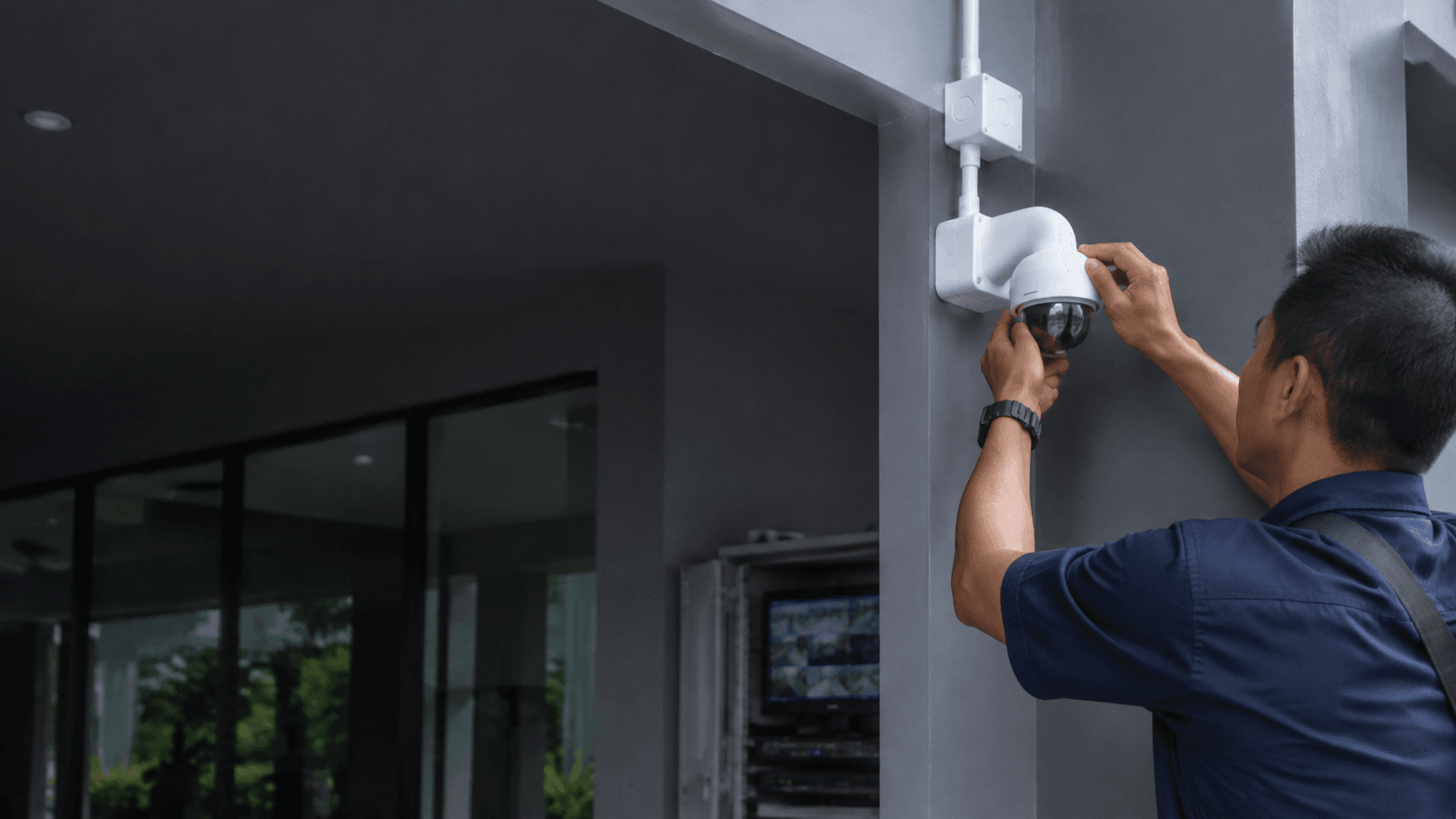
The exact-match query "cameras for your house" describes a decision, not a product. A household in Malaysia is choosing where cameras point, what they record onto, and who installs them. Eyonic Sdn Bhd, a security system supplier in Sarawak, plans, supplies and installs monitoring systems with camera placement, recording and remote viewing for homes, offices, shops and industrial sites.
Four stages shape the work, and they run in a fixed order.
- Site survey — the property is walked to see entry points, existing cabling routes and actual light levels.
- System proposal — the camera positions, recorder location and viewing setup are put in writing before purchase.
- Installation — cameras, cabling and the recorder are fitted and configured.
- Handover — recording and mobile viewing are demonstrated and tested with the household.
That sequence matters because placement decisions made after purchase are expensive to reverse. A camera bought for the wrong wall, or aimed at a spot that floods with headlights at night, still costs the same as one that works.
Cameras For Your House. What Shapes the Setup
Three things decide how a house camera setup performs: where each camera points, what light reaches that spot after dark, and where the footage is stored. Everything else — brand, model, app — sits downstream of those three.
Placement comes first because it fixes the field of view. A camera covering a gate sees the gate and whatever the gate faces. Move it two metres along the same wall and it may cover the gate plus the driveway, or neither. The survey exists to test that before drilling.
Lighting comes second because it changes what the camera can actually show. Eyonic recommends checking actual lighting conditions before confirming placement for ColorVu-style cameras, which is a check on the real scene rather than a specification on a page. A position that looks clear at midday can sit under a porch light, face a streetlamp, or fall into complete darkness by evening.
Storage comes third because it determines how far back the footage reaches. Recording configuration is part of the Hikvision CCTV Package at RM 1,599, alongside camera supply and setup and mobile viewing handover. The package describes what is included; it does not promise a retention period, and no retention figure should be assumed without checking the recorder and drive fitted on site.
Why Placement Comes Before Camera Choice
Choosing a camera before choosing a position inverts the problem. The position defines the job — how wide the view must be, whether the camera looks along a wall or across an open yard, whether it sits under an eave or on an exposed corner. The camera is then matched to that job.
Eyonic's own project work shows the same logic at a larger scale. The Kuching Immigration Office project focused on arrival flow, staff areas, visitor movement and dependable daily operation. Those are coverage questions first: which movement matters, and which positions see it. The equipment follows.
For a house, the equivalent questions are narrower but identical in kind. Which door does everyone use? Where do vehicles stop? Is there a side path that nobody watches? Is there a rear gate that opens onto a lane? Each answer points to a position, and each position has a constraint — a wall that cannot be drilled, a cable run that is too long, a neighbour's window in frame.
Two practical constraints recur. The first is cable routing. a position with no viable path back to the recorder is not a position, however good the view. The second is aiming height. Cameras mounted too high see the tops of heads rather than faces, which is a placement decision made at survey stage and difficult to correct later.
What the survey is for
The survey is where the proposal gets its evidence. It records where cameras can physically go, where cable can run, where the recorder can sit with power and ventilation, and what the scene looks like at night. A proposal built without that walk-through is a guess about a specific building.
Lighting Conditions and Camera Behaviour
Light is the variable most often underestimated in a house camera plan. A camera's usefulness after dark depends on the light actually present at that position, not on the position's appearance during the day.
Three lighting situations change the recommendation:
Mixed light. A camera facing a lit porch with a dark garden beyond it has to handle both at once. The bright area can dominate the exposure and leave the darker area unreadable.
Direct light sources in frame. A streetlamp, security light or reflective surface inside the camera's view can wash out the parts of the scene that matter.
Near-total darkness. Where no light reaches the position, the camera's own illumination becomes the deciding factor, and the check is whether the resulting image shows what the household needs to see.
This is why Eyonic checks actual lighting conditions before confirming placement for ColorVu-style cameras. The check is done at the property, at the position, in the conditions the camera will actually face. A camera that performs well in one lighting scene may be the wrong choice two metres away.
The trade-off is straightforward. Moving a camera to avoid a light source may reduce its coverage of the area that light illuminates. Adding light to a position may solve the image problem but change the property's appearance and running cost. Neither choice is free, and both are better made at survey stage than after installation.
Recording, Storage and Remote Viewing
Recording, storage and remote viewing are three separate decisions that are often treated as one.
Recording is what the system captures and when. Storage is where that footage lives and how long it stays. Remote viewing is how the household sees it from elsewhere. A setup can be strong on one and weak on another.
Eyonic's CCTV service covers camera placement, recording and remote viewing together, and the Hikvision CCTV Package at RM 1,599 includes camera supply and setup, basic recording configuration, and mobile viewing handover. The package wording is deliberately plain: basic recording configuration and a handover that demonstrates mobile viewing. It does not state a storage capacity, a retention period or a resolution, and none of those should be assumed from the package name.
Remote viewing depends on the household's internet connection at the property. A camera system can record correctly and still be awkward to view remotely if the connection is weak at the recorder's position. That is worth testing during handover rather than discovering later.
Storage decisions carry a practical edge case. Footage that overwrites quickly is fine for checking what happened this morning and useless for reviewing something from three weeks ago. The right retention depends on what the household expects to look back at, and that expectation should be stated before the recorder is specified.
Questions worth settling before installation
How far back does footage need to reach? Who needs remote access, and on how many devices? What happens to recording during a power interruption? These are answered by the system design, not by the camera model, and they are cheaper to settle at proposal stage.
How a Sarawak Installation Is Delivered
Eyonic's CCTV installation process runs through site survey, system proposal, installation and handover. The order is not administrative — each stage produces something the next stage depends on.
The survey produces positions and constraints. The proposal turns those into a specified system with a stated scope. Installation executes that scope. Handover confirms the household can actually use what was installed, including mobile viewing.
Eyonic Sdn Bhd is based in Sarawak and works across homes, offices, shops and industrial sites. The founder, Eric Yong, has been in the industry for more than ten years, with experience in technical installation of digital security solutions for commercial businesses in Sarawak. That commercial project background shows in how the work is scoped: the Kuching Immigration Office project and the KTA Sarawak Sdn Bhd project both centred on movement through a site, tidy cabling and clearer daily control rather than on equipment lists.
Household work is smaller in scale but follows the same discipline. The differences are mostly about disruption — where cable runs inside a finished home, how long the household is without access to a room, and how the recorder is housed so it is neither visible nor awkward to reach.
Two limits are worth stating plainly. First, the RM 1,599 Hikvision CCTV Package covers camera supply and setup, basic recording configuration and mobile viewing handover; anything beyond that scope is a separate conversation. Second, no warranty terms, response times or after-sales service levels are stated here, because none are confirmed in the available material. Those should be asked about directly rather than assumed.
. Practical Next Step
The useful next step is a survey, not a purchase. A survey converts a general intention into specific positions, a specific recorder location and a specific viewing setup, and it surfaces the lighting and cabling constraints that decide whether the plan works.
For a household in Sarawak, that means sharing the property location, the property type and the system required. Eyonic can then work from the actual building rather than from a description of it. The same applies to related systems — alarm, autogate, intercom and internet installation are all handled by the same supplier, which matters when several systems need to share cabling routes or a single point of control.
Share your location, property type and required system with Eyonic on WhatsApp at +60 11-5111 7959 for the next practical step.