
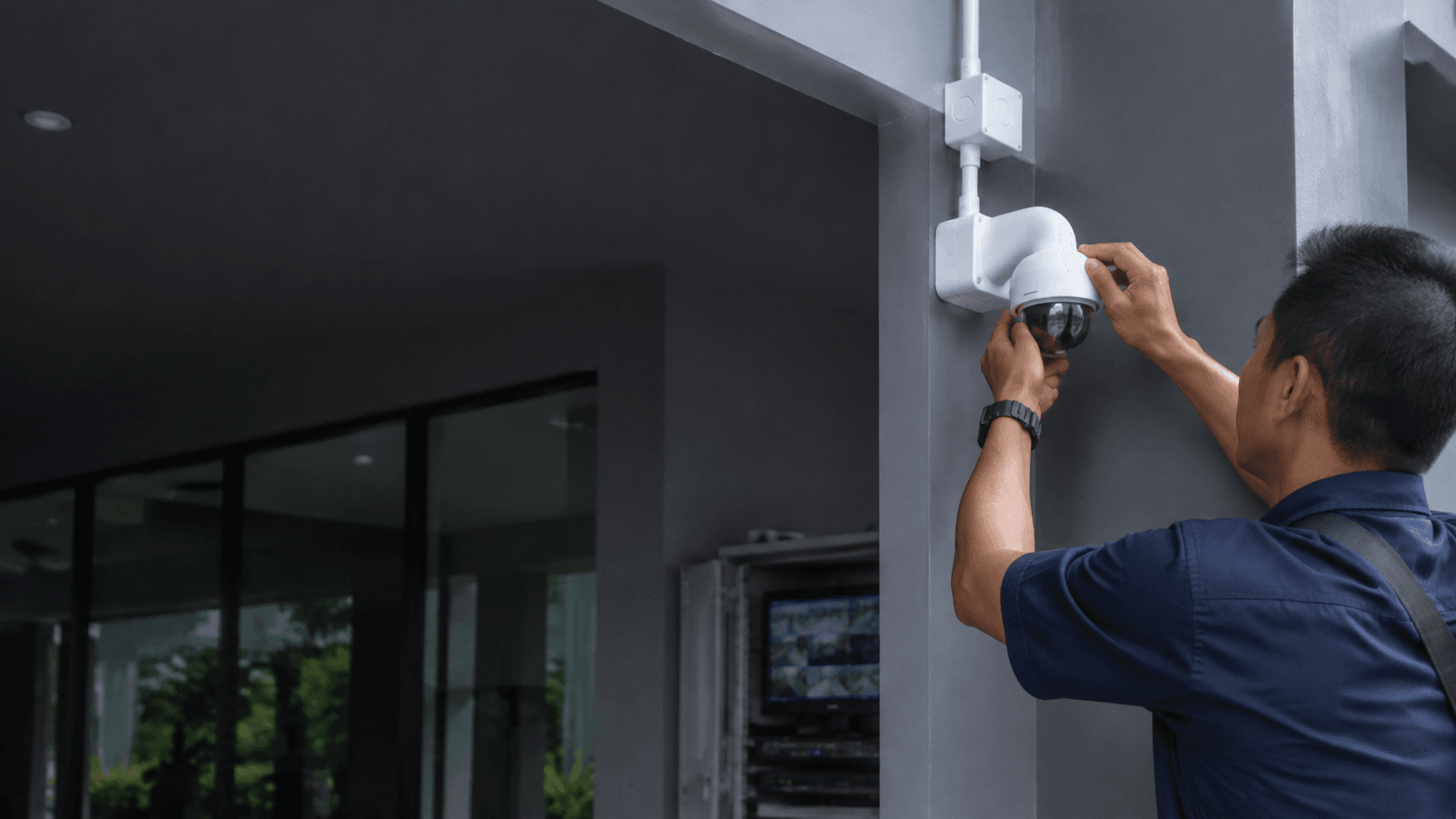
Buyers in Malaysia usually reach this camera through the same route: a property with no existing cabling, a need to watch an entrance or perimeter, and a preference for something that does not require a contractor to run power. The Arlo Ultra 2 Wireless Security Camera fits that brief, but the fit depends on placement, how recordings are stored, and who supports the system after installation.
Eyonic Sdn Bhd plans, supplies, and installs monitoring systems with camera placement, recording, and remote viewing for homes, offices, shops, and industrial sites. The company's founder, Eric Yong, has worked in the industry for more than 10 years, with a focus on technical installation of digital security solutions for commercial businesses in Sarawak.
What the Arlo Ultra 2 Wireless Security Camera Is Built For
The camera's defining trait is that it runs on battery and communicates wirelessly, so a mounting point does not need a power outlet or a data cable. That changes which locations are practical. A gate pillar, a back fence line, a stairwell corner, or a shop's rear loading area can all take a camera where running conduit would be disruptive or expensive.
Wire-free does not mean maintenance-free. A battery camera needs charging or battery replacement on a cycle, and that cycle depends on how often the camera is triggered, how long each recording runs, and how much live viewing happens. A camera pointed at a busy road will drain faster than one watching a quiet side entrance. This is the single most common planning mistake with battery cameras, and it is a placement question rather than a product question.
Wireless also means the camera depends on the wireless network at the property. Signal strength at the mounting point matters more than signal strength at the router. A camera mounted on the far side of a shophouse may sit at the edge of coverage, and the resulting dropouts look like camera faults when they are network faults.
Where the camera suits a property
Homes, offices, and shops that cannot easily run cabling are the natural fit. Rental properties, heritage buildings, and finished interiors where surface trunking would be unacceptable all fall into this group. Sites where a camera needs to move later also benefit, because a wire-free unit can be repositioned without re-running cable.
Sites that already have structured cabling and a recording room are a weaker fit. A wired system with a dedicated recorder usually costs less per camera at scale and avoids battery cycles entirely. The trade-off is installation disruption, which is exactly what the wire-free design avoids.
Wire-Free Placement and Power Decisions
Placement decides whether a battery camera is useful or frustrating. Three variables drive the decision: what the camera must see, how often that scene moves, and how easily the battery can be reached for charging.
- Site survey. walk the property, identify entry points, blind spots, and the lighting conditions at each candidate position.
- System proposal. confirm camera count, mounting positions, recording method, and how the system will be maintained.
- Installation. mount and configure the cameras, then verify live view and recording behaviour at each position.
- Handover. walk through the app, recording playback, and what to do when a battery needs attention.
Eyonic's CCTV installation process follows those four stages, and the same sequence applies to wire-free cameras because the survey and handover stages carry most of the risk.
Lighting deserves its own check. Eyonic recommends checking actual lighting conditions before confirming placement for ColorVu-style cameras, and the same discipline applies here. A position that looks clear in daylight can be useless at night if the camera is aimed at a bright wall, a reflective surface, or a light source that washes out the frame. Night performance is a placement outcome as much as a camera outcome.
Mounting height and angle
Higher mounting reduces the chance of tampering and widens the view, but it also makes battery access harder and can push the camera past the useful range of its motion detection. A camera mounted high and angled steeply down often captures heads and shoulders rather than faces. The practical compromise is a height that keeps the camera reachable with a step ladder while still covering the intended approach.
Angle matters for another reason: motion detection works best when movement crosses the frame rather than moving directly toward or away from the lens. A camera aimed straight down a driveway will trigger later than one aimed across it.
Recording, Storage, and Remote Viewing
Wire-free cameras store footage in one of two places. Local storage keeps recordings on a hub or base station at the property, so footage stays on site and playback does not depend on an internet connection. Cloud storage keeps recordings off site, which protects footage if the hardware is stolen or damaged, but depends on the internet link and usually on a subscription.
The choice affects three things. monthly cost, what happens during an internet outage, and how long footage is retained. Local storage avoids recurring fees but the recorder itself becomes a single point of failure and a target. Cloud storage removes that risk but adds a recurring cost and a dependency on upload bandwidth.
Remote viewing is the feature most buyers actually use day to day. It lets a phone check a live view or a recorded clip from outside the property. Two constraints matter in practice. First, upload speed at the property limits how smoothly remote live view runs. Second, the account and app setup must be handed over properly, because a system nobody can log into is not a working system.
Eyonic's service scope includes NVR setup and remote viewing, which is the same handover discipline a wire-free system needs even when the recording device is a hub rather than a traditional recorder.
What to confirm before committing
Confirm where recordings will live, how long they will be kept, and what happens when the internet drops. Confirm who holds the account credentials. Confirm what the battery cycle looks like at the chosen positions, based on how busy each scene is. These four answers determine the real running cost far more than the camera's headline features.
How the Compares With Other Wireless Cameras
Wireless cameras split into two broad groups: battery-powered models that can go almost anywhere, and plug-in models that need a power point but never need charging. The Arlo Ultra 2 Wireless Security Camera sits in the first group. Plug-in cameras from the same and competing ranges sit in the second.
The trade-off is straightforward. Battery models win on placement freedom and lose on maintenance. Plug-in models win on maintenance and lose on placement, because every camera needs a nearby outlet. A property with power points at each corner is usually better served by plug-in cameras. A property with none is usually better served by battery cameras, or by a wired system installed with new cabling.
Within the battery group, the differences that matter are battery behaviour, how storage is handled, and how the camera integrates with the rest of the property's systems. Integration matters for buyers who already run smart home devices or who want camera events to trigger other actions.
Cost comparison across brands is difficult to do honestly without current local pricing, and Malaysian pricing for this model is not something the available evidence confirms. The safer comparison is structural: count the cameras needed, decide whether storage is local or cloud, add the recurring cost of any subscription, and add the labour cost of installation and any future battery servicing.
When a wired system is the better answer
For a shop, office, or industrial site with multiple cameras and a permanent recording requirement, a wired system with a dedicated recorder is often the more durable choice. Eyonic's work at the Kuching Immigration Office is an example of that kind of brief: a public office needing practical support for arrival flow, staff areas, visitor movement, and dependable daily operation. That is a continuous-operation requirement, which suits wired infrastructure.
A wire-free camera is a better answer for a smaller site, a specific blind spot, or a location where cabling is genuinely impractical. The two approaches are not in competition so much as suited to different constraints.
Installation Handover and Local Support
The installation itself is the shorter part of the job. The longer part is deciding what the system must do and confirming it does that after handover.
For buyers in Sarawak, local support matters because a camera system is not a one-time purchase. Batteries need attention, settings need adjusting as the property changes, and faults need someone who can attend the site. Eyonic is based in Sarawak and works across homes, offices, shops, and industrial sites, with project experience including the Kuching Immigration Office and KTA Sarawak Sdn Bhd, where the brief covered staff movement, visitor handling, and tidy cabling.
Handover should cover four things: how to view live footage, how to find and export a recorded clip, what the battery or maintenance cycle looks like, and who to contact when something stops working. A handover that skips the second item leaves the system useful only in the moment and useless when a clip is actually needed.
Questions buyers ask before deciding
Does a wire-free camera need Wi-Fi? It needs a wireless link to its hub or network to deliver live view and alerts. Local recording can continue without an internet connection, but remote viewing cannot.
Can one camera cover a whole shopfront? Rarely. A single camera covers an approach or an entrance well. Covering a full frontage usually needs two or more cameras, or a camera positioned further back with a wider view.
What happens when the battery runs out? The camera stops recording until it is charged or the battery is replaced. Planning the charging cycle around the scene's activity level is what prevents gaps.
Is a subscription required? Cloud storage and some smart features typically depend on a subscription, while local storage avoids recurring fees. The applicable terms for Malaysia are not confirmed by the available evidence, so this should be checked directly before purchase.
Can the camera be added to an existing system? Sometimes, depending on the existing platform and whether the two systems can share events or storage. This is worth confirming during a site survey rather than after purchase.
For a property in Sarawak, the practical next step is a site survey that confirms camera positions, lighting at each position, network coverage, and the recording method. Share your location, property type and required system with Eyonic on WhatsApp at +60 11-5111 7959 for the next practical step.