
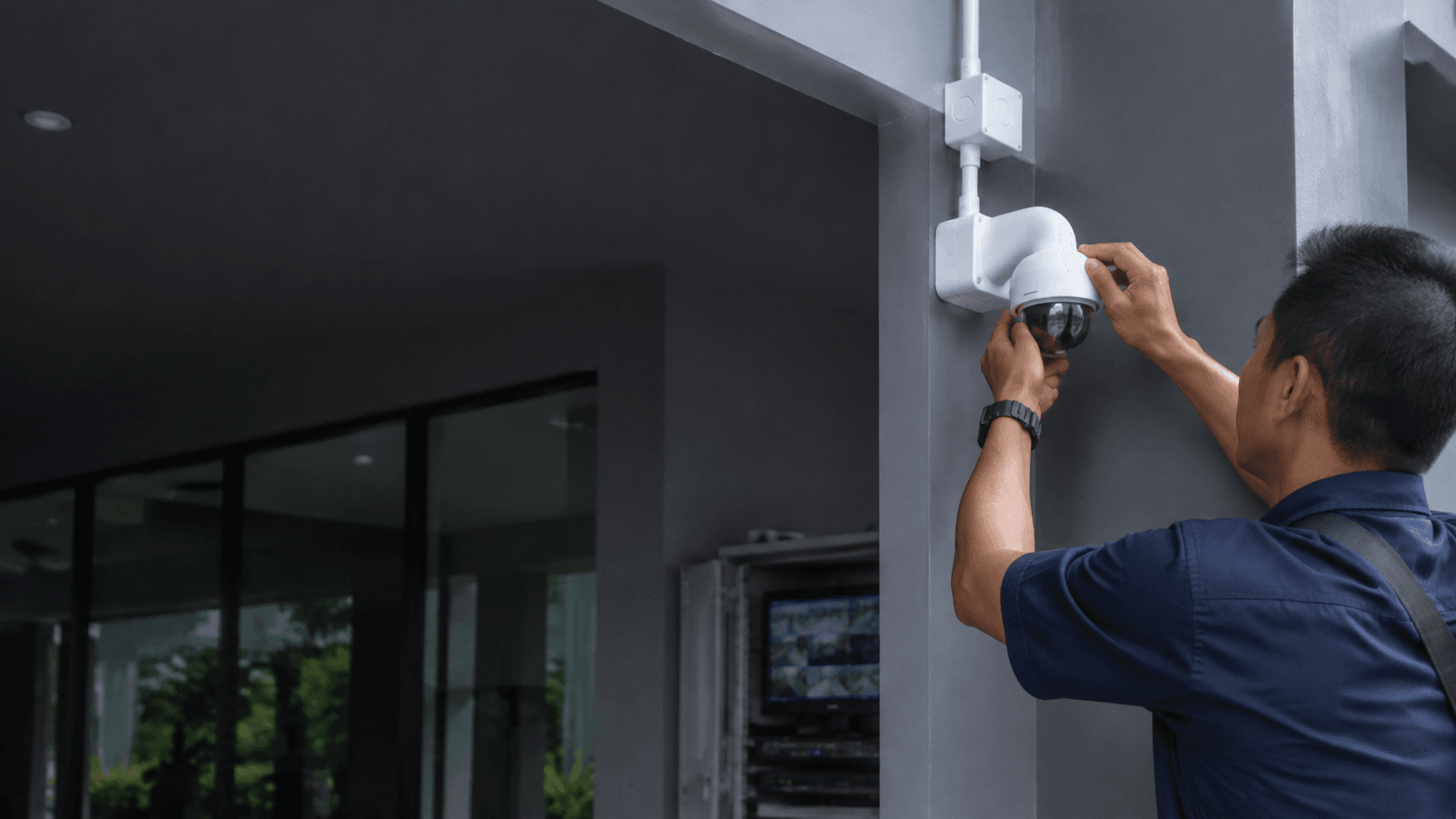
The 4MP label describes how much picture detail a camera captures, not how well it performs on a given wall. Two sites can run the same resolution and produce very different footage, because lens choice, mounting height, light at the scene and the recorder behind the camera all shape the result. That is why a Dahua 4MP camera decision is really a placement decision.
Eyonic Sdn Bhd plans, supplies and installs monitoring systems with camera placement, recording and remote viewing for homes, offices, shops and industrial sites, and its installation process runs through site survey, system proposal, installation and handover. The company is based in Sarawak and has completed work for a public office in Kuching and for engineering consultancy sites there.
Camara Dahua 4mp: what the resolution class actually covers
4MP means roughly four million pixels per frame. Dahua's 4MP models commonly output 2560 x 1440, which is the same pixel count as 1440p and about twice the detail of 1080p. More pixels help when the goal is identifying a face, reading a plate or counting people at a distance, because a wider frame can still hold enough detail on a small subject.
Resolution is only one variable. A 4MP camera with a narrow lens covers less area but puts more pixels on each person. A 4MP camera with a wide lens covers more area but spreads the same pixels thinner. The practical question is not whether 4MP is enough in the abstract, but whether 4MP behind a specific lens at a specific distance resolves the detail the site needs.
Storage and bandwidth scale with resolution. A 4MP stream carries more data than a 1080p stream at the same frame rate and compression, so recorder capacity and hard drive sizing matter more as camera count rises. Dahua cameras typically support H.265 or H.265+ compression, which reduces that load compared with older codecs, but the recorder still has to be sized for the channel count and retention period the site wants.
Dahua 4MP camera form factors and where each one fits
Dahua builds 4MP cameras in several physical shapes, and the shape usually decides the mounting position more than the resolution does.
Dome cameras sit flush against a ceiling or wall and hide the lens direction, which makes them harder to identify and push away from. They suit corridors, lobbies, retail floors and covered walkways where the camera is close to the subject and the ceiling is accessible.
Turret cameras use a ball-and-socket joint that lets the lens be aimed after mounting. They handle glare and reflection better than flat domes in some outdoor positions and are common on building exteriors and under eaves.
Bullet cameras are long-bodied and visibly directional. They suit long runs along a fence line, a gate approach or a perimeter where the camera needs to look down a distance rather than across a room. Their visible shape also acts as a deterrent in some settings.
PTZ bodies add motorised pan, tilt and zoom, and they cover large open areas that a fixed camera cannot. They cost more, need more power in some configurations, and depend on an operator or automated rules to be useful.
Wired and wireless variants exist within these shapes. Wired models are the norm for permanent installations because they carry power and data together over Ethernet and do not depend on Wi-Fi signal at the mounting point.
Lighting, night performance and placement checks
Daytime footage rarely separates one 4MP camera from another. Night footage does, and the difference comes from how the camera handles low light rather than from the pixel count.
Infrared models switch to black-and-white infrared illumination when light drops, which is reliable but loses colour and can wash out reflective surfaces such as plates and signage. Full-colour or dual-light models keep colour at night by using visible white light or a combination of infrared and white light, which helps identification but adds a visible light source at the camera position.
Eyonic recommends checking actual lighting conditions before confirming placement for ColorVu-style cameras, and the same reasoning applies to any low-light camera. A position that looks bright during a daytime survey can be dark at the hours that matter, and a position with a streetlight or shop sign nearby can behave differently again.
Placement checks that change outcomes include:
- Whether the camera looks toward a light source, which causes flare and washes out the frame.
- Whether the camera looks away from a light source, which leaves the subject in silhouette.
- Whether the mounting height puts faces in frame or only the tops of heads.
- Whether trees, signage or building edges will block the view as they move or grow.
- Whether the camera is under cover or fully exposed to rain and direct sun.
Weather exposure matters because outdoor Dahua models are commonly rated IP67, which covers dust and water ingress, but the rating applies to the camera body and not to an exposed connector or an untidy cable entry. A well-sealed camera on a poorly sealed bracket still fails.
Power, cabling and recording considerations
Most Dahua 4MP IP cameras run on Power over Ethernet, which carries power and data over a single network cable. That removes the need for a separate power outlet at each camera position, but it also means the cable run, the switch and the recorder all have to support the load.
PoE has distance limits. A standard Ethernet run is rated to about 100 metres, and longer runs need an extender, a fibre link or a mid-span device. Cable quality matters too, because a long run on thin or poorly terminated cable can drop power or data even when the run is within the distance limit.
Recording is the other half of the system. A Dahua 4MP camera can record to a network video recorder, to a memory card inside the camera, or to both. Recorder-based recording is the usual choice for multi-camera sites because it centralises storage, retention and playback. Card-based recording is useful as a backup or for a single camera with no recorder, but it is easier to remove or damage and harder to review across several cameras.
Retention drives hard drive sizing. More cameras, higher resolution and a longer retention period all increase the storage needed, and the recorder has to have enough channels and enough drive capacity for the plan. Remote viewing then depends on the recorder or the camera being reachable over the network, which is a configuration step rather than a hardware one.
Camara Dahua 4mp: what to confirm before ordering
Model-level specifications vary across the Dahua 4MP range, so the safe approach is to confirm the exact model and its datasheet before committing. The following sequence reflects how Eyonic runs a CCTV installation, from site survey through to handover.
- Survey the site and record the actual lighting at each position during the hours the camera needs to work.
- Confirm camera placement, mounting height and lens choice for each position, and check what each view will and will not cover.
- Confirm power and cabling, including PoE availability, cable route, run length and whether any position needs an extender.
- Confirm the recorder setup, including channel count, hard drive capacity and retention period.
- Confirm remote viewing, including who needs access, on what devices, and how the connection is secured.
- Confirm handover, including a walkthrough of live views, playback and user access.
Two items on that list are worth extra attention. The first is the exact model number, because Dahua 4MP covers a wide family and the datasheet is the only reliable source for sensor size, lens options, infrared range, frame rate and ingress rating. The second is the recorder, because a camera that meets the requirement can still disappoint if the recorder cannot hold the retention period or the channel count the site needs.
Budget expectations should be set against the whole system rather than the camera alone. Eyonic's published package pricing starts at RM 1,599 for a Hikvision CCTV package covering camera supply and setup, basic recording configuration and mobile viewing handover, and comparable project work has ranged from RM 8,000 to RM 18,000 for an office setup and RM 12,000 to RM 28,000 for a public office installation. Those figures describe complete installations, not a single camera, and Dahua 4MP pricing for Malaysia is not verified here.
For sites in Sarawak, the practical next step is to share the location, property type and required system with Eyonic on WhatsApp at +60 11-5111 7959 so the survey and proposal can be matched to the actual building.