
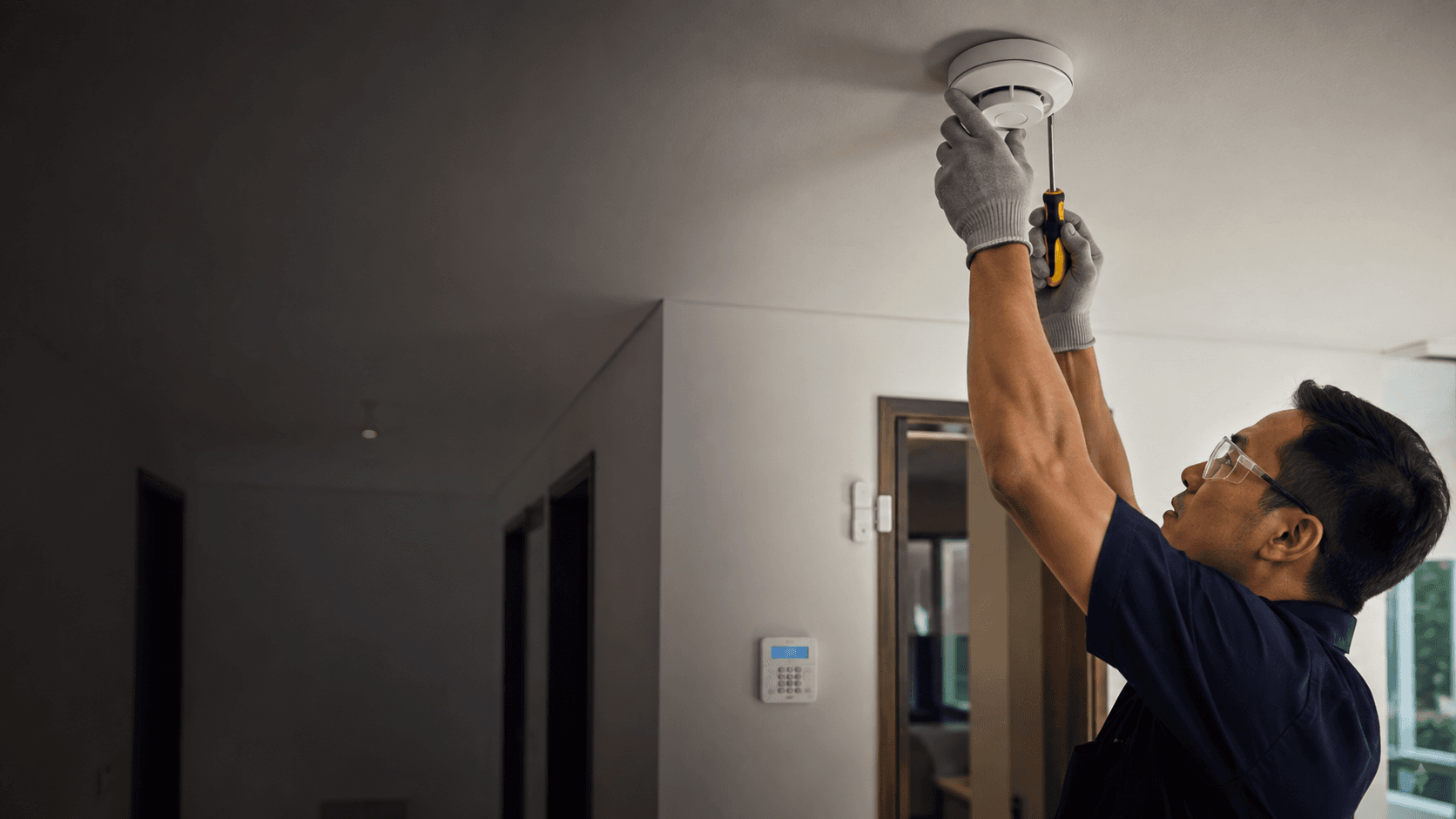
What smoke alarm fitting involves before installation
Smoke alarm fitting starts with location planning, not drilling holes. The National Fire Protection Association (NFPA) advises installing smoke alarms inside every bedroom, outside each sleeping area, and on every level of the home. Ceiling mounting is preferred because smoke rises, and wall mounting should place the alarm no more than 12 inches from the ceiling. The fitting decision sequence follows a clear order:- Confirm how many alarms the property needs based on bedrooms, levels, and hallways.
- Choose between battery-operated, hardwired, or 10-year sealed battery units.
- Select ceiling or wall positions that keep alarms away from kitchens, bathrooms, and vents.
- Test each alarm after mounting to confirm the sensor responds.
- Schedule monthly testing and battery replacement according to the manufacturer's instructions.
Choosing the right smoke alarm fitting approach
Battery-operated alarms suit most retrofit situations because they need no electrical work. Kidde's installation guidance covers marking mounting holes, inserting screw anchors, attaching the base, and placing the alarm. A 10-year sealed battery removes the annual battery-change task, though the whole unit needs replacement at the end of its service life. Hardwired smoke alarm fitting requires connection to household electrical circuits. BRK's installer guidance emphasizes turning off power at the circuit breaker, using the correct wire connectors, and following local electrical codes. Interconnected hardwired alarms share a signal so that one detected fire triggers every unit, which matters in larger homes where a single alarm may not be heard.Installing and maintaining smoke alarms per NFPA guidance
The NFPA's installing and maintaining smoke alarms guidance treats fitting as an ongoing responsibility. Alarms should be tested monthly, and batteries replaced at least once a year unless the unit uses a sealed 10-year battery. Smoke alarms do not last forever; NFPA recommends replacing the entire unit every 10 years. Maintenance extends beyond battery changes. Dust and debris can block sensors, so vacuuming alarms periodically keeps them responsive. Alarms that chirp to signal low battery need immediate attention, and units that fail testing should be replaced rather than repaired.Practical considerations for professional smoke alarm fitting
Professional smoke alarm fitting becomes relevant when properties need interconnected systems, hardwired installation, or compliance with local fire safety requirements. A qualified installer handles the electrical connections that battery units avoid, and can advise on placement that accounts for room layouts, ceiling heights, and airflow patterns. For commercial or multi-unit properties, smoke alarm fitting often connects to a broader security setup. Eyonic Sdn Bhd, a security system supplier in Sarawak, Malaysia, plans and installs monitoring systems for homes, offices, shops, and industrial sites. Their CCTV installation process includes a site survey, system proposal, installation, and handover, a sequence that also applies to alarm system work where detection and response need to work together.Comparing smoke alarm fitting options
The table below compares the main smoke alarm fitting choices based on installation effort, maintenance, and suitability.| Alarm type | Installation effort | Maintenance | Best fit |
|---|---|---|---|
| Battery-operated | Low; no electrical work | Replace batteries yearly | Retrofit homes and rentals |
| 10-year sealed battery | Low; no electrical work | Replace whole unit after 10 years | Properties wanting minimal upkeep |
| Hardwired | High; requires electrical connection | Battery backup still needs replacement | New builds and major renovations |
| Interconnected | High; wired or wireless linking | Test all units together | Larger homes and multi-level properties |