
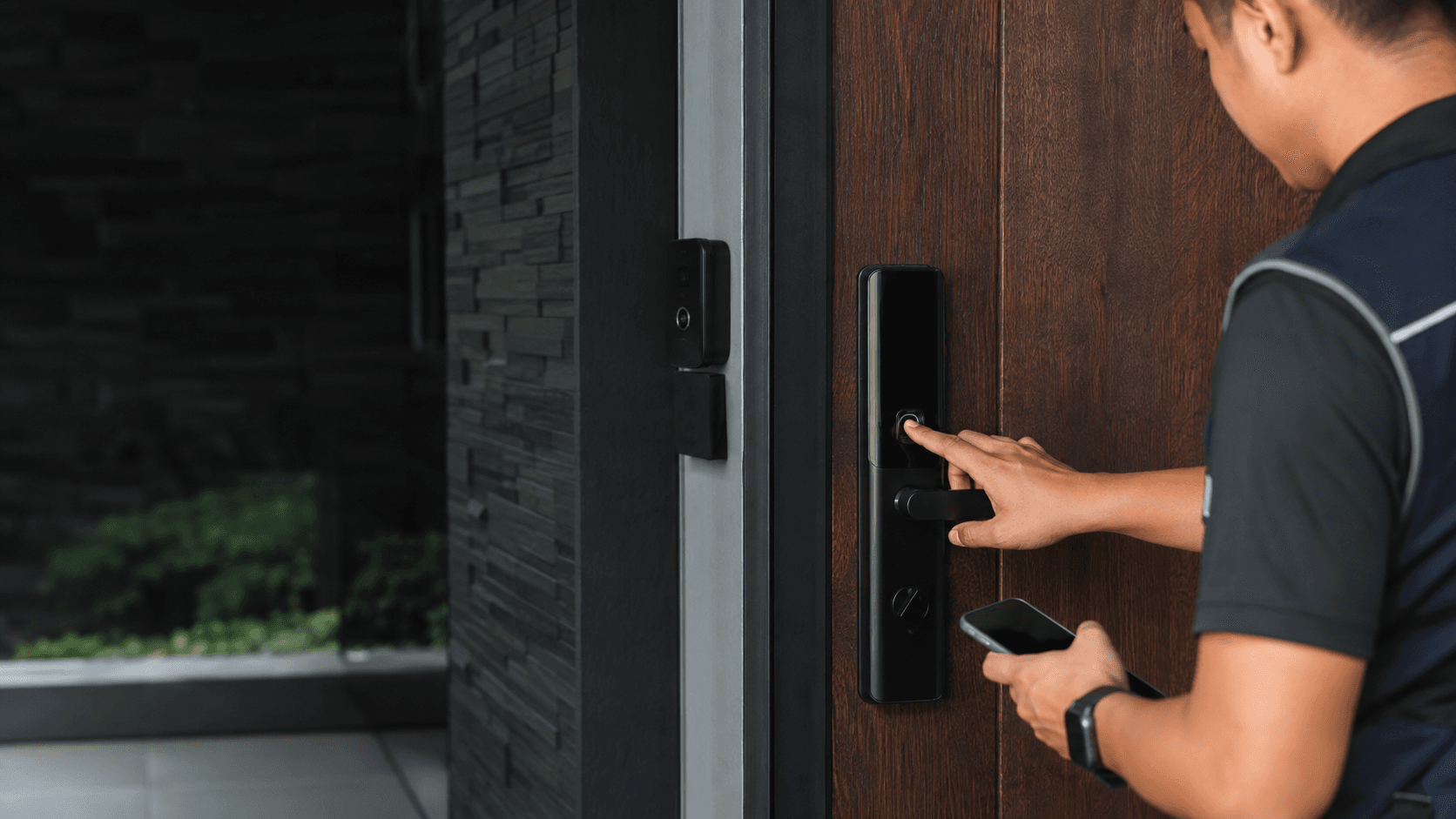
The hardwired smart lock sits in a different category from the battery-powered keypad locks sold in most hardware shops. Power arrives through cabling rather than cells, so the lock is tied to the building's electrical and low-voltage infrastructure. That changes who can install it, what happens during a power cut, and how the door behaves when the network or controller is unavailable.
Eyonic Sdn Bhd plans, supplies and installs security and extra-low-voltage systems in Sarawak, and its smart lock guidance treats door condition, user roles and backup method as the three things to settle before any hardware is chosen. The same logic applies whether the door serves a family home in Kuching or a staff entrance at a commercial site.
What a hardwired smart lock changes about power and control
Battery locks trade convenience for maintenance. Cells last months, then fail without warning, and the failure usually appears at the least convenient moment. A hardwired smart lock removes that cycle by taking power from a permanent supply, which also allows the lock to sit on a control system rather than operate as an isolated device.
Control is the second difference. A battery lock typically makes its own decisions: it reads a credential, checks its internal list, and releases the bolt. A wired lock can be told what to do by something else. In practice that means an access control panel, an intercom, or a building system can decide whether a door opens, and can record that a door opened. The lock becomes one component in a wider arrangement rather than a standalone product.
That arrangement has a cost. A wired lock depends on the supply, the cabling and the controller. If any of those three is missing or unreliable, the door behaves differently from a battery lock, which keeps working until the cells run down. The trade is deliberate. more integration and less routine maintenance in exchange for a dependency on infrastructure that has to be installed and maintained properly.
Remote unlocking and status monitoring are the practical benefits most often cited for wired locks. A lock that reports its own state lets a manager see whether a door is open or closed without walking to it. That capability only exists when the lock is connected to something that can receive and display the information.
Doors and sites where a hardwired smart lock fits
Wired power suits doors that are used often, doors that are hard to reach, and doors where a flat battery would cause a real problem. A main entrance used by dozens of people each day is a poor candidate for battery replacement schedules. A storage room, plant room or riser door in an awkward position is another, because nobody wants to climb or crawl to change cells.
Commercial and institutional sites fit the pattern well. Eyonic's work for the Kuching Immigration Office focused on arrival flow, staff areas, visitor movement and dependable daily operation, and those are exactly the conditions where a lock tied to a managed system earns its place. The KTA Sarawak Sdn Bhd project followed a similar theme: staff movement, visitor handling, tidy cabling and clearer daily site control. Tidy cabling matters because a wired lock is only as good as the route the cable takes.
Homes fit when the door is part of a larger plan. A house already running CCTV, an alarm panel and an intercom has the pathways and the power that a wired lock needs. A house with none of that is usually better served by a battery lock until the wider system exists.
Some doors do not fit at all. Thin frames, glass doors without a suitable cavity, heritage doors that cannot be cut, and doors where no cable route exists without damaging finishes all push the decision back toward battery power or a different locking method. Door material and frame condition decide more installations than product choice does.
What to check before choosing a hardwired smart lock
The checks below are the ones that change the answer. Skipping them usually produces a lock that works on paper and disappoints on the door.
Door condition. Material, thickness, frame depth and existing hardware determine whether a wired lock body will fit and whether the door can be modified without weakening it. A door that cannot accept the lock body cannot be forced to.
Power availability. A permanent supply has to reach the door. If no circuit is nearby, the cost of bringing one there may exceed the cost of the lock itself.
Cable route. The path from the power source and the controller to the door has to be practical. Surface trunking, concealed conduit and door loop transfers each carry different implications for appearance and for how the door swings.
User permissions. Who opens this door, at what times, and with what credential? A door used by two people needs far less planning than one used by rotating staff, contractors and visitors.
Backup entry. Every wired lock needs a defined way in when power, network or controller is unavailable. Mechanical key override, a separate keyed cylinder, or a documented manual release all count. The point is that the method is chosen deliberately rather than discovered during an outage.
Controller or panel choice. For business use, the decision between a standalone smart lock and an access control panel is usually made here. A standalone lock manages its own users. A panel manages many doors, many users and a shared record.
Integration with existing systems. Where an intercom, alarm or CCTV system already exists, the lock may need to work alongside it. Compatibility should be confirmed against the actual equipment on site rather than assumed from product categories.
How a hardwired smart lock is installed and handed over
Eyonic's installation process follows four stages, and the same sequence applies to door access work.
- Site survey — the door, frame, power source, cable route and existing systems are examined on site before anything is specified.
- System proposal — the survey findings are turned into a proposed arrangement covering the lock, the power and control method, and the backup entry approach.
- Installation — the lock, cabling and any controller or panel work are carried out, with the door returned to normal operation.
- Handover — users, credentials and the backup entry method are explained and tested so the site can operate the door without support.
The survey stage carries the most weight. A door that looks straightforward from a photograph often turns out to have no viable cable route, a frame that cannot take the lock body, or a power source on the wrong side of a wall. Finding that during a survey costs a conversation. Finding it during installation costs time, money and sometimes a changed design.
Handover is where backup entry stops being a plan and becomes a procedure. Someone on site needs to know how to open the door when the system is down, and that knowledge has to survive staff changes. A written note kept with the site's other access information is more reliable than a verbal explanation.
Hardwired smart lock questions worth settling early
Can a battery lock be converted to wired power? This depends entirely on the specific model. Some locks are designed for one power method only, and the available evidence does not establish which models can be converted. The question belongs with the manufacturer's documentation for the exact lock under consideration, not with a general rule.
What happens during a power failure? Behaviour varies by product and by how the lock is wired. Fail-safe and fail-secure designs behave in opposite ways, and the correct choice depends on what the door protects and what safety rules apply to it. This has to be confirmed for the specific lock rather than assumed.
Is a wired lock always better than a battery lock? No. A wired lock is better where power and cabling already exist or can be installed sensibly, where the door is used heavily, and where central control or reporting is wanted. A battery lock is better where none of those conditions hold, and it remains a legitimate choice for many homes.
Does a wired lock need an access control panel? Not necessarily. A wired lock can operate as a standalone unit with its own credential management. A panel becomes worthwhile when several doors, many users or a shared access record are involved.
How long does installation take? Duration depends on the cable route, the door condition and whether controller or panel work is included. A door with an existing route and power is a short job. A door needing a new circuit and concealed cabling is not.
What should be confirmed before committing? The door survey, the power source, the cable route, the user list, the backup entry method and the choice between standalone and panel-managed operation. Those six items decide whether a hardwired smart lock is the right answer for a particular door.
For sites in Sarawak, sharing the location, property type and the system required gives Eyonic enough to work from. WhatsApp +60 11-5111 7959 is the practical next step.