
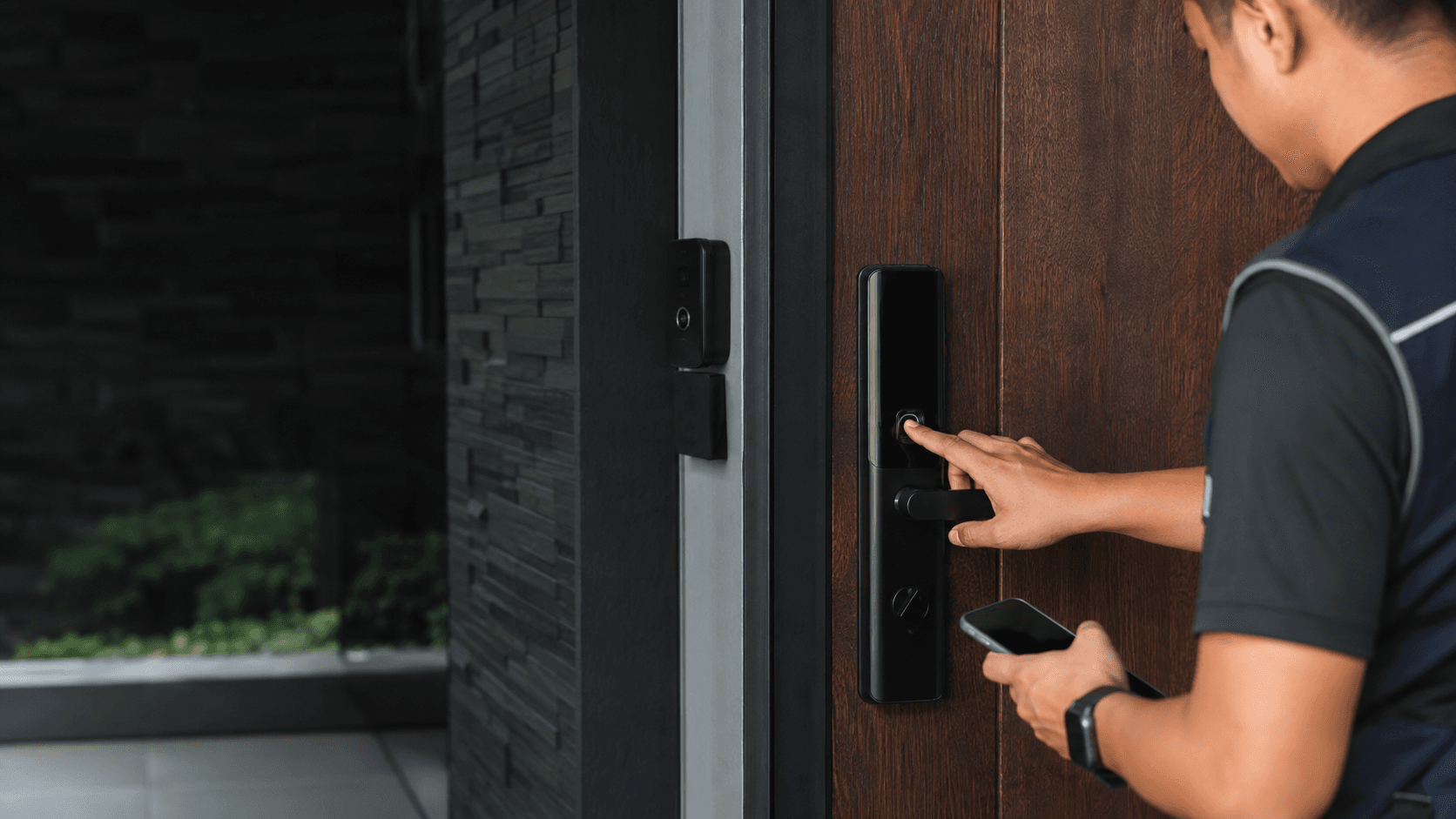
The term gets used loosely online. Some pages mean a locksmith who also sells smart locks. Others mean the lock hardware itself. For a property in Sarawak, the practical question is narrower: who assesses the door, who supplies the lock, and who handles the handover when staff or family members need access.
Eyonic Sdn Bhd is a security system supplier in Sarawak that plans, supplies and installs monitoring and ELV systems for homes, offices, shops and industrial sites. Its product range includes Hikvision cameras and smart locks. That combination matters because a door lock rarely sits alone in a commercial building; it usually sits alongside cameras, alarms and intercoms that all need to work together.
Locksmith Smart Lock. What the Term Actually Covers
Search results for this phrase mix two different trades. A traditional locksmith cuts keys, opens jammed doors and rekeys cylinders. A security systems supplier installs electronic access hardware and integrates it with the rest of a building's low-voltage systems.
Eyonic's own product review page describes smart lock door access as multi-brand hardware that is good for controlled convenience when user permissions and backup entry are planned properly. That wording is the useful part. The lock itself is rarely the hard decision. The planning around it is.
For business use, Eyonic usually checks whether a standalone smart lock or an access-control panel is more appropriate. That check separates a single-office door from a building with multiple entry points, shift changes and visitor traffic. A standalone lock suits one door with a small, stable group of users. An access-control panel suits a site where permissions change often or where entry records need to be reviewed.
Anyone searching for a locksmith smart lock in Malaysia will find most results written for United States cities. The door hardware conversation is similar, but the supply chain, the site conditions and the installer's local presence are not.
Why the Two Trades Get Confused
Both trades touch the same door. A locksmith may fit a smart lock as part of a general lock service. A security supplier fits the lock as one component of a wider system. The difference shows up later, when the lock needs to talk to a camera, an alarm zone or an intercom, or when a user's access has to be removed cleanly.
When a Locksmith Smart Lock Fits a Door
Door condition decides more than brand preference. A lock that fits a solid timber door with a sound frame behaves differently from one fitted to a hollow door, a warped frame or a gate that moves in the weather. Eyonic's stated approach is to review door condition, user roles and backup method before installation, which is the sequence that prevents most callbacks.
User roles matter as much as the door. A family home needs a handful of codes and a way to let a visitor in once. A shop needs staff codes that can be removed when someone leaves. An office needs to know who entered and when. Each of those needs points to different hardware.
Backup entry is the third check. Every electronic lock depends on something: a battery, a power supply, a network, or a phone. The backup method should be decided before installation, not after the first lockout.
Signs the Door Is a Poor Candidate
A door that does not close squarely, a frame that has been repaired repeatedly, or a strike plate that no longer aligns will keep causing problems regardless of the lock fitted. Those conditions are worth resolving first. A smart lock fitted to a failing door simply fails electronically instead of mechanically.
What to Compare Before Choosing a Locksmith Smart Lock
Comparison should start with the door and the people who use it, not with a brand list. The checks below are the ones that change the outcome.
- Confirm the door type, thickness and existing lock cutout, since these decide which hardware can be fitted without structural work.
- List every user group and how often that list changes, because frequent changes favour an access-control panel over a standalone lock.
- Agree the backup entry method for battery, power or network failure before installation begins.
- Decide whether the lock must connect to cameras, alarms or an intercom, or whether it stands alone.
- Confirm who supplies the hardware, who installs it, and who handles the handover and user setup.
The last point is where a locksmith smart lock decision often stalls. If the hardware comes from one party and the installation from another, the handover can leave the property owner holding a lock nobody has fully configured.
Eyonic's product review page notes that smart locks work best when door condition, user roles and backup method are reviewed before installation. That is a planning statement rather than a product claim, and it applies whether the lock is fitted in a Kuching shophouse or a family home.
Questions Worth Asking an Installer
Ask what happens when the battery runs flat, who can add or remove a user after handover, and whether the lock can be managed without the original installer. Ask what the installer checks on site before quoting. A site survey is the standard first step in Eyonic's installation process, and the same logic applies to a single door.
Installation Steps for a
Eyonic's CCTV installation process runs through site survey, system proposal, installation and handover. The same four stages map cleanly onto a smart lock job, because the decisions are the same kind of decisions.
- Site survey. inspect the door, frame, existing lock and the surrounding entry area.
- System proposal. recommend either a standalone smart lock or an access-control panel, based on user roles and door condition.
- Installation. fit the hardware, configure users and permissions, and connect the lock to any related system.
- Handover. test the lock, confirm the backup entry method, and show the responsible person how to manage users.
The survey stage is where a job is won or lost. Eyonic applies the same principle to camera placement, checking actual lighting conditions before confirming a position rather than assuming from a floor plan. A door assessment follows the same logic: the physical conditions on site decide the recommendation.
Handover deserves equal weight. A lock that has been fitted but not explained tends to be bypassed within weeks, with a key left under a mat or a door propped open. The handover is what makes the installation stick.
Limits and Backup Entry for a
Every electronic lock has a failure mode. Batteries discharge. Power supplies trip. Networks drop. Phones run out of charge. None of these are reasons to avoid a smart lock, but each one needs a planned answer.
The backup method should be physical and independent of the electronics wherever possible. A mechanical key override, a separate entry point, or a documented process for a lockout all work. What does not work is assuming the app will always be available.
Access records are a second limit worth understanding. A standalone lock may log entries on the device or in an app, while an access-control panel typically centralises that record. For a business that needs to review who entered and when, the panel route is usually the more useful one.
Eyonic's project work in Kuching has centred on movement through a building rather than on a single door. The Kuching Immigration Office project focused on arrival flow, staff areas, visitor movement and dependable daily operation. A KTA Sarawak Sdn Bhd project in Kuching supported staff movement, visitor handling, tidy cabling and clearer daily site control. Both illustrate the same point. entry hardware is judged by how a building operates day to day, not by the lock alone.
Where a Standalone Lock Stops Being Enough
Once a site has several entry points, rotating staff, or a need to review entry records, a single smart lock stops being the right tool. That is the point at which an access-control panel becomes the more sensible recommendation, and it is the check Eyonic applies for business use.
Practical Next Step With Eyonic
Eyonic Sdn Bhd is based in Sarawak and works across homes, offices, shops and industrial sites. Its founder, Eric Yong, has more than 10 years in the industry and works on technical installation of digital security solutions for commercial businesses in Sarawak.
For a single door, the useful information to prepare is the door type, the number of people who need access, how often that list changes, and whether the lock needs to connect to anything else. For a larger site, the same information applies door by door.
Eyonic's published packages cover a Hikvision CCTV package, a Hikvision alarm system and an autogate package, each at RM 1,599. Those packages describe camera, alarm and gate work rather than smart lock supply, so a smart lock enquiry should be raised directly rather than assumed to fall inside them.
Share the location, property type and required system with Eyonic on WhatsApp at +60 11-5111 7959 for the next practical step.