
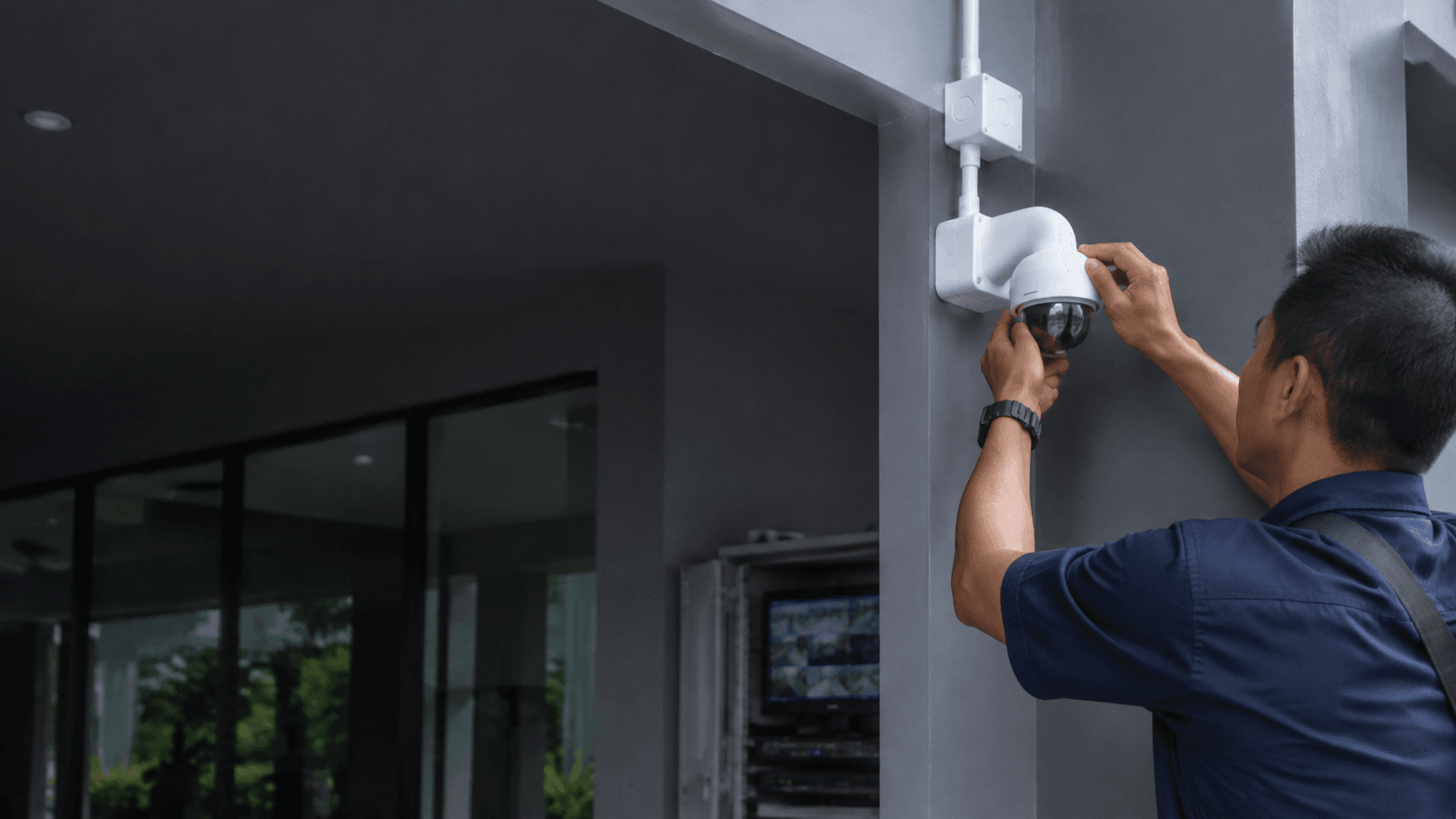
The exact-match query video security camera describes both the hardware and the work around it. Most buyers in Malaysia start by comparing camera brands, then discover the harder questions: where each camera points, how footage is recorded, who can view it remotely, and who installs and hands over the system. Eyonic Sdn Bhd plans, supplies, and installs monitoring systems with camera placement, recording, and remote viewing for homes, offices, shops, and industrial sites.
This guide follows the practical order of a real installation rather than a product catalogue. It covers what a system includes, how placement and lighting are checked, how recording and remote viewing are configured, the installation sequence, and the cost picture that is actually supported by published figures.
Video Security Camera Planning Starts With the Site
Planning begins with a site survey, not a camera model. The survey establishes what needs to be watched, where power and cabling can run, and which entry, exit, and circulation points matter most. Eyonic's CCTV installation process includes site survey, system proposal, installation, and handover, so the proposal is written after the site is understood rather than before.
For a home, the survey usually centres on the gate, car porch, and main door. For a shop, it covers the counter, entrance, and stock area. For an office or industrial site, it extends to staff movement, visitor handling, and perimeter access. The Kuching Immigration Office project is a useful reference point: the work focused on arrival flow, staff areas, visitor movement, and dependable daily operation. That is a public-office example, but the same logic applies to a shop counter or a factory gate — the camera plan follows the movement of people, not the shape of the building.
A site survey also surfaces constraints early. Cable routes, ceiling access, and the position of existing power points affect what is practical. Finding these during the survey is cheaper than finding them on installation day.
What a Video Security Camera System Includes
A complete system has four working parts: cameras, a recorder, storage, and a viewing method. Eyonic's service scope names camera placement, recording, and remote viewing as the core of a monitoring system, which maps directly onto those parts.
Cameras capture the scene. The recorder — commonly an NVR, or network video recorder — receives and stores the footage. Storage holds recordings for a retention period. Remote viewing lets an authorised user check live or recorded footage from a phone or computer. A system is only as useful as its weakest part: excellent cameras with no retention plan, or good recording with no remote access, both leave gaps.
Two practical distinctions matter when comparing options. Wired systems generally rely on a fixed cable run to the recorder, which suits permanent premises where cabling can be installed tidily. Wireless cameras reduce cabling but still depend on stable power and a reliable network signal at each camera position. Neither is automatically better; the choice follows the site.
Access control and alarms are separate systems that are often planned alongside cameras. Eyonic notes that smart locks work best when door condition, user roles, and a backup entry method are reviewed before installation, and that for business use the choice between a standalone smart lock and an access-control panel should be checked first. The same discipline applies to cameras: confirm the requirement before selecting the product.
Video Security Camera Placement and Lighting Checks
Placement decides how much of the footage is actually usable. A camera aimed at a wide open area may capture movement without capturing a face, while a camera placed too low or too close to a light source can produce glare that ruins the image at night.
Eyonic recommends checking actual lighting conditions before confirming placement for ColorVu-style cameras. That step matters because lighting varies across a site: a porch with a bright lamp, a corridor with dim fixtures, and an unlit back lane each behave differently after dark. Confirming the real conditions on site is more reliable than assuming from a product description.
Coverage should follow the points that matter. Entrances and exits, the path between a gate and a door, cash or stock areas, and any point where a person would need to be identified are the usual priorities. Overlapping fields of view reduce the chance that a single camera's blind spot hides an event.
Physical practicalities also shape placement. Cameras need a mounting surface, a route back to the recorder, and protection from the weather where they are outdoors. Height affects both the viewing angle and how easily the unit can be reached for maintenance. These are survey decisions, not afterthoughts.
Recording, NVR Setup, and Remote Viewing
NVR setup connects the cameras to the recorder and configures how footage is stored and reviewed. Remote viewing is then configured so an authorised user can check the system from outside the premises. Both are named parts of Eyonic's service scope, and both are typically completed before handover.
Retention is the question most buyers ask after installation. How long footage is kept depends on the number of cameras, the recording settings, and the storage fitted — and those figures are specific to each system, so they belong in the proposal rather than in a general estimate. The practical approach is to decide what retention the site actually needs, then size storage to match.
Remote viewing has its own requirements. The recorder needs a working internet connection, and the viewing app or platform must be set up on the devices that will be used. Handover is the point where this is tested rather than assumed: the user should be able to open the app, see live views, and find recorded footage without assistance.
Access should be deliberate. Deciding who holds viewing credentials, and reviewing that list when staff change, keeps the system useful without spreading access further than intended.
Video Security Camera Installation Sequence
The installation follows a defined order. Eyonic's process runs through four stages, and each one depends on the previous stage being settled.
- Site survey. The site is reviewed to establish what needs to be watched, where cameras can be mounted, and how cabling and power can be routed.
- System proposal. The survey findings are turned into a proposed system covering camera positions, recording, and remote viewing.
- Installation. Cameras, recorder, storage, and cabling are installed and configured according to the agreed proposal.
- Handover. The system is tested with the user, including recording checks and remote viewing setup, so the finished system is understood and usable.
The sequence matters because skipping the survey tends to push problems into installation. A proposal written without a site visit may specify cameras that cannot be mounted where they are needed, or a cable route that does not exist. Working in order keeps the proposal realistic and the installation predictable.
Handover is the stage most often undervalued. A system that records correctly but that nobody can review remotely has not delivered its purpose. Testing live view, playback, and app access at handover closes that gap.
Video Security Camera Costs and Next Practical Step
Published pricing gives a starting reference. Eyonic lists a Hikvision CCTV Package at RM 1,599, covering camera supply and setup, basic recording configuration, and mobile viewing handover. That package describes a defined scope rather than a full commercial installation.
Larger projects sit in a different range. The Kuching Immigration Office project carries an approximate budget of RM 12,000 to RM 28,000, and the KTA Sarawak Sdn Bhd office project carries an approximate budget of RM 8,000 to RM 18,000. Those figures reflect office-scale work with multiple areas to cover, and they show how widely a video security camera project can range depending on site size and requirements.
Cost is driven by the number of cameras, the recording and storage configuration, the cabling required, and the complexity of the site. A single-entry home and a multi-area industrial site are not comparable jobs, which is why a survey-based proposal is more useful than a generic price list.
For readers weighing a locally installed system against buying hardware alone, the difference sits in the survey, the placement decisions, the recording configuration, and the handover. Hardware can be purchased anywhere; the planning and setup are what make the footage usable when it is needed.
Eyonic Sdn Bhd is based in Sarawak and works across homes, offices, shops, and industrial sites, with founder Eric Yong bringing more than 10 years in the industry and experience in technical installation of digital security solutions for commercial businesses in Sarawak. Share your location, property type and required system with Eyonic on WhatsApp at +60 11-5111 7959 for the next practical step.