
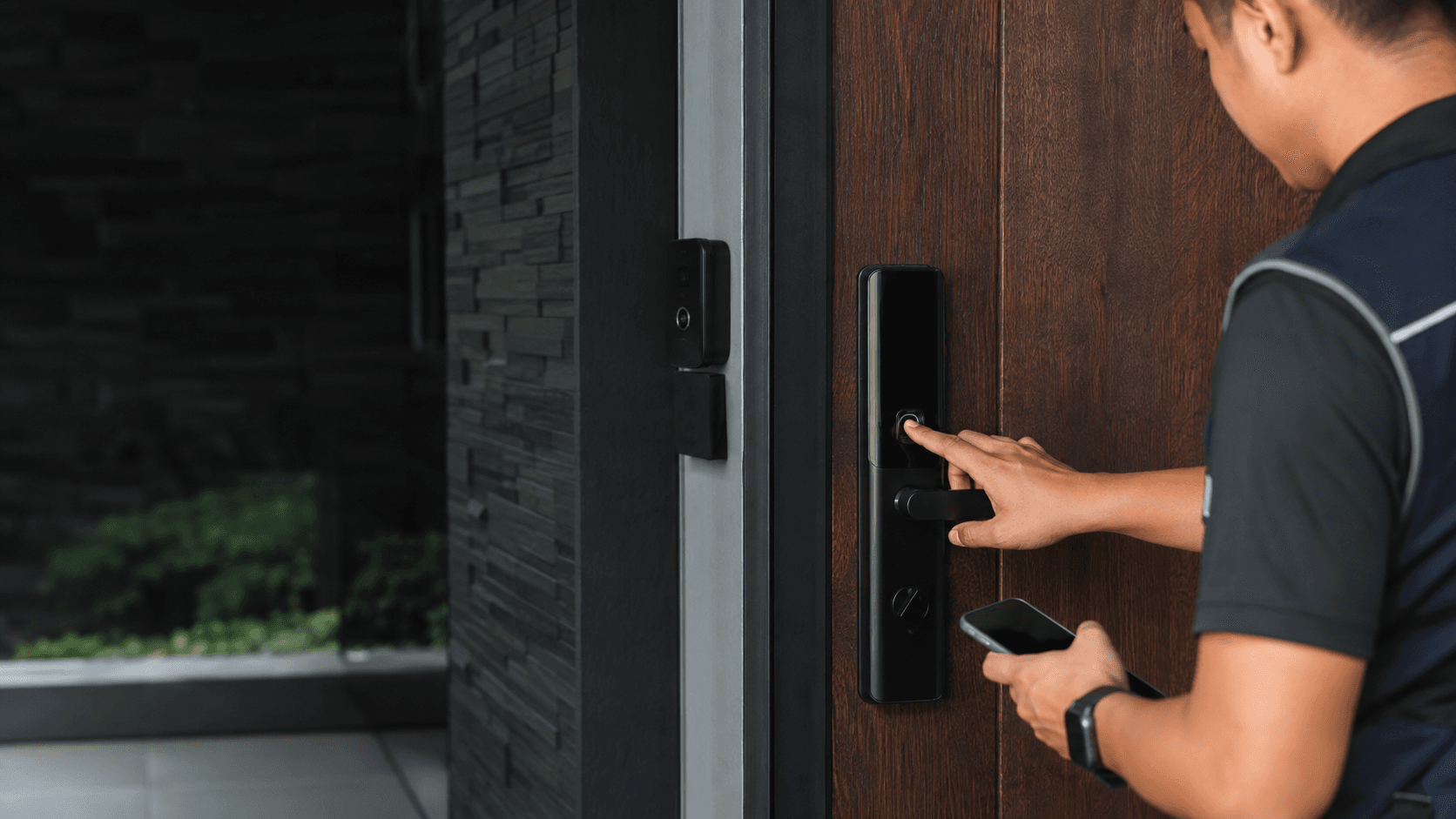
The exact-match query keyless house door lock describes hardware that grants entry without a cut key. In Malaysia, that usually means a keypad or touchscreen deadbolt on the main entrance door, sometimes paired with an autogate remote at the same property. The decision is less about brand fashion and more about whether the existing door can carry the lock, who needs entry, and what happens when the battery runs flat or a phone is unavailable.
Eyonic Sdn Bhd plans, supplies, and installs security and ELV systems in Sarawak, and its published smart lock door access guidance states that smart locks work best when door condition, user roles, and backup method are reviewed before installation. That review-first position shapes the checks below.
Keyless House Door Lock. How Entry Works Without a Key
A keyless house door lock stores credentials instead of cutting metal. The credential is presented at the door, the lock verifies it against its stored list, and the bolt retracts. Nothing about that sequence requires a key to exist.
The common credential types behave differently in daily use:
- Keypad or touchscreen code. A shared or personal number opens the door. Codes can be changed without rekeying hardware, which suits households that hand out access to helpers, relatives, or short-stay guests.
- Fob or card. A small token is tapped or presented. This suits people who dislike typing a code in the dark or while carrying groceries.
- Fingerprint. The lock reads a stored print. Nothing needs to be carried, but enrolment is personal and a print that fails to read becomes a lockout risk.
- App or phone credential. The phone acts as the credential, often over Bluetooth or Wi-Fi. This adds remote management but also adds a dependency on the phone, its battery, and its network.
Two mechanisms matter more than the credential type. The first is the bolt. a deadbolt throws a solid metal bar into the frame, while a latch-style lock relies on a spring bolt that is easier to slip. The second is the fail-safe direction. A lock that fails unlocked is convenient in a fire and wrong for a front door; a lock that fails locked is secure and needs a reliable backup path. Eyonic's published guidance notes that for business use, the choice between a standalone smart lock and an access control panel is part of the same review, because a panel manages many doors and many roles in a way a single lock cannot.
Keyless House Door Lock Options for a House Door
House doors in Malaysia vary enough that the lock has to follow the door, not the other way around. A solid timber main door, a metal gate-and-door combination, and a hollow-core interior door each present different mounting and strength conditions.
Three broad shapes cover most house doors:
- Full replacement deadbolt. The existing deadbolt is removed and the keyless unit takes its place. This gives the strongest result when the door has enough solid material around the bore hole and the new bolt aligns with the existing strike.
- Retrofit or add-on unit. The existing deadbolt stays and a keyless mechanism turns it from the inside. This preserves the current hardware and can suit doors where the existing lock is sound but the key is the inconvenience.
- Handleset with integrated entry. The handle and the lock arrive as one unit, which tidies the door face and often suits a main entrance where the old handle and lock were mismatched.
The trade-off is straightforward. Full replacement gives the cleanest security result but demands the most from the door. Retrofit is gentler on the door and the budget but depends on the existing deadbolt being in good order. A handleset changes the look of the entrance and usually costs more than a bare deadbolt swap.
For a property with both a gate and a house door, the two systems are usually managed separately. Eyonic supplies autogate packages alongside its other security work, and the practical question is whether the gate remote and the door credential should be one habit or two. Keeping them separate is simpler to support; combining them into one app or one fob is tidier but concentrates the failure point.
What to Check Before Choosing a Keyless House Door Lock
The checks below are the ones that decide whether a keyless house door lock works in daily life or becomes a recurring complaint. They follow the review order Eyonic applies to smart lock door access: door condition, user roles, then backup method.
- Confirm door condition and existing hardware. Check the door material, its thickness, whether the frame is solid, and whether the current deadbolt sits square in its bore. A door that has swollen, dropped, or been patched around the lock is a poor candidate for a tight-fitting electronic bolt.
- Decide who needs entry and with what role. List every person who opens the door: household members, domestic helpers, elderly parents, tenants, cleaners, contractors. Each needs a credential type and a way to revoke it. A code that is shared and never changed is not access control.
- Choose the entry method. Match the credential to the people. A fingerprint suits a small, stable household. A keypad suits a household with rotating helpers. An app suits an owner who wants to grant and revoke access remotely.
- Plan the backup entry method. Decide in advance how the door opens when the battery is flat, the phone is dead, or the fingerprint reader will not read. A mechanical key override, a hidden external power point, or a second credential type each solve a different failure.
- Confirm installation and handover. Establish who installs, who tests every credential, and who explains code changes and battery replacement to the people who live with the lock.
Two edge cases deserve a decision before purchase. A rental property raises the question of whether the door can be restored to its original lock at the end of the tenancy, which favours retrofit over full replacement. A household with elderly residents or young children raises the question of whether a code is easier to remember than a key is to carry, and whether the lock can be opened from inside without a credential at all.
Installation and Handover for a Keyless House Door Lock
Installation quality decides whether a keyless house door lock feels reliable six months later. A bolt that binds, a strike that is a millimetre out, or a door that has to be pushed before the code is entered will all shorten the lock's working life.
Eyonic's published installation process for its security work runs through four stages, and the same sequence applies to a door lock:
- Site survey. The door, frame, existing hardware, and power or network conditions are inspected on site rather than assumed from a photograph.
- System proposal. The recommended lock or access arrangement is put forward against what the site actually supports.
- Installation. The hardware is fitted and aligned to the door.
- Handover. Credentials are enrolled, tested, and explained to the people who will use them.
Handover is the stage most often skipped in self-install purchases. It is where the household learns how to add a code for a new helper, how to delete one when that helper leaves, and what the lock does when the battery warning appears. Eyonic's project work for the Kuching Immigration Office centred on arrival flow, staff areas, visitor movement, and dependable daily operation, which is the same logic a house door needs at a smaller scale: the entry point has to work every morning without someone troubleshooting it.
For a property that also carries CCTV, an alarm, or an intercom, the door lock is one part of a wider entry picture. Eyonic's documented package pricing covers a Hikvision CCTV package at RM 1,599, a Hikvision alarm system at RM 1,599, and an autogate package at RM 1,599. No equivalent published price exists for a keyless house door lock, so a lock figure should be confirmed against the actual door and hardware rather than assumed from those packages.
Backup Entry and Daily Reliability
Backup entry is the single most important design decision in a keyless house door lock, and it is the one most often left until it is needed. A lock with no backup path turns a flat battery into a locksmith call.
Reliability in daily use comes down to a short list of habits and conditions:
- Battery awareness. Most electronic locks warn before the battery fails. The warning is only useful if someone acts on it, so the person who changes the battery should be named at handover.
- Credential hygiene. Codes and fobs should be removed when a person no longer needs access. A lock that still opens for a departed helper is a security gap, not a convenience.
- Mechanical condition. A door that has dropped on its hinges will strain any bolt, electronic or not. Hinge and frame condition belongs in the same maintenance routine as the lock.
- Network dependency. App-based entry depends on the phone, the app, and often the network. Where the phone is the only credential, a second method should exist.
The honest limit is that no keyless lock removes every failure mode. It replaces a lost key with a flat battery, a forgotten code, or an unreadable fingerprint. The question is which failure is easier to manage in a given household, and whether a backup path exists for it. That is why the review order matters: door condition first, then roles, then backup.
Practical Next Step with Eyonic
Eyonic Sdn Bhd is a security system supplier in Sarawak that plans, supplies, and installs CCTV and ELV systems for homes, offices, shops, and industrial sites. Its founder, Eric Yong, has worked in technical installation of digital security solutions in Sarawak for more than ten years. The company's smart lock door access guidance is to review door condition, user roles, and backup method before installation, and to weigh a standalone smart lock against an access control panel where business use is involved.
For a house door in Kuching or elsewhere in Sarawak, the practical next step is a site survey rather than a product order, because the door decides what will fit. Share the location, property type, and required system with Eyonic on WhatsApp at +60 11-5111 7959 to arrange that step.