
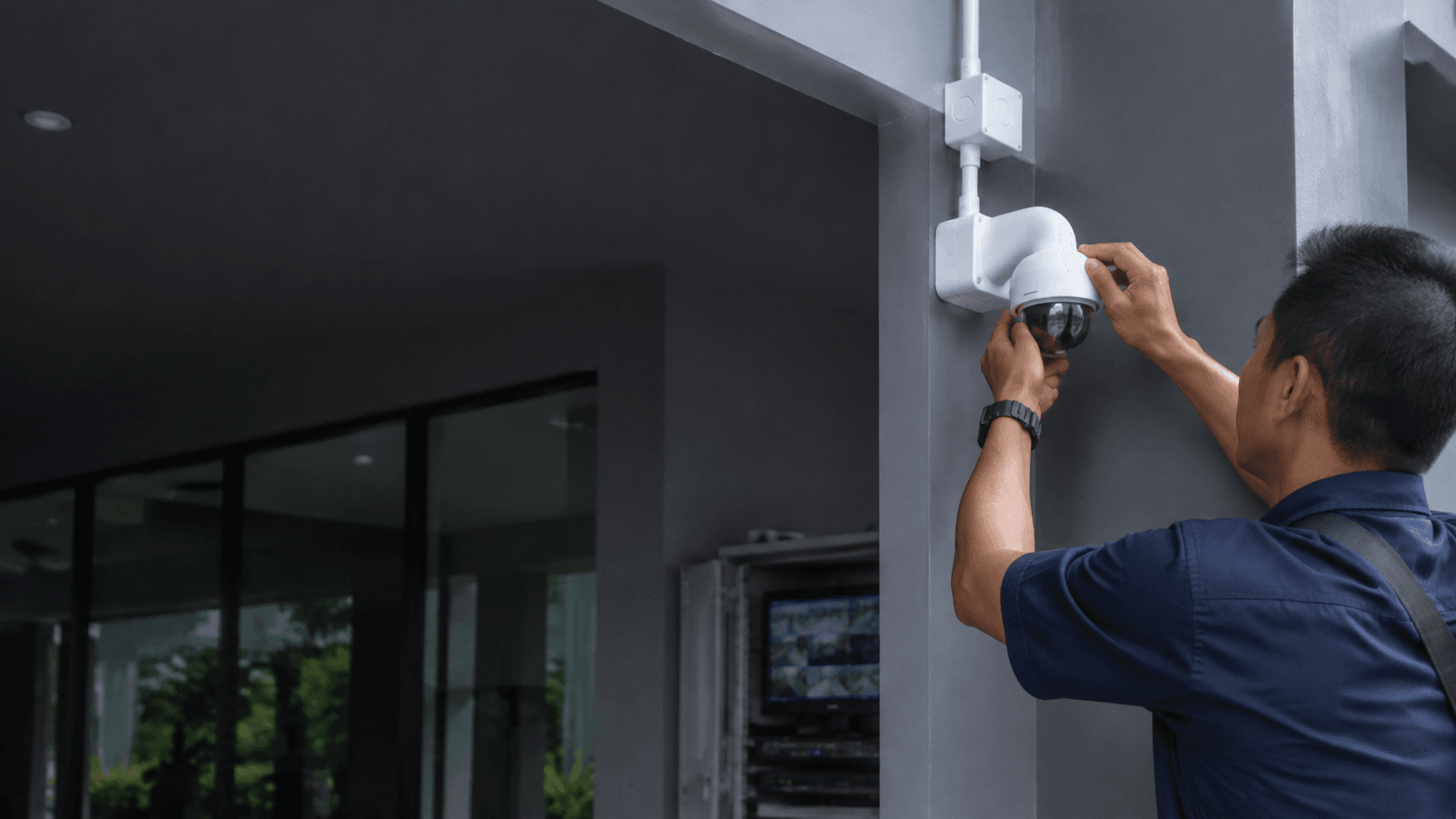
The exact-match query annke cctv describes a brand rather than a single product. Annke sells standalone cameras, multi-camera kits, and the recorders that store their footage. Buyers in Malaysia usually meet the brand through marketplace listings, the official site, or a review before deciding whether to buy a kit outright or ask an installer to supply and fit one.
What follows sticks to what the brand and its listings actually show: the parts of a system, how night vision and detection work, how recording and storage are handled, and where the practical limits sit. Where a specification is not confirmed by a primary source, it is left out rather than guessed.
What Annke CCTV systems include
A complete Annke CCTV setup is a chain of four parts, and each one constrains the others.
- Cameras, which capture the image and either send it over a network cable or feed it down a video cable.
- A recorder, which is an NVR for network cameras or a DVR for analogue and HD-over-coax cameras.
- A storage drive inside the recorder, which determines how many days of footage are kept.
- A viewing layer, which is the Annke Vision app on a phone plus a monitor or browser session at the recorder.
Annke's own site describes wired and wireless cameras and systems with high-resolution imaging, full-colour night vision, AI detection and search, and local shipping support. Marketplace listings show the same shape in product form: bullet cameras, pan-and-tilt models, solar wireless kits, and NVR or DVR bundles with a hard drive included or excluded.
The practical consequence is that a camera bought alone is not a system. A camera without a compatible recorder has no central place to store footage, and a recorder without a drive records nothing beyond a short buffer. Buyers who start with one camera usually end up adding the recorder and drive later, which costs more than planning the chain at the start.
Cameras, recorders, and app viewing
Annke's range splits along two lines that matter more than model names: how the camera connects, and what shape it is.
Wired cameras fall into two families. Network cameras run on Power over Ethernet, so one cable carries both data and power, and they pair with an NVR. Analogue and HD-over-coax cameras use a video cable and pair with a DVR, which is often the cheaper route when a building already has coax in place. Wireless cameras still need power at the camera, and the connection between camera and recorder is the part that is wireless.
Shape decides where a camera can go. Bullet cameras point along a fixed line and suit a wall or pole aimed at a gate, driveway, or corridor. Dome cameras sit closer to the mounting surface and are harder to redirect by hand. Pan-and-tilt models cover a wider area from one position but depend on a motor that has to keep working.
Viewing runs through the Annke Vision app, which the Google Play listing describes as a companion app for Annke products, covering live streaming, playback, and motion alarm notifications. The same listing carries a data safety section, which is the place to check what the app collects before installing it on a personal phone.
Two constraints apply to any app-based viewing setup. Remote viewing needs an internet connection at the recorder and at the phone, and it needs the recorder to stay powered. A recorder on a plug that gets switched off at night is not recording, no matter what the app shows.
Night vision and detection features
Annke markets full-colour night vision under its NightChroma name, alongside infrared night vision on other models. The two behave differently and suit different sites.
Infrared night vision produces a black-and-white image in low light and is the older, more predictable approach. Full-colour night vision keeps colour after dark, which helps identify clothing and vehicle colour, but it depends on ambient light or on the camera's own light source. A site with no street lighting and no other light will not get the same result as a lit car park.
Detection is the second half of the picture. Annke listings describe AI human and vehicle detection, which filters alerts so that moving branches and passing cats do not trigger the same notification as a person walking up a driveway. Some kits also list two-way audio and active deterrence through a light or siren.
Detection quality depends on placement as much as on the camera. A camera aimed across a public road will trigger on every passing vehicle. A camera aimed at the approach to a door, with the detection zone trimmed to that approach, produces fewer and more useful alerts. This is the same reasoning Eyonic applies when it recommends checking actual lighting conditions before confirming placement for full-colour night vision cameras, because the lighting at the site decides whether the feature performs as advertised.
Storage and recording options
Annke kits are sold with and without a hard drive, and the listings state the drive size where one is included. Storage is the part of the system that quietly decides how useful the footage is.
Continuous recording keeps everything and fills the drive fastest. Motion-triggered recording keeps only events and stretches the same drive much further, at the cost of missing whatever happens outside the trigger. Most installations end up somewhere between the two, with continuous recording on the main entrance and motion recording elsewhere.
Retention is a simple calculation. More cameras, higher resolution, and continuous recording all shorten the number of days the drive holds. A buyer who wants a month of history needs either a larger drive, fewer cameras, or motion recording. Annke listings also mention H.265+ compression, which reduces file size compared with older codecs and therefore extends retention on the same drive.
Some models accept a microSD card as a local backup, and cloud storage appears on some listings. Local storage on a drive inside the building keeps footage under the owner's control but is lost if the recorder itself is taken. Cloud storage survives that, but depends on upload bandwidth and on a subscription where one applies.
Comparing Annke CCTV with other brands
Annke sits in the value-to-mid range of the market, competing with brands such as Reolink, Hikvision, Amcrest, and ZOSI. The comparison that matters is not brand against brand in the abstract but which parts of the chain each option handles well for a specific site.
Annke's strengths in the listings are breadth and price: solar wireless kits, pan-and-tilt models, and DVR bundles with AI detection appear across the range, and the official site advertises fast local shipping. A buyer who wants a self-installed kit with a wide choice of configurations has plenty to work with.
The trade-offs are the usual ones for a direct-to-consumer brand. Support and warranty handling run through the brand rather than a local dealer, so a fault means shipping or remote troubleshooting rather than a technician on site. Firmware, app behaviour, and data handling are set by the manufacturer. For a homeowner replacing a single camera, that is manageable. For a shop or office where a camera outage stops daily operations, the support path matters as much as the specification.
This is where the local route differs. A supplier who plans, supplies, and installs takes responsibility for the whole chain, including the recorder, the drive, the cabling, and the handover of remote viewing. Eyonic's own installation process runs through site survey, system proposal, installation, and handover, and its completed work includes the Kuching Immigration Office, where the focus was arrival flow, staff areas, visitor movement, and dependable daily operation. A comparable office project sits in the RM 12,000 to RM 28,000 range, and a smaller office setup in the RM 8,000 to RM 18,000 range, which shows how far a commercial installation can sit from the price of a self-installed kit.
For buyers weighing the two paths, the deciding questions are who answers when a camera goes offline, who holds the spare parts, and who reconfigures the app when a staff member leaves. A self-installed Annke kit answers those questions with the owner. An installed system answers them with the supplier.
Eyonic's published packages start at RM 1,599 for a Hikvision CCTV package covering camera supply and setup, basic recording configuration, and mobile viewing handover, with matching packages for alarm systems and autogates. Those are different brands from Annke, so they are a reference point for what a supplied and installed package costs in Sarawak rather than a like-for-like comparison.
Anyone comparing quotes should ask what is included at handover: whether the recorder is configured, whether the drive is fitted, whether remote viewing is tested on the owner's phone, and whether the cabling is concealed or surface-run. Those four items separate a package price from a final cost.
For buyers who want to move forward, sharing the location, property type, and required system with Eyonic on WhatsApp at +60 11-5111 7959 gives enough detail for a practical next step.