
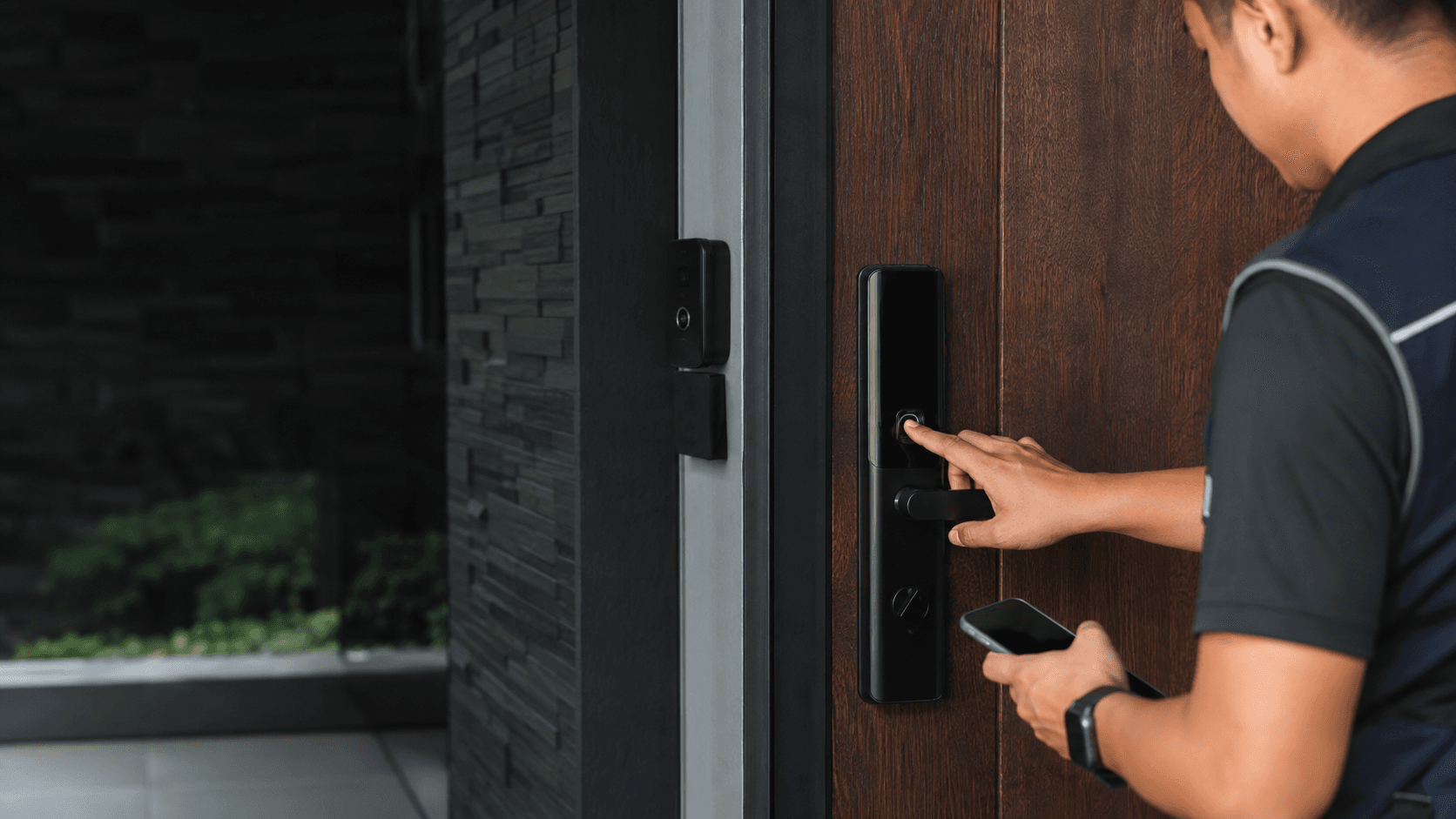
Geek Smart is a smart-lock brand sold through retailers such as Wholesale Home and the Geek Tale store, and its fingerprint models appear in both lever-handle and deadbolt formats. Buyers comparing these locks usually weigh three things: how the door is drilled, how many people need entry, and what happens when the battery dies.
Geek Smart Fingerprint Door Lock: What Matters Before Choosing
The single biggest compatibility question is the door itself. A lever-handle lock such as the L-B201 replaces an existing knob or lever set and needs the standard cross-bore and edge-bore holes already cut into the door. A deadbolt version replaces the deadbolt and keeps the existing handle. These are different products for different doors, and the model number matters more than the brand name.
Geek Smart lock listings describe fingerprint recognition, keypad codes, app control, auto-lock, and a mechanical key as backup. The L-B201 is described as a 3-in-1 keyless entry lock combining biometric fingerprint, mechanical key, and remote control through an app. That combination is the core of what the brand sells.
What is geek smart fingerprint door lock?
A geek smart fingerprint door lock is a battery-powered door lock that opens by reading a stored fingerprint instead of a physical key. The same lock usually accepts a keypad code and a phone app command, and it keeps a mechanical key cylinder for emergency entry. Geek Smart sells this format in both knob-style and deadbolt-style bodies.
The fingerprint sensor is the primary daily method. A registered finger touches the sensor, the lock verifies the print against its stored list, and the motor retracts the latch. Codes and app commands exist as secondary methods for people whose prints are not enrolled or who are arriving without a registered finger.
Choosing the Right Geek Smart Fingerprint Door Lock
Work through the decision in order, because each answer narrows the model list.
- Identify the door hardware already installed. A lever or knob set points to a handle-style lock; a separate deadbolt above a handle points to a deadbolt-style lock.
- Measure the door thickness and check the bore hole diameter against the lock's stated requirements before ordering.
- Count the people who need regular entry. Households with several residents need enough fingerprint and code slots for everyone.
- Decide whether remote app access is required or whether local fingerprint and code entry is sufficient.
- Confirm the backup method. Every Geek Smart fingerprint model reviewed here includes a mechanical key override.
- Check the door's exposure. Interior doors and sheltered entrances suit these locks better than doors fully exposed to driving rain.
Step two is where most returns happen. A lock sold for a standard residential door will not fit a door with an unusual bore spacing, and no amount of app configuration fixes a physical mismatch.
Product Details
The L-B201 is the model most often listed under the Geek Smart Fingerprint Door Lock name. Retail listings describe it as a smart door lock for bedrooms, apartments, offices, and hotels, with biometric fingerprint entry, a mechanical key, and remote control through an app. It uses a lever handle rather than a deadbolt body.
Geek Smart also sells keypad deadbolt versions with app control, anti-peeping password entry, auto-lock, and backup keys, finished in matte black or gold. A separate GeekTale line covers Bluetooth deadbolts that work with an existing deadbolt, and a WiFi Bluetooth gateway is sold to connect compatible locks to Alexa and Google Home.
Geek Smart lock documentation references the Smart Life app ecosystem and a Geek Smart app, and the brand publishes installation guides for specific models. Model numbers and app names should be confirmed against the exact listing before purchase, because the range spans several generations of hardware.
Practical Considerations for Geek Smart Fingerprint Door Lock Use
Battery life is the constraint that shapes daily use. These locks run on batteries, and the auto-lock and app-connection features draw power continuously. A lock that is polled constantly by a phone app will drain faster than one used only for local fingerprint entry.
Plan the backup before it is needed. The mechanical key should be stored somewhere other than inside the locked room, and the emergency power option described in the brand's documentation should be understood before the battery reaches zero. A lock with a dead battery and a key locked inside the house is the failure mode worth designing around.
Fingerprint reliability varies with the user. Dry skin, worn ridges, and very young fingers all read less consistently than average adult prints. Enrolling the same finger twice, or enrolling a second finger per person, reduces the number of times a code has to be used instead.
For shared or commercial doors, the decision changes. Eyonic, a security system supplier in Sarawak, notes that smart locks work best when door condition, user roles, and backup method are reviewed before installation, and that business use sometimes calls for a standalone smart lock and sometimes for an access-control panel. That distinction matters when a door needs an audit trail or time-based permissions rather than simple convenience.
Where These Locks Fit and Where They Do Not
Interior bedroom and office doors are the strongest fit. The lock replaces a handle, entry is fast, and the security requirement is modest. Apartments and rental units also suit this format when the landlord permits hardware changes and the tenant wants to avoid key handovers.
Main exterior doors on a home are a weaker fit for a handle-only model, because a lever lock alone does not provide the same resistance as a deadbolt. Where the door already has a deadbolt, a Geek Smart deadbolt version is the more appropriate choice. Doors fully exposed to weather, and doors on commercial premises with regulatory access requirements, need a different conversation entirely.
Making an Informed Choice About
Match the model to the door before comparing features. A buyer with a deadbolt door should be looking at the keypad deadbolt range, and a buyer replacing a handle should be looking at the L-B201 and similar lever models. Feature lists are nearly identical across the range, so the physical format is the deciding variable.
Then confirm the access methods actually needed. Fingerprint and code entry cover most household use without any app at all. App control and gateway connectivity add remote management, and they also add a device that must stay powered and connected.
Finally, decide who installs it. These locks are marketed for straightforward replacement of existing hardware, and the brand publishes model-specific installation guides. A door that has been modified, painted over, or fitted with non-standard hardware is a case for professional assessment rather than a self-install.
For readers in Sarawak weighing a smart lock against a wider access-control setup, Eyonic handles smart lock door access alongside CCTV, alarm, autogate, and intercom systems, and reviews door condition and user roles before recommending a standalone lock or a panel-based system. Sharing the property type, door condition, and number of users with Eyonic on WhatsApp at +60 11-5111 7959 is the practical next step.
Common Questions About
Does the lock still work if the battery dies? Every Geek Smart fingerprint model described in retail listings includes a mechanical key override, and the brand's documentation describes an emergency power method. The key should be stored outside the secured space.
Can several people use one lock? Yes. Fingerprint and code slots allow multiple users, which is the main reason households choose this format over a single-key lock.
Does it need WiFi? No. Fingerprint and keypad entry work locally. Remote app access and voice assistant control require the compatible gateway or a Bluetooth connection to a phone.
Will it fit an existing door? Only if the bore holes and door thickness match the model's requirements. Handle-style and deadbolt-style locks are not interchangeable, so the existing hardware determines which model applies.