
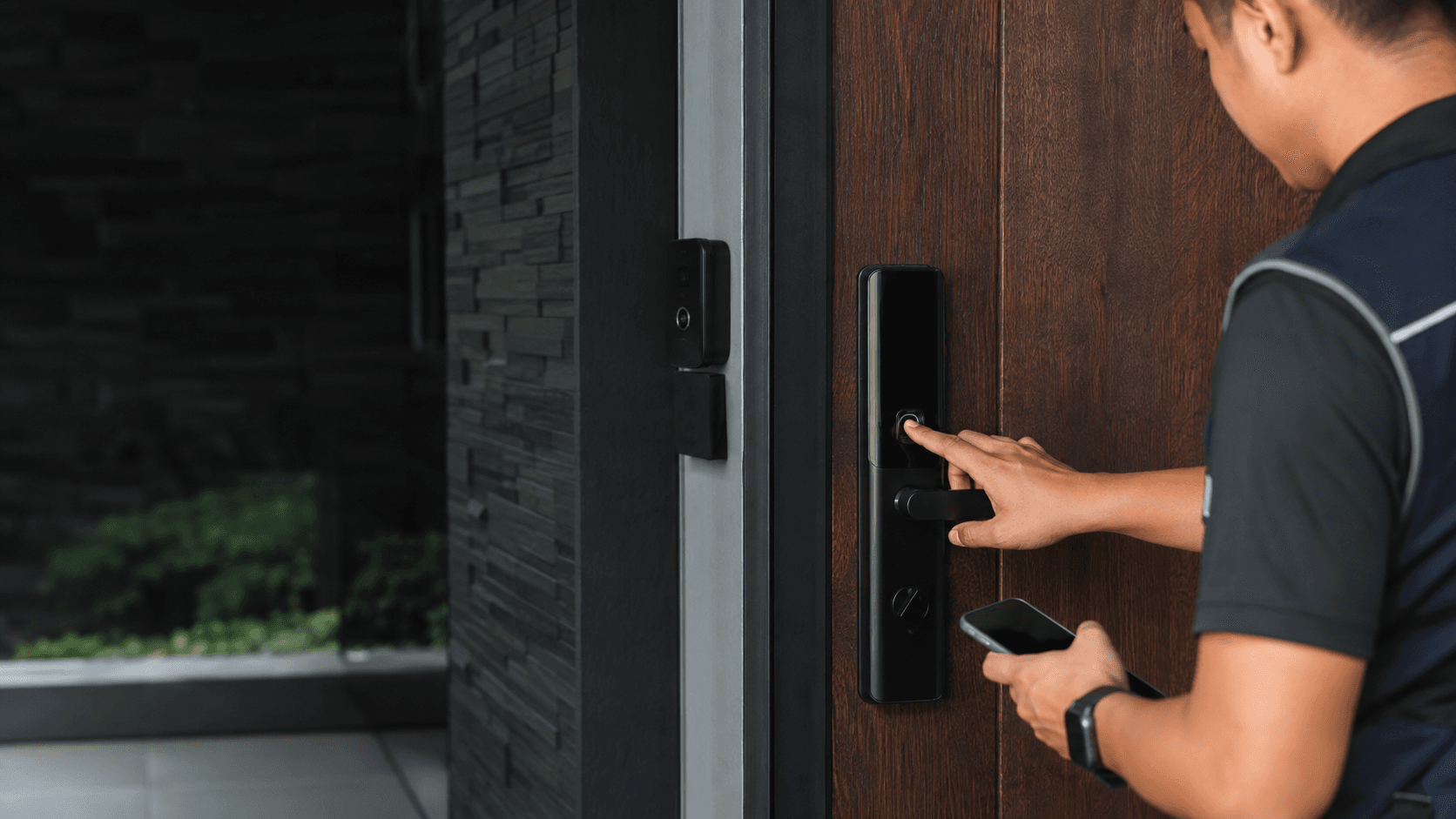
Most glass doors were never designed to carry a lock body. The frame is thin, the panel is tempered, and there is often no timber stile to mortise into. That single constraint shapes everything about how a glass door digital lock is chosen, fitted and maintained.
- Confirm the door type. frameless tempered glass, aluminium narrow stile, or a glass panel set inside a timber or metal frame.
- Measure the glass thickness and the gap between the door leaf and the fixed frame.
- Decide whether drilling is acceptable, or whether a clamp-and-bracket fixing is required.
- Match the access method to the users: PIN code, proximity card, fingerprint, or app-based control.
- Plan the backup entry route before installation, not after a lockout.
- Confirm the power source and what happens when the batteries run down.
Glass Door Digital Lock. What Matters Before You Choose
The deciding factor is rarely the electronics. It is the door. A lock that clamps onto the glass edge behaves very differently from one that replaces an existing mortise cylinder in an aluminium stile, and the two are not interchangeable.
Yale's YDG313 Shine is a rim lock designed for glass doors, with a clip-type bracket that the manufacturer states requires no drilling. Its published specifications list a door thickness range of 10 to 12 mm and a door gap of 2.5 to 5 mm, with power from 4 AA batteries and a low-battery alarm plus 9V emergency power. Those numbers matter because they exclude a large share of glass doors outright. A 12 mm frameless panel falls inside the range; a thicker laminated shopfront leaf may not.
igloohome positions its Glass Door Lock as an all-in-one option for managing multiple properties, including offices, retail shops, co-working spaces and homes. That framing points at a different buyer: someone with several doors and a need to issue and revoke access without rekeying anything.
Codelocks describes its CL4000 Glass Door Lock as a medium-duty electronic patch door lock. The word "patch" is the useful part. Patch fittings mount onto the face of the glass rather than into it, which suits doors where drilling is undesirable or prohibited by the panel's condition.
Choosing the Right Glass Door Digital Lock
Work from the door outward. The lock is the last decision, not the first.
Match the fixing to the door construction
Frameless tempered glass doors usually need a clamp or patch fitting. Aluminium narrow-stile storefront doors often accept a lock that replaces or supplements the existing hardware. All-glass interior openings may suit a product like the BRUKEN DL-GS3550, which ASSA ABLOY Glass describes as providing keyless access control with three distinct access methods for all-glass interior openings.
If the door already has a mortise deadbolt in an aluminium stile, the replacement path is different again. The existing cutout constrains the choice, and a lock that ignores it will not fit without additional fabrication.
Match the access method to the people using it
PIN codes suit shared entrances where codes can be changed and shared verbally. Proximity cards suit staff who already carry a credential. Fingerprint readers suit a small, stable group of regular users. App-based control suits landlords and operators managing several doors remotely.
Yale's YDG313 Shine supports 4 to 12 digit PIN codes and up to 20 proximity card users, with automatic locking and left or right opening. Twenty card users is a real ceiling. A co-working space with rotating tenants will exhaust it quickly.
Plan the failure case
Every battery-powered lock eventually loses power. Yale's specification includes a low battery alarm and emergency power from a 9V battery. That is a recovery path, but it assumes someone is present, knows about it, and has a 9V battery on hand.
For a business entrance, the more robust pattern is a lock plus a documented secondary route: a mechanical key override, a second entrance, or a staffed reception point. Eyonic's own review of smart lock door access notes that smart locks work best when door condition, user roles and backup method are reviewed before installation, and that for business use the choice between a standalone smart lock and an access-control panel should be checked first.
What is glass door digital lock?
A glass door digital lock is an electronic locking device adapted for glass door construction, using code, card, fingerprint or app credentials instead of a mechanical key. The adaptation is the point. standard cylindrical and mortise locks assume a solid door edge, and glass does not provide one.
Three physical approaches cover most installations. Rim and patch locks mount on the door face or edge. Clamp fittings grip the glass without drilling. Replacement hardware swaps out existing storefront lock bodies inside an aluminium stile. Each has a different tolerance for glass thickness, door gap and panel condition.
The category also splits by duty rating. Codelocks labels the CL4000 as medium duty, which signals a design assumption about traffic volume. A home office door and a retail entrance with hundreds of daily cycles are not the same application, and the hardware reflects that.
Practical Considerations for Installation
Installation is where most of the risk sits, and it is mostly about the door rather than the lock.
Glass thickness and gap tolerances
Yale publishes 10 to 12 mm for door thickness and 2.5 to 5 mm for door gap on the YDG313 Shine. A door outside those ranges needs a different product, not a workaround. Measuring before ordering avoids a return and a second site visit.
Drilling clamping and reversibility
Clip and clamp fittings preserve the glass panel and suit rented premises where modification is restricted. Drilled fittings give a more rigid result but are effectively permanent. Tempered glass cannot be drilled after manufacture without shattering, so any hole must be specified before the panel is made.
Power duty and environment
Battery life depends on cycle count, not calendar time. A door used forty times a day will drain cells far faster than a storeroom door opened twice. In humid or coastal conditions, contacts and battery compartments need periodic inspection. Sarawak's climate makes that a routine item rather than an afterthought.
Who should install it
Eyonic's installation process runs through site survey, system proposal, installation and handover. That sequence exists because door condition, user roles and backup method all need checking before hardware is ordered. The same logic applies to a single glass door lock as to a larger system.
For context on how access control fits into a wider building setup, Eyonic's work at the Kuching Immigration Office focused on arrival flow, staff areas, visitor movement and dependable daily operation. A glass door lock sits inside that same question: who moves through which opening, and what happens when the primary method fails.
Making an Informed Choice About
The choice narrows quickly once the door is measured and the user list is written down. A frameless panel with a 12 mm edge and a handful of regular users points at a clamp-mounted lock with PIN and card access. A narrow-stile storefront with an existing deadbolt points at replacement hardware. A multi-property operator points at app-managed access with revocable credentials.
Two constraints deserve a decision before purchase. The first is the user ceiling. Yale's 20-card limit is generous for a home and tight for a shared workspace. The second is the recovery path, because a lock with no documented backup entry is a single point of failure regardless of how good the electronics are.
Where a site has several openings, mixed door types, or a need to log who entered and when, a standalone lock may be the wrong shape of solution. Eyonic's review notes that for business use, the choice between a standalone smart lock and an access-control panel is worth checking first. That check costs little and can change the specification entirely.
Share your location, property type and required system with Eyonic on WhatsApp at +60 11-5111 7959 for the next practical step.