
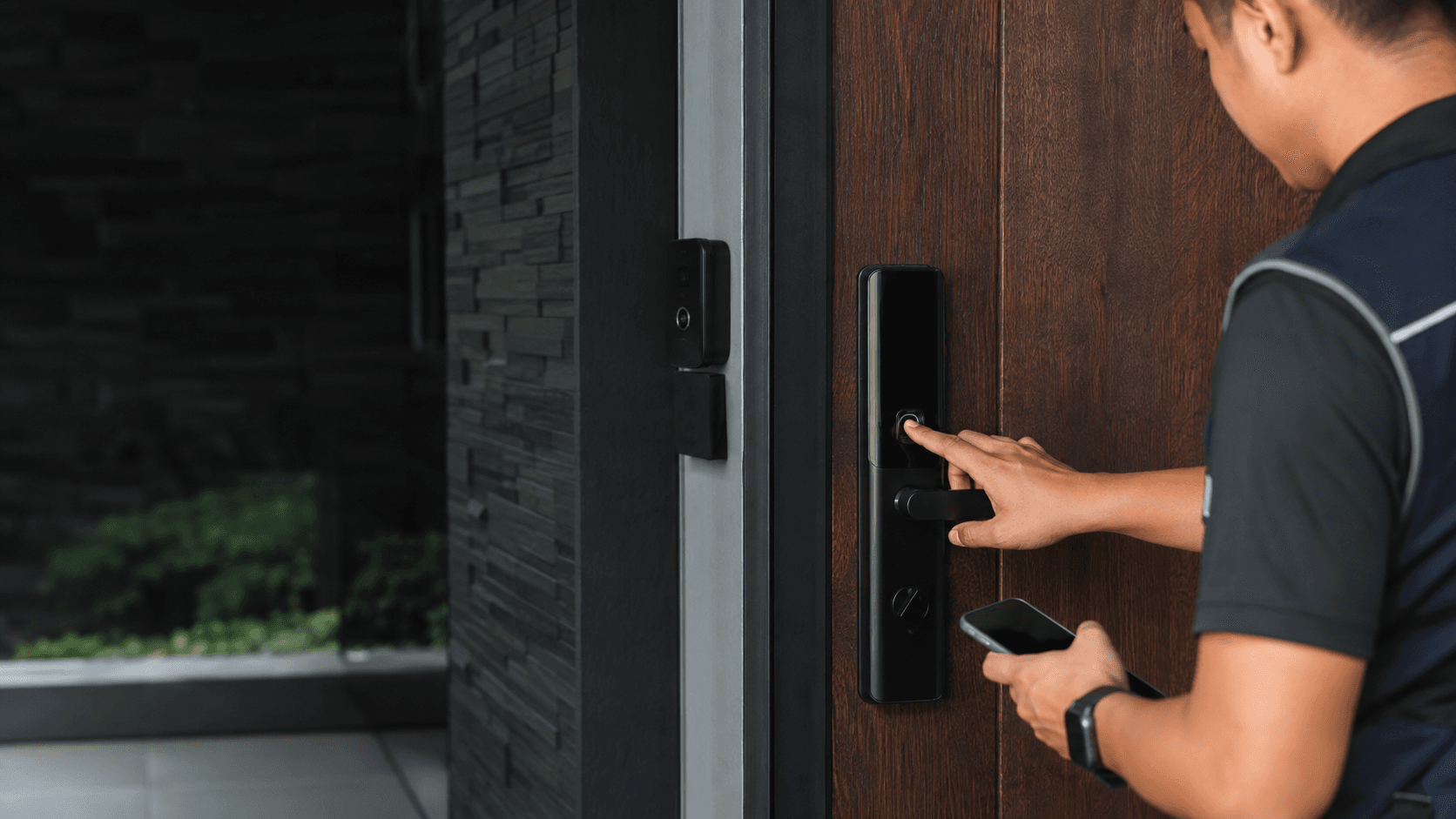
Buyers in Malaysia researching an ADT smart lock usually arrive with the same question: does the lock have to come from ADT, or can any compatible deadbolt be fitted and linked to the alarm system? The honest answer is that the lock is the easy part. The panel, the door, and the plan for getting in when the electronics fail are what determine whether the setup is worth the money.
This guide covers what changes about daily door access, which lock hardware appears alongside ADT panels, how compatibility and connection protocol work, what to check on the door itself, and how installation and handover run in Sarawak.
What an ADT smart lock changes about daily door access
A conventional deadbolt gives one behaviour: turn the key, the door opens. A smart lock adds a second layer of decisions on top of that mechanical action — who is allowed in, when, and whether the alarm system knows about it.
The practical changes fall into four areas.
- Confirm which panel or platform is already installed, because the lock has to speak to that specific system.
- Confirm the connection protocol the lock supports and whether the panel accepts it.
- Measure the door and frame, including backset and cross-bore, before ordering hardware.
- Decide the backup entry method for the day the battery dies or the network drops.
- Confirm who manages user permissions after handover, and how codes are added or revoked.
Entry stops being a single physical act and becomes a permission. A household can issue a temporary code to a cleaner or a contractor and revoke it the same evening without rekeying anything. A small office can give each staff member a separate credential so the record shows who arrived and when.
The trade-off is dependency. A keyed deadbolt works in a power cut, a network outage, and a flat battery. A smart lock works when its power source, its network path, and its controlling platform all work. That is why backup entry is not an optional extra in the planning — it is the thing that keeps the door usable when the smart layer is unavailable.
Which lock hardware appears alongside ADT panels
Across published coverage of ADT-compatible locks, the hardware names that recur are Yale and Kwikset, with Yale's Assure range appearing most often in discussions of ADT integration. Kwikset's keypad deadbolts appear in discussions of older panels and of setups where a mechanical key override matters.
What is not established from the available evidence is whether ADT-branded lock hardware is sold or supported in Malaysia, or which specific models are officially compatible with which ADT panel generation. That gap matters, because a lock sold in one market may not be supported by the panel installed in another.
The practical consequence is that model selection should follow the panel, not the other way round. A buyer who picks a lock first and then discovers the panel does not accept its protocol has bought a standalone lock with extra steps.
For business premises, the more useful question is often not which lock but which architecture. A standalone smart lock suits a single door with a handful of users. An access-control panel suits a site where multiple doors, staff roles, and visitor movement all need to be managed together. Eyonic's own product guidance makes the same distinction: smart locks work best when door condition, user roles, and backup method are reviewed before installation, and for business use the choice between a standalone lock and an access-control panel is usually checked first.
Panel compatibility and connection protocol
Compatibility is decided by two things: which platform the panel runs, and which wireless protocol the lock speaks. If either side does not match, the lock still opens doors — it just does not talk to the alarm system.
Z-Wave is the protocol most commonly associated with ADT lock integration in published coverage. A lock that supports Z-Wave and a panel that accepts Z-Wave devices is the pairing that makes remote lock and unlock, code management, and alarm-state changes possible from one interface. Locks that rely on Wi-Fi or Bluetooth alone typically operate through their own manufacturer app instead, which means two apps and two separate permission lists.
Panel generation is the second variable. Older ADT panels and newer platforms do not necessarily accept the same device list, and a lock confirmed to work with one generation may not be supported on another. Because no verified compatibility matrix for the Malaysian market is available here, the only reliable check is against the specific panel installed at the property — its model, its firmware, and the device list it currently accepts.
Two edge cases are worth naming. First, a lock that integrates with the panel for arming and disarming is doing something different from a lock that merely reports its status; the first changes the alarm state, the second only observes it. Second, integration features can be withdrawn. Hardware that worked with a platform at purchase has, in at least one documented case, been affected when that platform was discontinued, leaving the lock functional but the integration gone.
Door condition, user roles and backup entry
Most smart lock failures in the field are not electronic. They are mechanical — a door that does not sit square in its frame, a strike plate that needs the door pushed before the bolt will throw, or a frame too thin to take the hardware.
Before ordering anything, the door needs three measurements confirmed: the backset, which is the distance from the door edge to the centre of the existing bore; the cross-bore diameter, which is the size of the hole through the face of the door; and the door thickness. A lock designed for one set of dimensions will not fit a door built to another, and adapters do not solve every mismatch.
Door material matters too. Solid timber, hollow-core, metal, and glass doors each take hardware differently, and a door that flexes under load will defeat a motorised bolt regardless of how good the lock is.
User roles are the second half of the planning. A home with four residents needs four credentials and one administrator. A shop with rotating staff needs a way to add and remove codes without a site visit each time. An office with visitors needs a distinction between people who hold a permanent credential and people who are let in for an hour. Deciding this before installation avoids the common outcome where every user shares one code and nobody can tell who entered.
Backup entry is the third. The options are a mechanical key override, a keyed cylinder retained alongside the electronic lock, a second entrance that stays mechanical, or a documented process for what happens when the battery fails. Whichever is chosen, it needs to be tested while someone is still on site — not discovered at the door on a public holiday.
Installation and handover in Sarawak
Installation quality decides whether a smart lock lasts. A lock fitted to a misaligned door will bind, drain its battery faster, and eventually fail to throw the bolt. The work is not complicated, but it is unforgiving of a door that was never checked.
Eyonic's installation process for security systems in Sarawak runs through site survey, system proposal, installation, and handover. The same sequence applies to door access work: the survey establishes the panel in use, the door dimensions, and the user roles; the proposal sets out what will be fitted and how it connects; installation fits and configures the hardware; handover covers testing, credential setup, and the backup entry procedure.
That sequence matters more in Sarawak than it might elsewhere, because replacement parts and a second site visit are not always quick. Getting the door measurement and the panel check right at survey stage is cheaper than correcting them afterwards.
Eyonic has completed work for the Kuching Immigration Office, focused on arrival flow, staff areas, visitor movement, and dependable daily operation, and for KTA Sarawak Sdn Bhd, where the requirement was a practical office setup in Kuching supporting staff movement, visitor handling, and tidy cabling. Both are examples of the same principle: door access decisions sit inside a wider question about how people move through a building, not in isolation.
For readers weighing a lock against a broader system, Eyonic's published packages start at RM 1,599 for a Hikvision CCTV package, RM 1,599 for a Hikvision alarm system, and RM 1,599 for an autogate package. Those figures cover the named packages, not smart lock supply or installation, and no verified pricing for lock hardware or lock installation in Malaysia is available here.
What to weigh before committing
The case for an ADT smart lock is strongest where the property already runs an ADT panel, the door is sound, and the household or business genuinely needs per-user credentials rather than a shared key. In that situation the lock adds convenience and a usable access record without adding a second system to manage.
The case is weaker where the panel generation is uncertain, the door is out of square, or the property has only one entrance and no mechanical fallback. In those conditions a standalone smart lock with its own app, or a conventional deadbolt with a keyed cylinder, may deliver most of the benefit with fewer dependencies.
Three checks settle most of the decision. Confirm the panel model and the protocols it accepts. Measure the door rather than assuming it is standard. Decide the backup entry method and test it before the installer leaves.
Share your location, property type and required system with Eyonic on WhatsApp at +60 11-5111 7959 for the next practical step.