
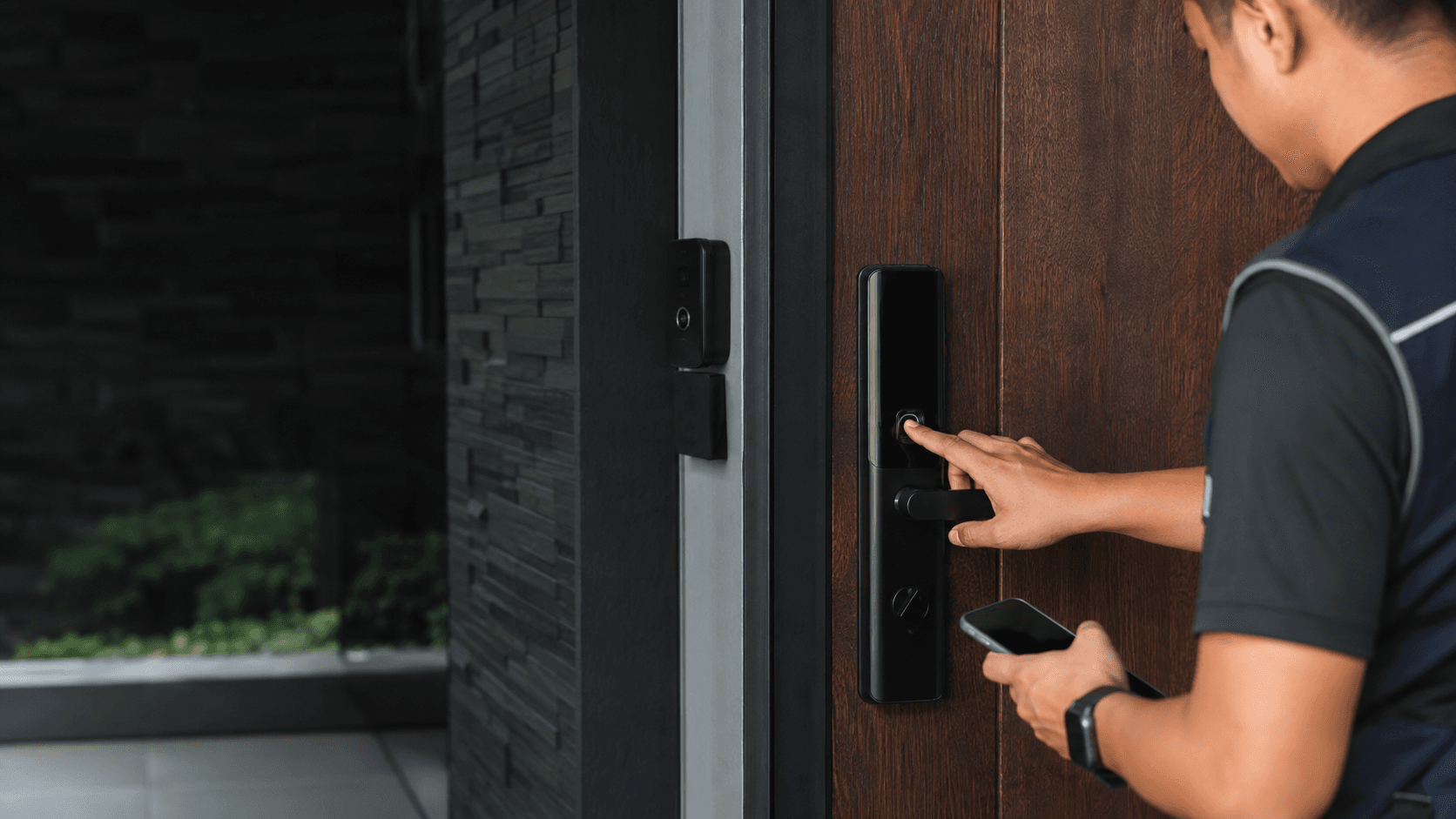
The exact-match query digital entry lock describes hardware that grants or refuses entry after checking a code, card, fingerprint or app command rather than a mechanical key. In Malaysia, the decision is rarely about the lock alone. It is about the door it sits on, the people who need to pass through it, and what happens on the day the electronics stop cooperating.
Eyonic Sdn Bhd, a security system supplier in Sarawak, reviews door condition, user roles and backup method before recommending door access hardware, and checks whether a standalone smart lock or an access-control panel suits a business door. That review order matters more than any product shortlist, because the same lock can be sensible on one door and wrong on the next.
Digital Entry Lock. What It Controls at a Door
A digital entry lock governs one thing at the point of entry: whether the door releases. Everything else — logging, scheduling, remote release, integration with a camera or alarm — is built on top of that single decision.
That distinction separates two categories of hardware. A standalone digital entry lock makes the decision inside the lock body. An access-control panel makes the decision centrally and then drives a release mechanism at the door. Eyonic usually checks which of the two is more appropriate for business use, because the answer changes who administers credentials and how quickly access can be withdrawn.
What the lock controls in practice:
- Who may open the door, expressed as a code, card, fingerprint or app credential.
- When the door may open, if scheduling is part of the chosen system.
- Whether an entry is recorded, if the system keeps an event log.
- How access is withdrawn when a person leaves, a tenant changes or a credential is lost.
The fourth item is the one most often skipped during planning. Adding a user is easy to demonstrate. Removing one cleanly, without reissuing everything else, is the test of whether the system was specified properly.
How a Digital Entry Lock Differs From a Keyed Lock
A keyed lock carries its authority in a physical object. A digital entry lock carries its authority in a credential that can be issued, limited and revoked without cutting new metal.
That difference produces practical consequences on both sides.
On the digital side, access can be granted to a cleaner, a contractor or a short-stay guest without handing over a key that works forever. A lost credential can be cancelled. A code can be changed after a tenancy ends. These are real operational gains for a shop, office or rental property.
On the keyed side, the lock works when the battery is flat, the network is down and the power is out. There is no firmware, no app account and no administrator who must be reachable. A mechanical key also cannot be silently duplicated through a phone.
The trade-off is not security versus convenience in the abstract. It is administrative control versus independence from power and software. A building that needs to know who entered, and needs to stop someone entering next week, gains more from the digital side. A store room that must open during a blackout gains more from the mechanical side. Many doors end up needing both, which is why backup entry is a planning item rather than an afterthought.
Door Condition and User Roles Decide the Fit
Eyonic's own review guidance states that smart locks work best when door condition, user roles and backup method are reviewed before installation. Those three checks are worth taking in order.
Door condition
A digital entry lock is a mechanism that must align, latch and deadlock reliably, thousands of times, on the door it is fitted to. A door that already sticks, a frame that has moved, or a strike plate that no longer lines up will punish any lock fitted to it. The electronics are not usually the failure point; the alignment is.
Door material and thickness also constrain what can be fitted. A hollow metal door, a solid timber door and a glass door present different fixing options. This is why a site survey precedes a proposal rather than following it.
User roles
The number of people who need access, and how often that list changes, decides whether a standalone lock is enough or whether a panel-based system is warranted. A family home with four regular users and occasional visitors has a different administrative load from an office where staff, cleaners, couriers and contractors all need different levels of access.
Roles also determine whether entry needs to be logged. If a business must be able to answer who entered a restricted area and when, the logging requirement pushes the specification toward a system that records events rather than a lock that simply opens.
Backup method
Every electronic lock needs a defined answer to failure. That answer might be a mechanical key override, a temporary power source, or a documented procedure for a named person. What matters is that the answer is decided before installation, not discovered during the first outage.
Where a Suits Malaysian Properties
Malaysian buildings vary widely in construction, and door access decisions tend to follow the property type rather than a single national pattern.
In Sarawak, Eyonic has completed work for a public office in Kuching focused on arrival flow, staff areas, visitor movement and dependable daily operation, and for an engineering consultancy office in Kuching supporting staff movement, visitor handling, tidy cabling and clearer daily site control. Both are office environments where the movement of people, rather than the lock hardware itself, shaped the requirement.
That pattern repeats across common property types:
- Terrace houses and apartments. A single main door with a small, stable user list. Convenience and lost-key replacement are usually the driving concerns.
- Offices and shop lots. Multiple staff, changing rosters and visitors. Access withdrawal and entry records matter more than the lock's appearance.
- Rental and short-stay units. Frequent credential changes between occupants. The ability to reissue access without rekeying is the main gain.
- Industrial and gated sites. Often better served by access control tied to a gate or barrier than by a lock on a pedestrian door alone.
Climate is a background factor rather than a deciding one. Heat and humidity are constant in Malaysia, and any door hardware is exposed to them, but the supplied evidence does not establish ratings or durability figures for specific digital entry lock models, so no such claim is made here.
Planning Access Backup Entry and Handover
Eyonic's installation process runs through four stages: site survey, system proposal, installation, and handover. The same sequence applies to door access work.
- Site survey. The door, frame, alignment, material and surrounding cabling are inspected on site, along with how people actually move through the entrance.
- System proposal. The survey findings are turned into a recommendation covering the hardware approach, the user roles it must support, and the backup method for power or battery failure.
- Installation. The lock or access-control hardware is fitted and configured, with credentials set up for the agreed user roles.
- Handover. The people who will administer access are shown how to add and remove users, and how the backup entry method works.
Handover is where most access problems are prevented or created. A system that nobody on site can administer becomes a call-out every time a staff member leaves. The handover should leave at least one named person able to add a user, remove a user and open the door when the electronics are unavailable.
Two planning questions deserve an answer before installation begins. First, who holds administrator rights, and what happens when that person is away. Second, what is the documented procedure for a failed battery, a power cut or a network outage, and who is authorised to use it.
Questions to Settle Before Installation
These are the questions that change a specification, and they are cheaper to answer before drilling than after.
Does the door close and latch cleanly today? If it does not, the door should be corrected first. A digital entry lock fitted to a misaligned door will keep reporting problems that belong to the frame.
How many people need access, and how often does that list change? A short, stable list points toward a standalone lock. A long or fast-changing list points toward a system with central administration.
Is entry logging required? If the answer is yes, the specification must include something that records events, which is a different class of hardware from a lock that only opens.
What is the backup entry method, and who can use it? This should be written down and demonstrated at handover.
Who administers the system day to day? Naming that person, and a deputy, prevents the most common operational failure.
Does the door serve an escape route or a shared building entrance? Doors on shared or protected routes can carry requirements that a single-unit lock does not address. The supplied evidence does not cover Malaysian regulatory or fire-door requirements for door access hardware, so those should be confirmed with the building's own advisers rather than assumed.
Eyonic's founder, Eric Yong, has worked in technical installation of digital security solutions for commercial businesses in Sarawak for more than ten years, and the review sequence above reflects that commercial focus: door condition, user roles and backup method first, hardware second.
For a property in Sarawak or elsewhere in Malaysia, the practical next step is to describe the door, the property type and the people who need access. Eyonic can be reached on WhatsApp at +60 11-5111 7959 with those details.