
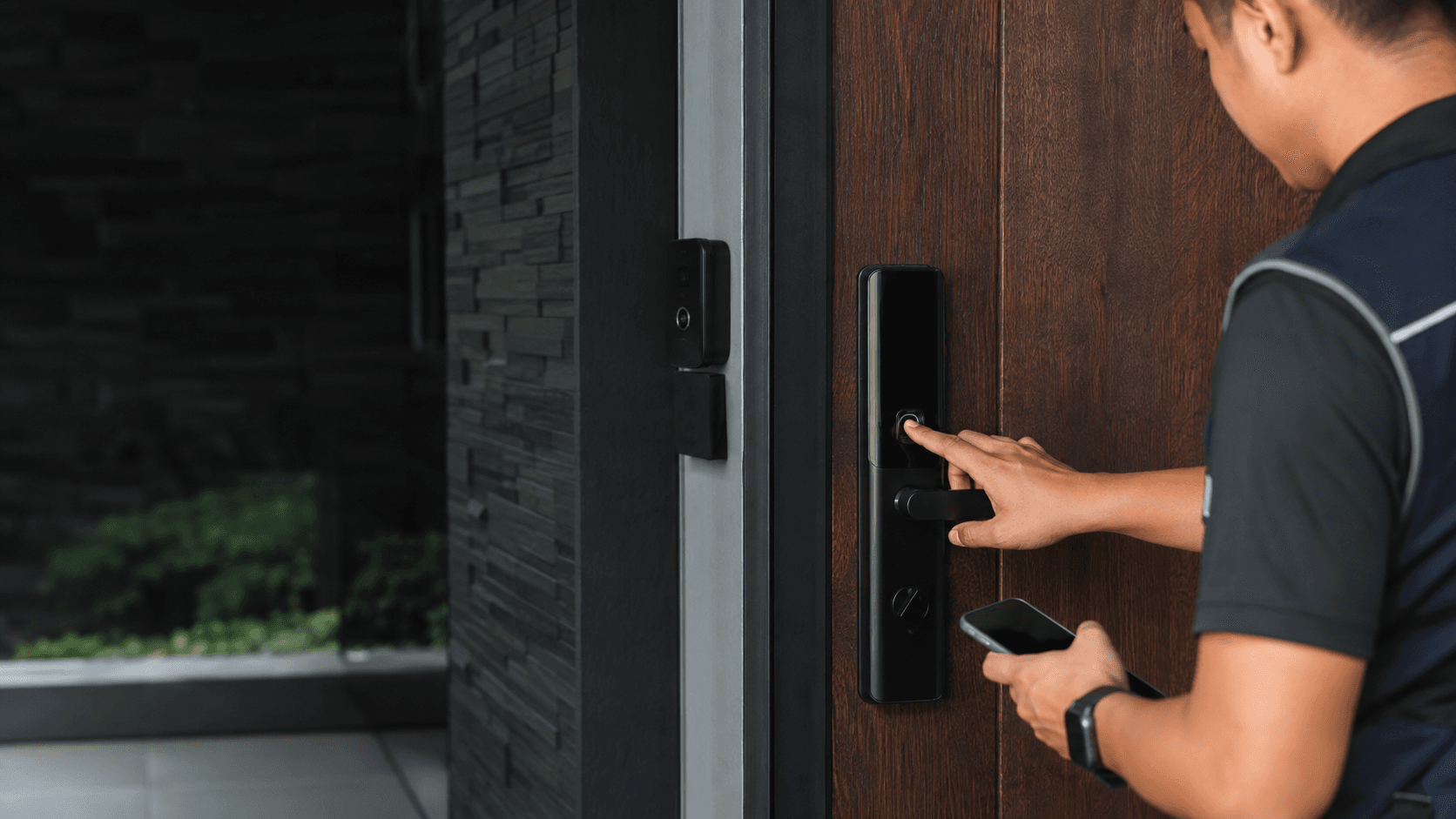
The term covers a lock that opens by credential rather than a physical key, plus a wireless link that lets an app or management platform see and change access. In Malaysia, the practical question is rarely which model looks best on a product page. It is whether the door, the people using it and the fallback when the network drops have all been settled before anything is ordered.
Electronic Door Locks Wifi. What the Term Covers
Electronic door locks wifi sit at the meeting point of two older categories. A standalone electronic lock replaces the key cylinder with a keypad, card reader, fingerprint reader or phone credential. A Wi-Fi connection adds remote status, remote unlock, and the ability to change who holds access without walking to the door.
That combination is what separates these locks from a purely offline digital lock. An offline unit still removes the key, but every change has to be made at the door. A connected unit moves that control to a phone or a management screen, which is the reason most buyers look at this category in the first place.
Eyonic's own product review describes smart lock door access as good for controlled convenience when user permissions and backup entry are planned properly. That phrasing matters. The convenience is real, but it depends on planning rather than on the lock alone.
How Wi-Fi Changes Daily Lock Use
Wi-Fi changes three daily habits: who can open a door, when that access expires, and how the person responsible finds out what happened.
On a home door, the change is small. A household member opens the door with a phone or a code instead of a key, and a visitor can be let in without a spare key being cut. On a shop or office door, the change is larger, because access is no longer a single key that gets copied. It becomes a list of people, each with a start and end point.
Remote viewing and remote unlock are the features buyers ask about most, and they are also the features most dependent on the network at the door. A lock that reports status over Wi-Fi is only as useful as the signal reaching that spot. A door at the far end of a shop lot, behind a roller shutter, or inside a concrete stairwell is a different proposition from a door beside the router.
This is where a Wi-Fi lock and a wired access control panel diverge. A panel suits a site where many doors, many users and a single record of movement matter more than fitting a lock to one existing door. A Wi-Fi lock suits a site where one or two doors need controlled convenience without a full access control build. Eyonic's review notes that for business use, the choice between a standalone smart lock and an access-control panel is usually checked case by case rather than assumed.
Door Condition, User Roles and Backup Entry
Three checks decide most installations, and all three happen before a model is chosen.
- Site survey of the actual door and its surroundings.
- System proposal covering the lock, the network path and the access roles.
- Installation and configuration on site.
- Handover, including user setup and the backup entry method.
That sequence is the one Eyonic follows on access work, and it is deliberately front-loaded. A survey answers questions that a product listing cannot: whether the door is a hollow metal frame or a solid timber leaf, whether the existing deadbolt position can take a replacement body, whether the frame closes squarely enough for a motorised bolt, and whether power or a network point can reach the lock without exposed cabling.
User roles come next. A home needs a short list and a simple way to add a helper or a family member. A shop needs a longer list with clearer boundaries, because staff turnover is the normal case rather than the exception. A commercial site may need access grouped by department, shift or contractor, with a record of who entered and when.
Backup entry is the check most often skipped and the one that causes the most trouble. Every electronic lock needs a defined way in when the battery is flat, the network is down, or the phone is lost. That may be a mechanical key override, a code held offline, or a documented process for the person who manages the site. The method matters less than the fact that it exists and that someone on site knows it.
Electronic Door Locks Wifi in Malaysian Buildings
Malaysian buildings add constraints that overseas product pages rarely mention. Shop lots, offices and homes here are built to a range of door standards, and the same lock body will not suit every leaf. A survey is the only reliable way to confirm fit.
Tenancy and building management add a second layer. A tenant fitting a lock to a rented premises may need approval, and a lock that alters the door may need to be reversible at the end of the tenancy. Where a door forms part of a building's fire or escape route, the requirements are stricter again, and those rules should be confirmed against the applicable standard rather than assumed from a supplier's description.
Network conditions are the third local factor. Wi-Fi coverage inside a shop lot or an office is not uniform, and a lock placed where signal is weak will behave differently from one placed near an access point. That is a placement question, not a lock question, and it is settled during the survey.
Eyonic has completed access and security work for sites with exactly these pressures. The Kuching Immigration Office project focused on arrival flow, staff areas, visitor movement and dependable daily operation, which is the same set of concerns a busy office or service counter brings to a door. The KTA Sarawak Sdn Bhd project covered staff movement, visitor handling, tidy cabling and clearer daily site control in a Kuching office. Both show the pattern. the door is one part of a flow, not an isolated device.
What a Site Survey Should Confirm
A useful survey produces answers, not a brochure. It should confirm the door type and condition, the existing locking hardware, the frame and its alignment, and whether the door is on an escape route or subject to building rules.
It should confirm the network path to the door and the realistic signal at that point. It should confirm how many people need access, how often that list changes, and who administers it. It should confirm the backup entry method and who holds it. It should confirm whether the site needs one controlled door or a wider access control arrangement, because that answer changes the equipment list.
Only after those points are settled does a model make sense. Without them, a buyer is choosing a lock for a door nobody has measured and a user list nobody has counted.
Electronic Door Locks Wifi. Practical Next Step
The practical next step is a survey of the actual door, followed by a proposal that names the lock, the network path and the access roles. Eyonic plans, supplies and installs security and ELV systems for homes, offices, shops and industrial sites in Sarawak, and the same survey-first approach applies to access work.
Share the location, property type and required system with Eyonic on WhatsApp at +60 11-5111 7959. For a door lock enquiry, the useful details are the door itself, the number of people who need access, and how the site should be entered when the network or the battery is not available.