
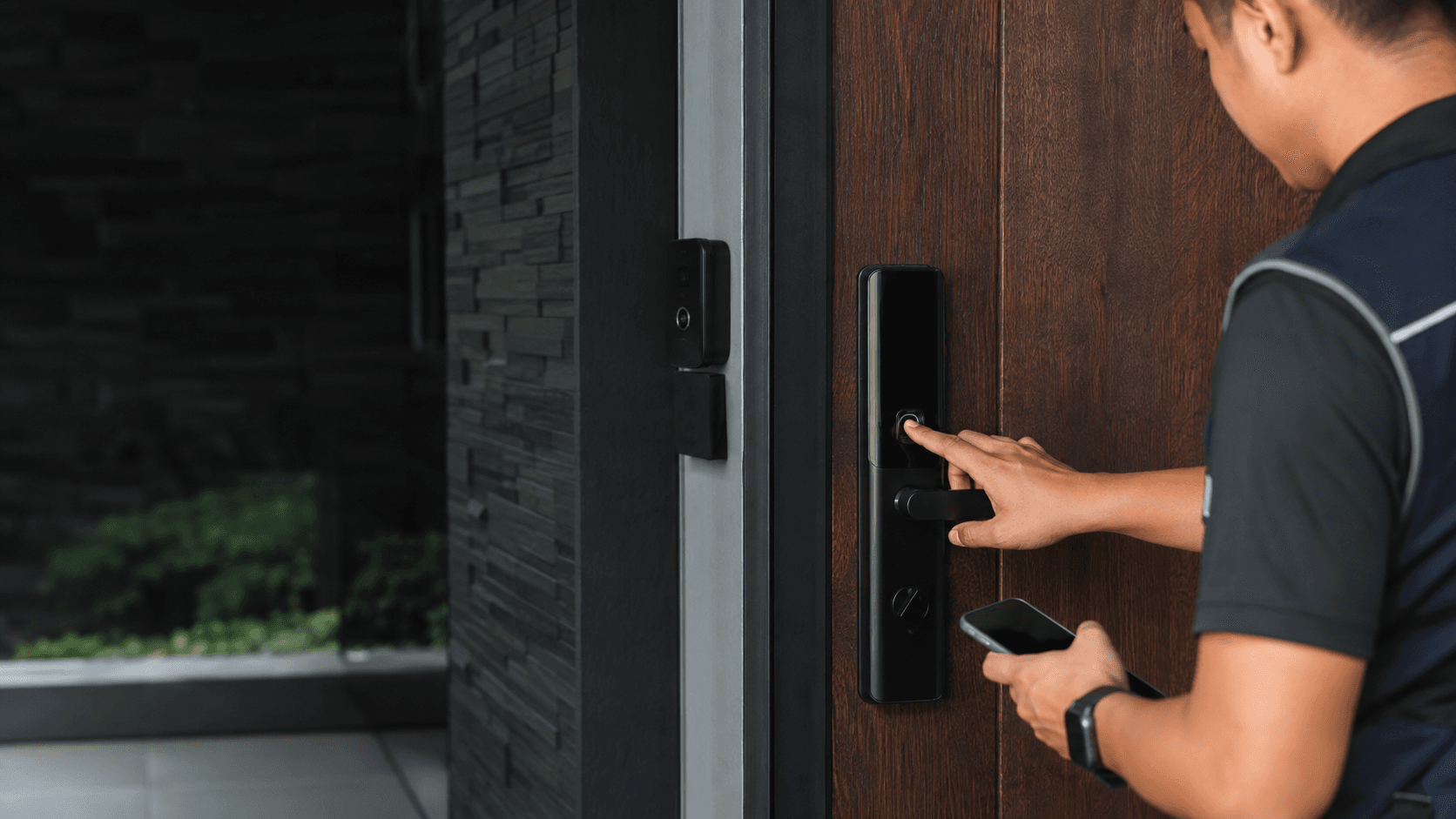
That distinction matters in Malaysia, because the two halves of the name come from different places. Kwikset builds the lock. ADT builds the panel and the monitoring service. Whether the two meet depends on the radio technology inside the lock and the panel it is meant to talk to.
Most published material on this topic is written for a North American market, where ADT sells monitored packages and Kwikset locks are stocked in the same retail channel. None of that automatically transfers to a Malaysian property. The practical questions are narrower: can the lock be sourced, will it fit the door, and does the site need a standalone lock or a managed access-control panel.
Adt Kwikset Lock. what the pairing actually covers
The phrase describes an integration, not a manufacturer. Kwikset makes residential deadbolts with keypads, motorised bolts, and wireless radios. ADT makes alarm panels and monitoring services. When the two are described together, the lock is being used as a device that the panel can see and control.
That control usually runs over Z-Wave, a wireless protocol used for home automation devices. A Z-Wave lock can be added to a compatible panel so that locking, unlocking, and user codes appear alongside other system events. The lock still works as a lock if the panel is offline, because the keypad and the bolt are local to the door.
What the pairing does not cover is the lock hardware itself. ADT does not manufacture the deadbolt. Kwikset does not provide monitoring. Any claim about one brand supporting the other rests on a specific panel model and a specific lock model, and that combination has to be confirmed rather than assumed.
Kwikset smart lock models commonly paired with ADT systems
Competitor coverage of this query clusters around a small set of Kwikset models. The names that recur are the SmartCode 914, the SmartCode 916 touchscreen deadbolt, the 919 Premis, the 888 SmartCode, and the Obsidian. These appear repeatedly in compatibility discussions, which makes them the models most likely to be referenced when someone searches for an Adt Kwikset Lock.
Recurring in the same discussions does not mean verified for a Malaysian installation. No supplied evidence confirms which of these models is stocked locally, which radio frequency variant is sold here, or which ADT panel generation they would pair with. Model numbers alone are not a compatibility guarantee.
The safer reading is that these model names are a starting point for a supplier conversation, not a shopping list. A supplier can confirm what is actually available, what radio it uses, and whether it matches the panel already on site.
Why the model number is not enough
Smart locks are often sold in more than one wireless variant. The same body and keypad can ship with different radios for different ecosystems. Two locks with similar model names can behave differently once they reach a panel.
This is the single most common source of disappointment in smart lock projects. The lock is correct, the panel is correct, and the two still do not speak to each other because the radio variant was never checked. Confirming the variant before purchase removes that risk entirely.
Door condition and user roles before any Adt Kwikset Lock installation
Door condition decides whether a smart deadbolt is a straightforward swap or a joinery problem. Smart locks are heavier than standard deadbolts and rely on a motor to throw the bolt. A door that has swollen, dropped, or been repaired around the existing lock may not accept one cleanly.
User roles decide whether a smart lock is the right category of product at all. A home with four residents needs a handful of codes and a way to remove one when someone moves out. An office with staff, cleaners, and contractors needs scheduled access, an audit trail, and a way to revoke a credential the same day.
Eyonic's own product guidance makes this distinction directly: smart locks work best when door condition, user roles, and backup method are reviewed before installation, and for business use the usual check is whether a standalone smart lock or an access-control panel is more appropriate. That is a category decision, not a brand decision, and it should be settled before any model is chosen.
- Check the door. confirm the leaf is solid, the existing bore and backset match the new lock, and the frame allows the bolt to throw without binding.
- Map the user roles. list who needs entry, how often, and whether access must be revoked on a schedule or on demand.
- Choose the backup entry method. decide how the door opens if the battery dies, the keypad fails, or the panel is offline.
- Decide standalone or panel-managed: a single door with a few users suits a standalone lock, while multiple doors, staff turnover, and audit requirements point toward an access-control panel.
Backup entry and access planning for an Adt Kwikset Lock
Every smart lock needs a way in that does not depend on the smart part. A mechanical key override is the most common. A second entrance with its own lock is another. A keypad with a known code is not a backup if the keypad is the thing that failed.
The failure modes are predictable. Batteries run down, usually without warning if nobody checks them. A panel can lose power or network. A keypad can be damaged. In each case the question is the same: how does the door open, and who holds the means to open it.
Access planning also covers removal. When a staff member leaves, their code should stop working the same day. When a tenant changes, the codes should be cleared. A lock that cannot be audited or cleared quickly becomes a liability rather than a convenience.
Where a standalone lock stops being enough
A standalone smart lock is a good fit for a home, a small office with stable occupants, or a single controlled door. It becomes awkward when several doors need consistent rules, when access has to be reviewed after the fact, or when a manager needs to see who entered and when.
At that point the conversation shifts from a lock to an access-control panel. The lock may still be part of the system, but the panel holds the rules, the schedules, and the records. Choosing the lock first and discovering this later usually means paying twice.
What Eyonic checks on a smart lock site survey
Eyonic Sdn Bhd is a security system supplier based in Sarawak, working across CCTV and ELV systems for homes, offices, shops, and industrial sites. The company's installation process runs through site survey, system proposal, installation, and handover, and the same sequence applies to a door access job.
The survey is where the door, the user roles, and the backup method get settled together. It is also where the standalone-versus-panel question is answered, because the answer depends on how many doors and how many people are involved.
Eyonic's completed work includes the Kuching Immigration Office, where the focus was arrival flow, staff areas, visitor movement, and dependable daily operation, and KTA Sarawak Sdn Bhd, where the requirement was a practical office setup supporting staff movement, visitor handling, and tidy cabling. Both are examples of access and movement being planned around how a site is actually used rather than around a single device.
For a door access job, the practical next step is to share the location, the property type, and the required system with Eyonic on WhatsApp at +60 11-5111 7959. That gives enough context to say whether a standalone lock or a panel-managed setup fits the site.
questions worth settling before purchase
The questions below are the ones that decide whether a purchase is sensible. They are worth answering in writing before any money changes hands.
Is the lock actually available in Malaysia? No supplied evidence confirms local availability, a distributor, or pricing for an Adt Kwikset Lock. That has to be confirmed with a supplier rather than assumed from overseas listings.
Does the radio match the panel? A Z-Wave lock and a Z-Wave panel are the usual pairing, but the specific variant has to be checked. This is the step most often skipped.
Will it fit the existing door? Bore diameter, backset, door thickness, and frame alignment all matter. A lock that does not seat properly will not throw the bolt reliably.
What happens when the battery dies? There should be a mechanical override or a second entrance. If the only way in is the keypad, the backup plan is incomplete.
Is a standalone lock enough, or is a panel needed? One door and a few stable users usually suit a standalone lock. Multiple doors, staff turnover, and audit requirements point to a panel.
Who supports it after installation? A lock sourced overseas without local support leaves the site dependent on whoever installed it. Local supply and local support are worth more than a lower headline price.
None of these questions require a brand decision. They require a clear picture of the door, the people who use it, and the way the site operates. Once those are settled, the choice between a standalone smart lock and a managed access-control system becomes straightforward, and the Adt Kwikset Lock question resolves into a specific, checkable answer.