
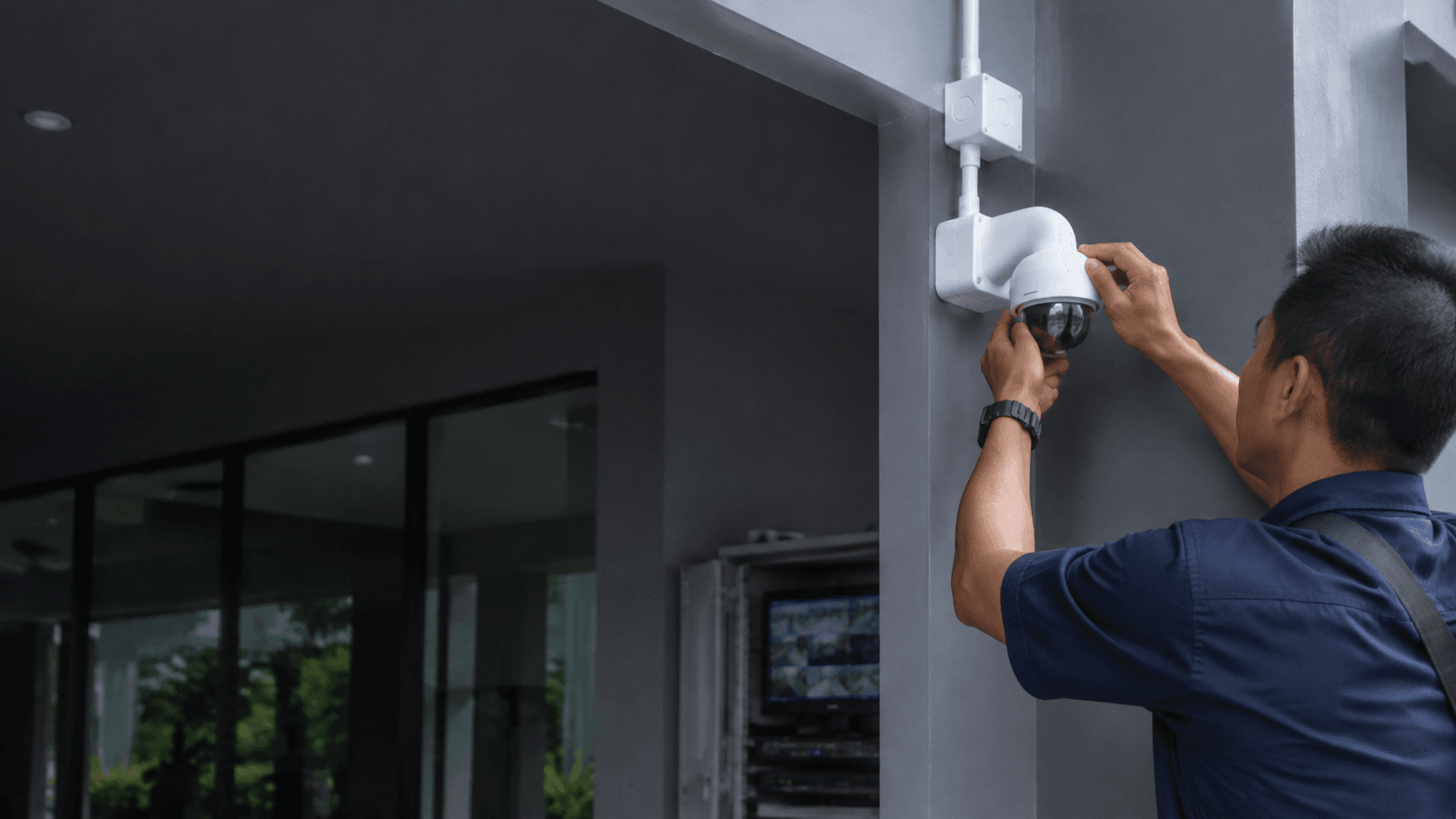
The appeal is simple. no trenching, no cable run to the fence line, and no dependence on a nearby power point. The trade-off is equally simple. A solar camera outdoor unit lives or dies by how much direct sun its panel receives, and in Sarawak that calculation changes with roof overhang, tree cover, and monsoon cloud.
Eyonic Sdn Bhd plans, supplies, and installs CCTV and ELV systems for homes, offices, shops, and industrial sites in Sarawak. The company's installation process runs through site survey, system proposal, installation, and handover, which matters here because panel placement is a survey decision, not a purchase decision.
Solar Camera Outdoor. What Matters Before You Choose
Most buyers start with resolution and end with a camera that reports low battery every few weeks. The order should be reversed. Sun exposure, mounting height, and detection range decide whether a solar camera outdoor unit performs, and resolution only matters after those three are settled.
A solar panel rated for the camera's daily consumption needs roughly consistent daylight to keep the internal battery topped up. Shade from a single branch across the panel face can cut charging enough to matter over a week of rain. That is why a site survey comes before a product list, and why Eyonic checks actual lighting conditions before confirming placement for low-light cameras such as ColorVu-style models.
Three practical numbers shape the decision:
- Confirm the panel's daily sun window at the exact mounting spot, not the general area.
- Check Wi-Fi signal strength at the camera position, since a wire-free camera still needs a stable link to the recorder or router.
- Decide the recording path — local storage, NVR, or cloud — before installation, because it changes what gets installed.
- Set the detection zone and sensitivity after mounting, so alerts reflect real movement rather than passing rain or foliage.
- Agree the handover scope, including mobile viewing setup and a walkthrough of playback.
Steps four and five are where most DIY installs stall. A camera that sends forty alerts a night gets ignored within a week, and a camera nobody can review footage from is not doing security work.
Choosing the Right Solar Camera Outdoor Setup
The right configuration depends less on brand than on where the camera points and what it must prove. A gate camera covering a driveway has different demands from a camera watching a shop's rear loading area.
Match the camera to the site condition
Open car porches, perimeter walls, and standalone gates with unobstructed sky are the strongest candidates for solar. Covered walkways, basement-adjacent walls, and shaded corridors are weak candidates, and a wired camera with a proper cable run usually costs less over time than fighting a panel that never charges.
For sites where lighting is genuinely poor at night, the camera choice matters as much as the power source. Eyonic's review guidance on ColorVu-style cameras notes that actual lighting conditions should be checked before confirming placement, because a camera marketed for low-light performance still depends on what light is physically present.
Decide what happens when the battery drops
Every battery camera has a floor. Extended rain, a dirty panel, or a misjudged angle can push a unit below its operating threshold. The practical question is whether the site can tolerate a gap in coverage. For a home gate, a gap is an inconvenience. For a commercial perimeter or a public-facing entrance, a gap is a liability, and a wired or PoE camera on a UPS-backed recorder is the more defensible choice.
Plan storage and review before installation
Wire-free cameras typically support local storage, a recorder, or a subscription cloud plan. The choice affects cost, retention length, and how quickly footage can be pulled after an incident. Deciding this during the proposal stage avoids a second visit later.
What Is a Solar Camera Outdoor System?
A solar camera outdoor system is a surveillance camera powered by an integrated or attached photovoltaic panel that charges an internal battery, removing the need for a mains connection at the camera itself. The camera still transmits video over Wi-Fi or a cellular link, and it still stores or streams footage through a recorder, memory card, or cloud service.
The distinction that matters commercially is between the power source and the data path. Solar solves power. It does not solve connectivity, storage, or detection logic, and those three are usually what determine whether a deployment is useful six months later.
Practical Considerations for Installation in Sarawak
Sarawak's climate is the dominant variable. High humidity, frequent rain, and dense vegetation around many properties mean panel soiling and shading are ongoing conditions rather than one-time setup issues.
Panel angle affects both charging and self-cleaning. A panel mounted flat collects water and debris; a panel angled toward the prevailing sun window sheds rain more effectively. Mounting height affects both security and maintenance access — a camera high enough to resist tampering may be a camera that requires a ladder and a scheduled cleaning routine.
Network coverage is the second constraint. A wire-free camera at the far end of a long driveway may have adequate sun and inadequate signal. Checking signal at the mounting position during the survey prevents a camera that records locally but cannot be viewed remotely.
Eyonic's completed work includes a project for the Kuching Immigration Office, focused on arrival flow, staff areas, visitor movement, and dependable daily operation, and a project for KTA Sarawak Sdn Bhd supporting staff movement, visitor handling, tidy cabling, and clearer daily site control. Both illustrate the same principle: camera placement follows movement patterns, not wall availability.
Making an Informed Choice About Coverage
Solar is the right answer when the mounting position has reliable sun, the site can tolerate occasional coverage gaps, and running cable is impractical or disproportionately expensive. It is the wrong answer when the position is shaded, the site needs uninterrupted recording, or the camera must operate through extended overcast periods without intervention.
A mixed approach often works best. Solar cameras cover gates, perimeter walls, and outbuildings where cabling is difficult. Wired cameras cover entrances, cash areas, and anywhere footage continuity is non-negotiable. Both feed the same recorder and the same mobile viewing setup, so the operator sees one system rather than two.
Eyonic's published packages start at RM 1,599 for a Hikvision CCTV package covering camera supply and setup, basic recording configuration, and mobile viewing handover. Alarm system and autogate packages are listed at the same starting figure. Larger commercial scopes sit well above that — the Kuching Immigration Office project carried an approximate budget of RM 12,000 to RM 28,000, and the KTA Sarawak Sdn Bhd project an approximate RM 8,000 to RM 18,000. Those ranges reflect scope, camera count, and cabling work rather than the cameras alone.
For a site in Sarawak, the useful next step is a survey that answers three questions: how much direct sun reaches the intended mounting point, how strong the network signal is there, and what happens to coverage during a week of rain. Those answers determine whether a solar camera outdoor deployment is the practical choice or whether a wired installation serves the site better.
Share the location, property type, and required system with Eyonic on WhatsApp at +60 11-5111 7959 to arrange the next practical step.