
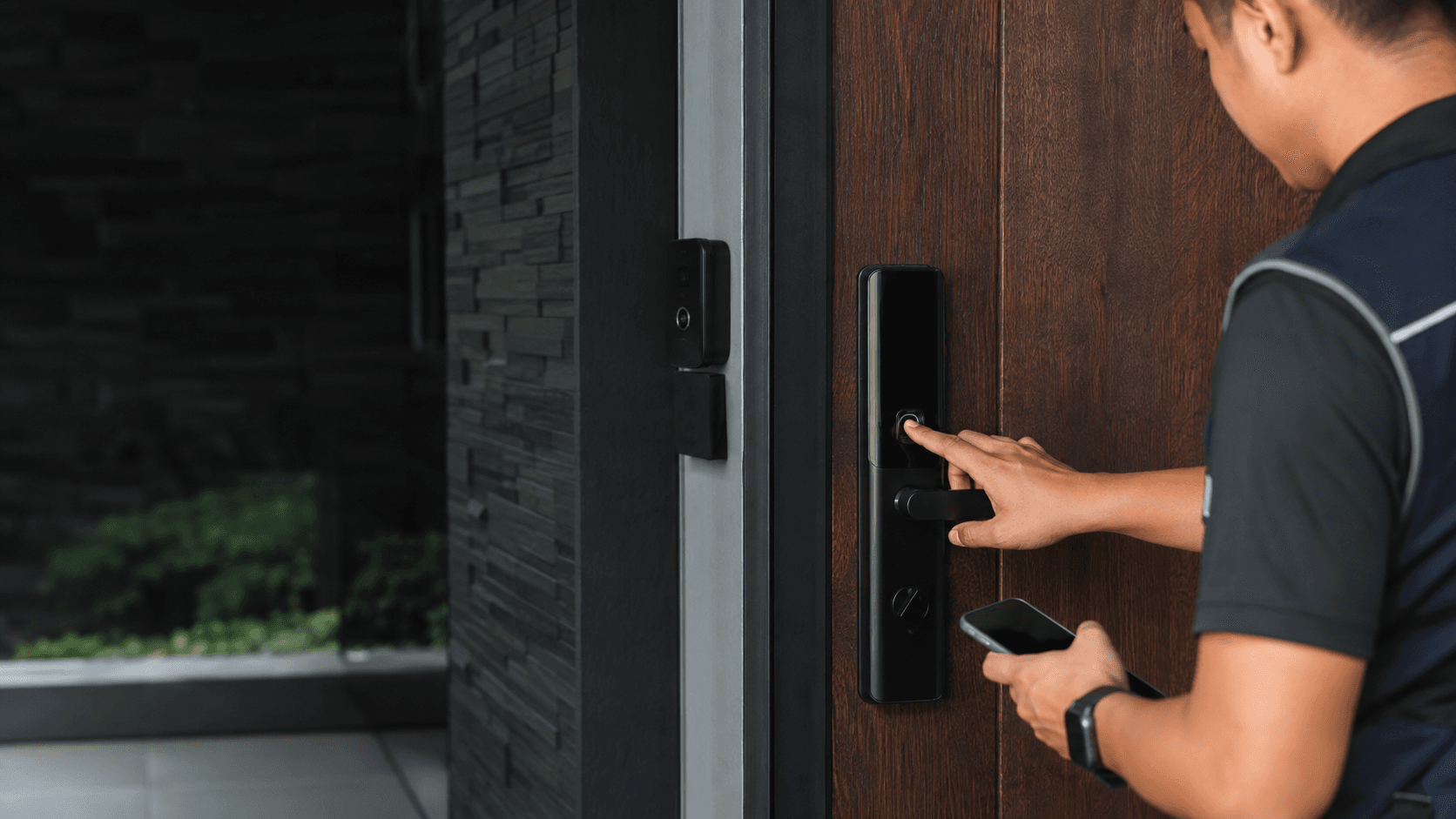
The exact-match query keyless entry apartment describes a building where residents enter without carrying a mechanical key. The term covers two different scales of hardware: a single smart lock on one unit door, and a building-wide access control system covering the main entrance, gates, lifts, and shared facilities. Confusing the two is the most common planning error, because a unit lock and a building system have different power, wiring, and management requirements.
Keyless Entry Apartment. What Matters Before Choosing
Before any hardware is selected, four questions determine which system fits. Each answer narrows the shortlist quickly.
- Count the entry points that need control — unit door only, or main entrance, gate, lift, and facility doors as well.
- Count the people who need credentials and how often that list changes, since frequent tenant turnover favours systems with easy revocation.
- Check the door itself — thickness, frame condition, existing locking hardware, and whether wiring already reaches the frame.
- Decide the backup method for power loss, phone failure, or a forgotten credential, because every keyless system needs at least one fallback.
Eyonic's own review guidance makes the same point in narrower terms: smart locks work best when the door condition, user roles, and backup method are reviewed before installation. For business use, the company checks whether a standalone smart lock or an access-control panel is more appropriate. That distinction applies directly to apartment buildings, where a single unit door and a shared lobby entrance rarely suit the same product.
What Is Keyless Entry Apartment Access?
A keyless entry apartment is a residential unit or building where door access is granted by a credential other than a cut metal key. The credential may be a numeric code entered on a keypad, a card or fob tapped on a reader, a fingerprint, or a digital credential held in a smartphone app or mobile wallet.
The mechanism differs by type. Keypad and PIN systems store codes in the lock or controller and grant access when the entered code matches. Card and fob systems read a short-range radio tag and check it against a list. Mobile credential systems use Bluetooth Low Energy or NFC so a phone can present the credential, and biometric systems compare a stored fingerprint or face template. Multi-factor setups combine two of these, such as a card plus a PIN.
What all types share is that access is a data record rather than a physical object. That is the practical difference from a key: a credential can be issued, limited by time, and revoked without changing any hardware.
Key Fobs and Keys Compared With Keyless Entry
A traditional key or fob is a physical token. Losing it means either the lock is rekeyed or the loss is accepted as a risk. A keyless credential can be deleted from the system the same day, and a temporary code can be set to expire on its own. The trade-off is dependence on power, network, and working electronics, which is why backup entry planning is not optional.
Keyless Entry for Apartments. How Mobile Access Works
Mobile access turns a smartphone into the credential. The resident installs an app or adds a digital pass to a mobile wallet, and the phone communicates with a reader at the door using Bluetooth Low Energy or NFC. The reader sends the credential to a controller, the controller checks it against the current permission list, and the door releases if the credential is valid and active.
Because the permission list lives in software, a property manager can add a new resident, set a cleaner's access to weekday mornings only, or revoke a credential after move-out without touching the door. Audit logs record which credential opened which door and when, which is useful for deliveries, shared facilities, and disputes.
Mobile-first is not the same as mobile-only. A building that relies entirely on phones creates a failure case every time a battery dies or a resident changes devices. Mixed credential support — a keypad code or a card alongside the app — keeps entry working when a phone does not.
Where Mobile Access Fits and Where It Does Not
Mobile access suits buildings with frequent turnover, shared amenities, and residents who expect app-based control. It fits less well where residents include people who do not use smartphones, where network coverage at the door is unreliable, or where the door hardware cannot accept a reader without replacement. In those cases a keypad or card system delivers most of the management benefit with fewer dependencies.
Practical Considerations for Keyless Entry Apartment Systems
Reliability planning separates a system that works on installation day from one that still works two years later. Three areas carry most of the risk.
Power and network resilience. Electronic locks and controllers need power, and cloud-managed systems need a network path. Battery-backed locks and controllers with backup power keep doors working during an outage. Where a system depends on the internet for permission checks, a local fallback or offline credential cache prevents a network fault from locking residents out.
Emergency egress. Exit requirements are set by building codes and the authority having jurisdiction, and they take priority over convenience features. A door that must open freely in an emergency cannot be held shut by an access system, so the hardware choice follows the egress requirement rather than the other way around.
Door and frame compatibility. Existing locking hardware, door thickness, frame condition, and available wiring determine whether a retrofit reader fits or the door needs modification. This is the point where a site survey saves money, because a compatibility problem found after purchase is more expensive than one found before.
Eyonic's installation process follows a comparable sequence for its security work: site survey, system proposal, installation, and handover. The same order applies to access control, since the survey is what confirms door condition and wiring before any product is committed.
Cost Factors and Budget Ranges
Cost depends on the number of doors, the credential type, whether wiring exists, and whether the system is standalone or centrally managed. Eyonic publishes package pricing for related security work at RM 1,599 for a Hikvision CCTV package, RM 1,599 for a Hikvision alarm system, and RM 1,599 for an autogate package, each covering supply, setup, and handover. Access control is quoted per site because door count and condition vary too widely for a fixed package.
For larger multi-door work, Eyonic's completed projects give a sense of scale. The Kuching Immigration Office project, covering arrival flow, staff areas, visitor movement, and dependable daily operation, had an approximate budget of RM 12,000 to RM 28,000. The KTA Sarawak Sdn Bhd office project in Kuching, covering staff movement, visitor handling, tidy cabling, and clearer daily site control, had an approximate budget of RM 8,000 to RM 18,000. Both figures describe office projects rather than apartment buildings, so they indicate the range for multi-door commercial work rather than a residential quote.
Visitor Delivery and Vendor Access
Shared buildings need a way to admit people who are not residents. Common approaches are a temporary PIN that expires after a set window, a QR code sent to a visitor's phone, or a video intercom that lets a resident see and release the door remotely. Each has a different failure mode: temporary codes can be shared onward, QR codes depend on the visitor's phone, and intercom release depends on the resident being available. Buildings with frequent deliveries often combine a time-limited code for the delivery window with a log that records when the door was opened.
Making an Informed Choice About Access
The decision comes down to matching the credential type to the building's actual constraints. A single unit door with an existing deadbolt and no wiring is a smart lock decision. A building with a shared lobby, a gate, and a lift is an access control decision, and it needs a survey before a product list.
Two limits are worth stating plainly. First, no keyless system removes the need for a backup entry method, whether that is a mechanical override, a managed master credential, or a documented emergency procedure. Second, biometric credentials raise privacy considerations that PIN and card systems do not, so opt-in consent and clear communication about what data is stored matter as much as the hardware choice.
For properties in Sarawak, Eyonic Sdn Bhd plans, supplies, and installs security and ELV systems for homes, offices, shops, and industrial sites, and lists smart lock door access among its product reviews. The company's founder, Eric Yong, has worked in technical installation of digital security solutions for commercial businesses in Sarawak for more than 10 years. A site survey is the practical first step, because door condition, user roles, and backup method determine which system is appropriate.
Share the location, property type, and required system with Eyonic on WhatsApp at +60 11-5111 7959 for the next practical step.