
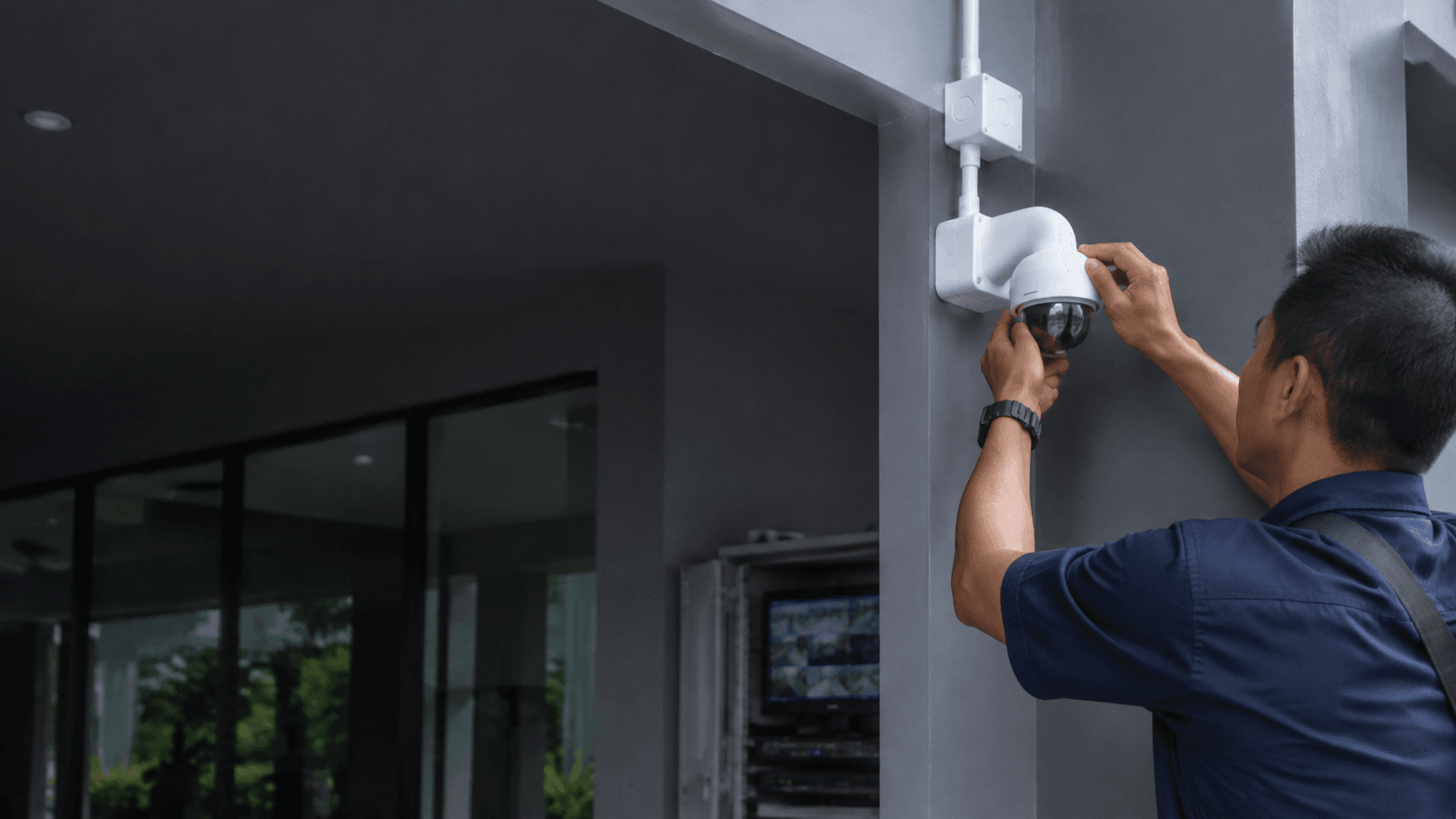
The work behind cctv services is mostly planning. A camera on the wrong wall records the wrong thing, and no amount of resolution fixes that. Eyonic Sdn Bhd plans, supplies and installs monitoring systems, and the process starts before any hardware is chosen.
Cctv Services in Malaysia. What the Work Actually Covers
Cctv services in Malaysia range from a single-camera shop setup to multi-point coverage across an office floor. The scope usually settles into five areas: deciding where cameras go, running cable and mounting hardware, configuring the recorder, setting up remote viewing on phones, and handing the finished system to the people who will use it daily.
Eyonic works across homes, offices, shops and industrial sites, so the same service label covers very different jobs. A shop needs counter and entrance coverage. An office needs staff areas and visitor movement. An industrial site needs perimeter and loading points. The camera count and placement change with each, but the sequence does not.
Repair and troubleshooting sit alongside new installation in most Malaysian markets, and the competitor set reflects that. Password resets, recorders that stop writing, and cameras that drop offline are common service calls. Those are separate from a fresh installation and usually need the existing system identified before any work starts.
How a Site Survey Shapes Camera Placement
A site survey is a walkthrough that decides camera positions before purchase. It looks at entry points, movement paths, existing cabling routes, power availability and lighting at the times the site is actually occupied.
Camera placement follows from what the survey finds. A camera aimed at a doorway from across a bright lobby will silhouette every face that walks in. The same camera mounted lower and closer to the door captures identification instead. Neither position is universally correct; the survey decides which applies.
Two practical constraints shape most surveys. First, cable routes: existing conduit and ceiling access decide whether a position is cheap or disruptive to reach. Second, recorder location: the NVR needs power, network and a place that is not trivially accessible to anyone on site. Both are settled on the walkthrough, not after drilling starts.
What the Survey Should Record
A useful survey notes entry and exit points, staff-only areas, cash or asset locations, visitor routes, and any spot where lighting changes sharply between day and night. It also notes where cabling can follow existing paths rather than new ones.
The Four Stages of a CCTV Installation
Eyonic's installation process runs through four stages, and each one produces something the next stage depends on.
- Site survey. A walkthrough of the property to map entry points, movement, lighting and cable routes, and to confirm what the system needs to cover.
- System proposal. A written plan covering camera positions, recorder choice, storage approach and remote viewing, matched to what the survey found.
- Installation. Mounting, cabling, recorder configuration and network setup, carried out to the agreed positions.
- Handover. Walking through live and recorded views, confirming remote access works on the owner's devices, and explaining how to review footage.
The proposal stage is where most cost variation appears. Camera count, cable distance and whether existing infrastructure can be reused all move the number. A quote given without a survey is a guess about all three.
NVR Setup and Remote Viewing
NVR setup covers recording schedules, storage retention and how footage is searched later. Remote viewing is configured so the system can be checked from a phone, which requires the recorder to sit on a network with working outbound access. Both are finished before handover, not left as a follow-up visit.
What Lighting Conditions Change Before Placement
Lighting decides whether a camera records usable detail or just movement. Eyonic recommends checking actual lighting conditions on site before confirming placement, particularly for ColorVu-style cameras that are chosen for low-light performance.
The check matters because lighting is not uniform. A corridor lit at 8am may be dark by 7pm. A car park with floodlights may be well lit only when someone remembers to switch them on. A camera placed for the bright version of a scene can fail at the hour the site is most exposed.
Three conditions usually change a placement decision:
- Backlight. A camera facing a bright window or entrance will expose for the light and darken the subject. Moving the camera or changing its angle fixes this without new hardware.
- Mixed light. Areas lit partly by daylight and partly by artificial light shift colour and contrast through the day, which affects how consistently a scene is recorded.
- Unlit periods. Where a site is dark for part of the night, the camera choice has to match that reality rather than the daytime view.
None of this is settled by a specification sheet. It is settled by standing on site at the right hour.
A Completed Public Office Project in Kuching
Eyonic completed a project for the Kuching Immigration Office, focused on arrival flow, staff areas, visitor movement and dependable daily operation. The requirement was practical support for a public office rather than a showcase installation.
Public buildings put specific pressure on a camera system. Arrival and visitor movement has to be covered without obstructing it. Staff areas need coverage that respects how those spaces are used. And the system has to keep running every working day without someone babysitting it.
The approximate budget for that type of work is RM 12,000 to RM 28,000. A separate project for KTA Sarawak Sdn Bhd, an engineering consultancy, covered a practical office setup in Kuching supporting staff movement, visitor handling, tidy cabling and clearer daily site control, with an approximate budget of RM 8,000 to RM 18,000.
For smaller jobs, Eyonic lists a Hikvision CCTV Package at RM 1,599 covering camera supply and setup, basic recording configuration and mobile viewing handover. That package suits a straightforward single-site installation; it is not a substitute for a surveyed multi-point system.
What to Prepare Before Requesting a Survey
Preparation shortens the survey and improves the proposal. Four things are worth having ready.
- Location and property type. Whether the site is a home, office, shop or industrial premises, and where it sits.
- What needs covering. Entrances, counters, stock areas, staff rooms, perimeter, or a combination.
- How the system will be used. Live monitoring only, or recorded footage reviewed after an incident.
- Existing infrastructure. Any current cameras, cabling, network points or recorder already on site.
Existing systems are the most common complication. Where cameras are already installed, the survey has to establish whether they can be reused, replaced, or integrated, and that decision affects both cost and timeline.
Eyonic is based in Sarawak and the documented project work sits in Kuching. Sites outside that area should confirm coverage before scheduling.
Where the Cost Comes From
Cost tracks three variables. how many cameras are needed, how far cable has to run, and whether existing infrastructure can be reused. A single-camera addition to a wired site costs far less than a fresh multi-point installation with new cabling. The RM 1,599 package covers the straightforward end of that range; surveyed office and public-building work sits in the RM 8,000 to RM 28,000 band shown by the two documented projects.
Service-only and repair pricing is not published, because the work depends on what is already installed and what has failed.
Choosing Between Providers
The clearest difference between providers is whether a survey happens before a price is given. A provider that quotes from a phone description is guessing at camera count, cable distance and lighting. A provider that walks the site first is pricing the actual job.
The second difference is handover. A system is only finished when the people using it can review footage and check remote viewing without calling for help. That step is worth confirming in advance.
Share the location, property type and required system with Eyonic on WhatsApp at +60 11-5111 7959 to arrange the next practical step.