
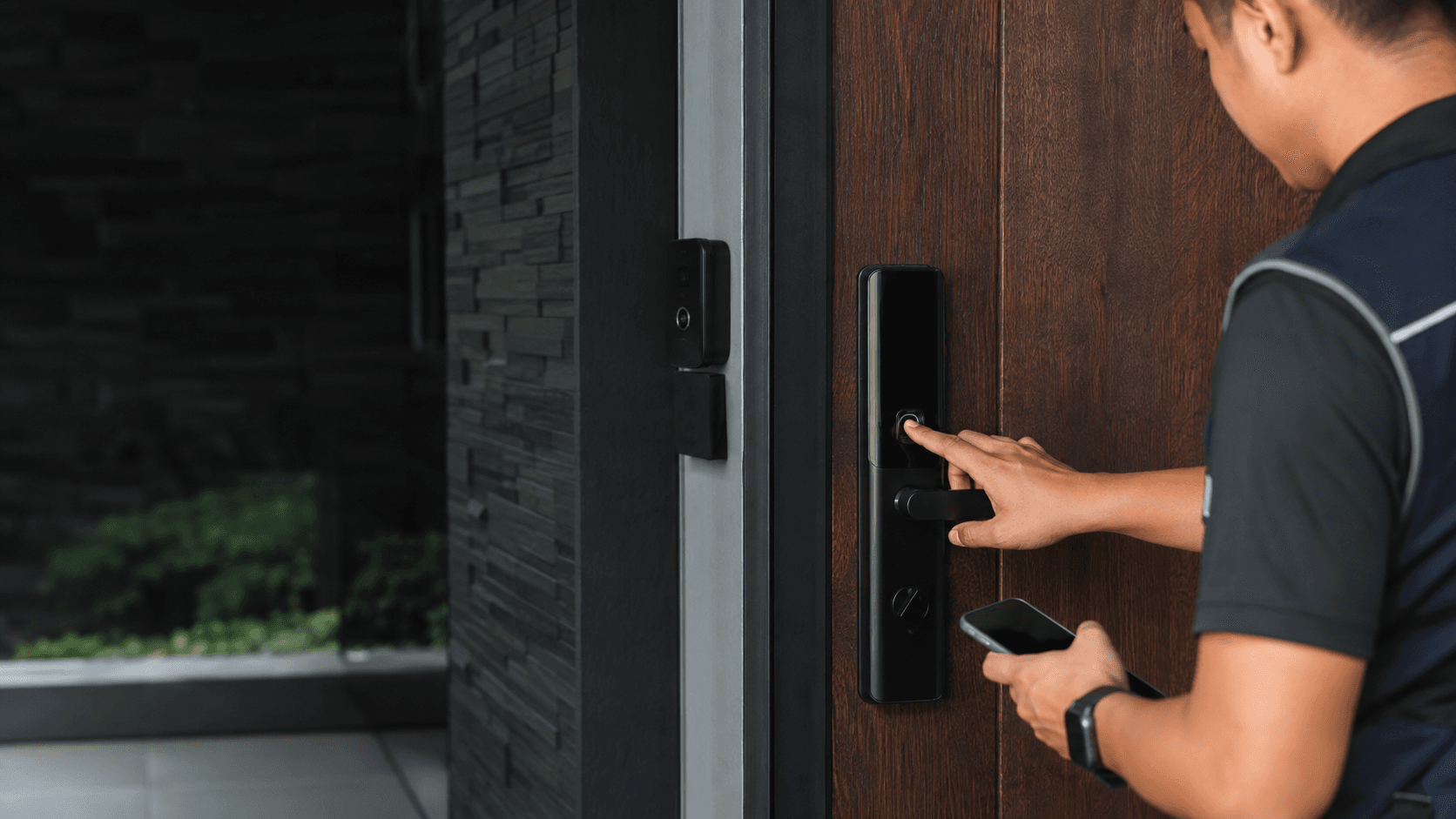
The Latch Door App belongs to a category of app-based door access that pairs a phone with a physical lock or controller. Latch hardware and the Latch app were documented on the App Store and Google Play listings, and the vendor page at door.com states that Latch is now DOOR and that the Latch App is now the DOOR App. That naming shift matters for anyone searching the older term, because support articles and app store listings may still carry the Latch name while the current product documentation uses DOOR.
What the Latch Door App Does
The app is the control layer. The lock or reader is the physical layer. Competitor listings describe the app handling keyless entry, doorcode access, access recording, and letting someone in remotely. The Google Play listing summarised the product as being free of keys and able to let someone in while away from the property.
For a Malaysian property, the practical question is not what the app screen looks like but which door it controls and who is allowed through it. App-based door access splits into two broad patterns. A standalone smart lock serves one door and one small group of users. An access control panel serves many doors, many users, and a building-wide permission structure. Eyonic's own product review notes that for business use, the choice between a standalone smart lock and an access-control panel is usually checked before installation, and that smart locks work best when door condition, user roles, and backup method are reviewed first.
User permissions are the part that decides whether the system stays manageable. A household needs a handful of roles. An office with staff, cleaners, contractors, and visitors needs a structure that can be changed without reissuing physical keys. Remote viewing and access logs are useful only if someone actually reviews them.
Latch Door App Hardware and Connectivity
App-based door access depends on three things working together: the lock or controller, the network path between that device and the app, and the phone itself. Competitor app listings reference Bluetooth connectivity issues, offline mode, and backup access as recurring themes in user feedback. Those are the failure points to plan around rather than discover later.
Connectivity design should match the building. A single residential door can often rely on the phone's own connection to the lock. A commercial entrance with multiple users and a need for central records usually needs the controller to sit on a stable network so permissions and logs stay current. Where the network drops, the door still has to open for the people who need to get through.
Door condition is a constraint that gets overlooked. Lock bodies, door thickness, frame alignment, and existing wiring all affect what can be fitted and how much work the installation involves. Eyonic's smart lock review places door condition alongside user roles and backup method as the three things to check before installation, which is a reasonable order because a door that cannot take the hardware makes every later decision moot.
Eyonic's own installation work follows a site survey, system proposal, installation, and handover sequence, and the same logic applies to door access. A survey confirms what the door can accept, where power and network reach, and how many separate entry points are involved. The Kuching Immigration Office project is an example of that approach applied to a public building, where arrival flow, staff areas, visitor movement, and dependable daily operation shaped the design.
What to Compare Before Choosing a Latch Door App
Comparison should start with the property, not the app. The checks below are the ones that change the answer most often.
- Door condition. confirm the door, frame, and existing hardware can accept the lock or controller, and check whether wiring or power is already present.
- User roles. list every group that needs entry, including staff, tenants, cleaners, contractors, and visitors, and decide how each group is added and removed.
- Backup entry method. agree on what happens during a network outage, a flat phone battery, or a failed device, and who holds that fallback.
- Connectivity. confirm the network path at each door and whether the controller needs a stable connection for permissions and logs to stay accurate.
- Handover testing. test every user role, the backup route, and the access records before the system is treated as live.
Two further comparisons sit outside that list. The first is standalone versus panel-based access control, which decides whether the property is buying a lock with an app or an access system with a management layer. The second is who supports the installation locally. A system that cannot be serviced on site becomes a liability the first time a door stops responding.
Cost is a real constraint, and it is worth being clear about what is and is not known. Eyonic publishes package pricing for a Hikvision CCTV package, a Hikvision alarm system, and an autogate package at RM 1,599 each, and its completed project budgets have ranged from RM 8,000 to RM 18,000 for an office setup and RM 12,000 to RM 28,000 for a public office. Those figures cover different scopes and are not a Latch Door App price. No verified pricing for Latch Door App hardware in Malaysia was available for this article, so any budget should be built from a surveyed scope rather than a published number.
Latch Door App Setup and Handover
Setup is where an app-based door access project either becomes routine or becomes a support burden. The sequence that works is the same one Eyonic uses on its installation work: survey, proposal, installation, then handover. Skipping the survey is the most common cause of a door that needs rework.
Handover deserves more attention than it usually gets. Every user role should be tested on the actual door, not described on paper. The backup entry method should be tested with the network deliberately disconnected. Access records should be checked to confirm the events that matter are actually being captured. Where a property has staff turnover, the person who manages permissions should be shown how to add and remove a user before the installer leaves.
Documentation matters for the same reason. A short record of which door is on which controller, how the backup route works, and who to contact when something fails will outlast any handover briefing.
Latch Door App Limitations and Backup Entry
App-based door access has limits that are worth stating plainly. A phone is a single point of failure for the person holding it. A network outage can interrupt remote functions even when local entry still works. Older residents, visitors without smartphones, and anyone who cannot use a mobile app need a route through the door that does not depend on the app at all.
Competitor app store feedback referenced accessibility concerns and offline mode, which reflects the same issue from the user side. The design answer is a backup entry method that is independent of the app: a physical key, a code, a card, or a staffed entry point. Which one is appropriate depends on the property, but the decision should be made before installation rather than after the first outage.
There is also a naming caveat. The vendor page states that Latch is now DOOR and that the Latch App is now the DOOR App, and a support article on migrating from Latch to DOOR exists in the vendor's help centre. Anyone specifying the Latch Door App today should confirm which app and which hardware generation the property is actually being quoted, because the older name still appears across app store listings and support material.
For properties in Sarawak, Eyonic plans, supplies, and installs security and ELV systems for homes, offices, shops, and industrial sites, and its project work has covered both a public office and an engineering consultancy office in Kuching. Share the location, property type, and required system with Eyonic on WhatsApp at +60 11-5111 7959 for the next practical step.