
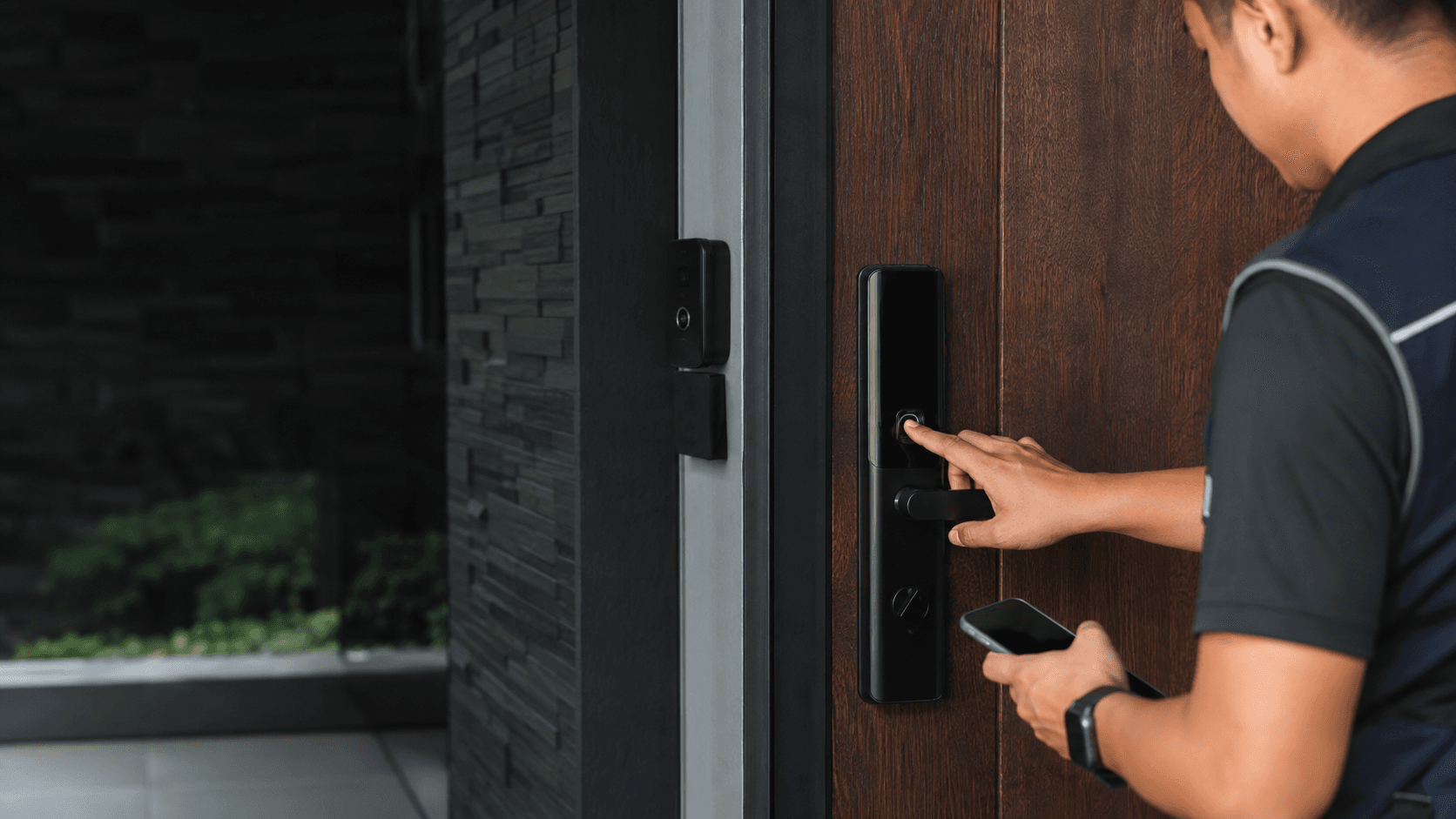
The phrase sits at a confusing intersection. Some readers picture a physical U-shaped bolt. Others have seen the ULTRALOQ U-Bolt in a review and want to know what it does. Both readings are reasonable, and the practical questions that follow are the same: what the lock actually is, how it differs from an ordinary deadbolt, which entry methods it supports, whether the door can take it, and what happens when the electronics or the battery fail.
U bolt door lock. what the term covers
In the live results for this query, the term is dominated by the ULTRALOQ U-Bolt smart deadbolt family from U-Tec, alongside review and roundup pages that compare it with other smart deadbolts. That means a search for a U bolt door lock is usually a search for a specific product line rather than for a generic hardware category.
The naming is not a description of the bolt's cross-section. It is a product name. A reader who expects a hardware-shop term for a U-shaped bolt will instead land on smart deadbolt pages, which is why the intent mixes product identification with model comparison and keyless entry evaluation.
Two things are worth separating before any buying decision. First, whether the lock is a standalone smart deadbolt or part of a wider access-control setup. Second, whether the entry is a home front door, a shop lot, an office, or a rental unit, because the same lock behaves differently across those settings.
How a U bolt door lock differs from a standard deadbolt
A standard deadbolt is mechanical. A key turns a cylinder, the bolt extends into the strike, and the lock does nothing else. A U bolt door lock in the ULTRALOQ sense keeps the deadbolt form factor but adds electronic authentication, so the bolt can be driven by a fingerprint, a code, an app command, or a physical key.
The mechanical core still matters. The electronic layer decides who may retract the bolt; the bolt, the strike, and the door frame decide how much resistance the assembly offers once it is extended. A smart lock fitted to a door with a weak frame or a shallow strike does not become stronger because it has a fingerprint reader.
There is also an operational difference. A mechanical deadbolt has no battery, no firmware, and no user list. A U bolt door lock introduces all three, which means someone has to own the user list, replace batteries, and decide what happens when the lock is offline.
Keyless entry methods found across U bolt door lock models
Across the ULTRALOQ U-Bolt pages and the review coverage, the recurring entry methods are fingerprint access, an access code on a keypad, a smartphone app, and a physical backup key. Some models add hands-free or proximity unlocking, and some add smart-home integration through platforms such as Apple Home, Alexa, Google Assistant, SmartThings, Z-Wave, or Matter.
The differences between models are mostly about which of those methods are present and whether remote management needs a separate bridge or hub. That distinction matters more than the headline feature list, because remote access and access logs are the features that usually require the extra hardware.
For a household, fingerprint access plus a code plus a backup key covers most daily situations. For a business, the deciding factor is usually whether access needs to be granted, scheduled, and revoked remotely, which pushes the decision toward a model with remote management or toward a separate access-control panel.
Door condition and user roles before a U bolt door lock is installed
Eyonic's own product review guidance states that smart locks work best when the door condition, user roles, and backup method are reviewed before installation, and that for business use the choice between a standalone smart lock and an access-control panel should be checked first. That sequence is the useful part, because it front-loads the two things that most often force a change of plan.
Door condition covers whether the existing bore and backset suit a deadbolt replacement, whether the door and frame are solid enough for the strike to hold, and whether the door is exposed to weather. User roles cover how many people need regular access, whether any of them need time-limited access, and who removes a user when someone leaves.
- Check the door first. confirm the existing deadbolt bore, the backset, and whether the door and frame are sound enough for the strike to hold.
- List the user roles. separate permanent users, occasional visitors, and anyone who needs access for a limited period only.
- Choose the entry methods. decide which combination of fingerprint, access code, app, and physical key the property actually needs.
- Plan the backup entry. agree how the door opens if the battery is flat, the lock is offline, or the app is unavailable.
- Agree daily operation. settle who manages users, who replaces batteries, and how access is removed when a person no longer needs it.
For a business, the same checks apply but the user list changes more often, which is where a standalone smart lock and an access-control panel start to diverge. Eyonic's review guidance notes that this comparison is usually worth making before committing to either.
Backup entry and daily operation for a U bolt door lock
Backup entry is the part of the plan that gets tested least and matters most. The ULTRALOQ material describes a mechanical key as one of the unlock methods, and some models also describe a micro-USB backup power option. Those are the two fallbacks to confirm for whichever model is chosen, because they cover different failures: a flat battery and a lock that will not respond.
Daily operation is quieter but just as important. A fingerprint reader needs enrolled prints that actually read reliably for the people using the door. A keypad needs codes that are changed when someone leaves. An app needs a working network if remote access is part of the routine. None of these are installation problems; they are habits that have to be assigned to a person.
There is a genuine trade-off here. More entry methods mean more convenience and more ways for the door to be opened, so each method added should answer a real need rather than pad a feature list. A household with three regular users and a cleaner does not need the same configuration as a shop lot with rotating staff.
Practical next step for a U bolt door lock in Sarawak
For a property in Sarawak, the practical sequence is a site check before a product decision. Eyonic's installation process runs through site survey, system proposal, installation, and handover, and that order suits door access as well as it suits cameras, because the door condition and the user roles determine what will actually work.
Eyonic's completed work includes the Kuching Immigration Office project, which focused on arrival flow, staff areas, visitor movement, and dependable daily operation, and the KTA Sarawak Sdn Bhd project, which covered staff movement, visitor handling, tidy cabling, and clearer daily site control. Both are examples of access and movement being planned around how a building is actually used rather than around a product list.
Eyonic's published packages are priced at RM 1,599 for the Hikvision CCTV package, RM 1,599 for the Hikvision alarm system, and RM 1,599 for the autogate package. Those figures cover those three systems and do not represent U bolt door lock pricing, which is not published.
Share your location, property type and required system with Eyonic on WhatsApp at +60 11-5111 7959 for the next practical step.