
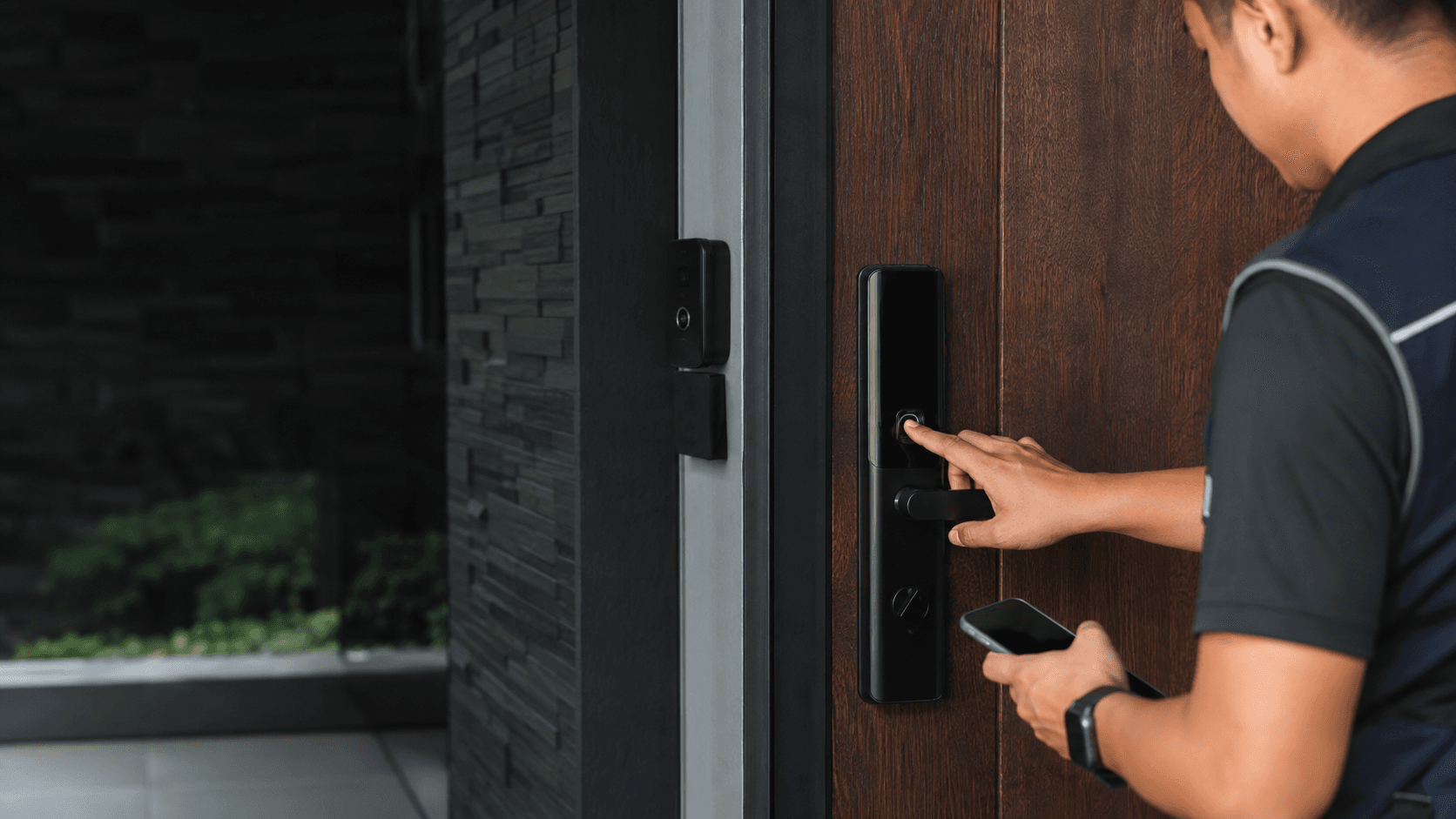
U-tec builds its locks around keyless entry rather than keys, and the range covers deadbolts, latch-style locks and bundles. The company also sells smart cameras, plugs, dimmers and lighting under the same account, so a lock purchase often sits inside a wider smart-home plan.
For buyers in Malaysia, the practical question is rarely whether a Utec Smart Lock can open a door. It is whether the lock suits the door, the people who use it, and the way the property is managed day to day.
Utec Smart Lock. What Matters Before You Choose
A Utec Smart Lock replaces a keyed cylinder with a mix of fingerprint, code, phone, watch, card or fob entry, depending on the model. The lock still needs a physical door that can accept it, a power source, and a fallback method for the day the electronics fail.
U-tec's own product pages describe the range in three broad shapes: deadbolt, latch, and bundle. Deadbolts replace an existing deadbolt position. Latch models suit doors that use a latch rather than a separate deadbolt. Bundles combine a lock with other U-tec devices.
Three things decide whether a specific model fits:
- Door condition — thickness, backset, bore hole size and whether the frame closes cleanly.
- Entry methods required — fingerprint, PIN code, phone app, watch, card, fob or physical key.
- Backup and recovery — what happens when the battery drains or a user loses access.
U-tec's own guidance on smart locks makes the same point in operational terms: locks work best when door condition, user roles and backup method are reviewed before installation. For business premises, the choice between a standalone smart lock and a wider access-control panel is a real fork in the road, not a formality.
Choosing the Right Utec Smart Lock
Model names matter less than the entry method list. U-tec's catalogue separates products by how the door is unlocked and what the lock connects to.
Fingerprint models store prints locally on the lock and unlock on contact. NFC and card models suit people who prefer a tap over a scan. Wi-Fi models connect directly to a network, while Matter-over-Thread models join a Thread border router and work with Matter-compatible platforms. Apple Home Key support appears on selected models for wallet-based unlocking.
Connectivity choice has consequences. A Wi-Fi lock needs usable signal at the door. A Thread lock needs a border router in the home. A Bluetooth-only lock needs a phone nearby for remote functions, or a bridge accessory. U-tec sells a Bridge Wi-Fi Adaptor and a Door Sensor as separate accessories, which indicates that some functions depend on add-ons rather than the lock alone.
Accessories also matter for fit. U-tec lists thick-door kits for specific series, deadbolt cover plates for particular models, and key cards and fobs for tap-based entry. A lock that fits a standard door may still need a kit for a thicker door, and the kit is series-specific rather than universal.
What is utec smart lock?
Utec Smart Lock is the consumer-facing name for U-tec's smart lock products, most of which carry the ULTRALOQ brand. The line includes the U-Bolt and U-Bolt Pro deadbolt series, the Latch 5 series, and the Bolt series, which includes fingerprint, NFC and Matter-over-Thread variants.
The locks are designed for keyless daily use. U-tec's product copy describes auto-lock behaviour, temporary access sharing for guests, cleaners and service providers, and app-based control from a phone. The same app, now branded Xthings Home, manages locks, cameras and other U-tec devices in one place.
U-tec is headquartered in California and ships primarily within the United States through its own store. That distribution detail matters for buyers outside the US, because warranty handling, returns and support channels follow the point of sale rather than the product name.
U-tec Smart Home. Smart Lock, Smart Camera And Home Products Store
U-tec positions itself as a smart-home store rather than a lock-only brand. The catalogue runs across locks, cameras, lighting, plugs, dimmers and accessories, with bundles that combine categories.
The camera line sits under the Ulticam name, with models including the Ulticam Dot, Ulticam IQ and Ulticam IQ 4G. Lighting includes the Bright A19 Color bulb and Matter lighting options. Power and control accessories include the UTEC Matter Plug, smart dimmer switches and a 35W charger.
Bundles are a visible part of the store structure. U-tec lists a Front Door Bundle, a Matter Guardian Pack, a Bolt Home Key 2-Pack, and Air Property Manager Packs aimed at rental management. The property-manager packs point to a specific use case: short-term rental hosts who need to issue and revoke access without meeting guests.
For a buyer already running cameras or an alarm system, the appeal of a single app is real but limited. U-tec devices work with Amazon Alexa, Google Home, Samsung SmartThings and Apple Home on supported models, and Matter support extends that further. A lock that speaks Matter can be controlled from a platform the household already uses, which reduces dependence on any single vendor app.
Practical Considerations for Utec Smart Lock
Smart locks fail in predictable ways, and most of those failures are installation or planning problems rather than product defects.
Door alignment is the first constraint. A deadbolt needs the bolt to slide freely into the strike plate. If the door swells, sags or the frame has shifted, a motorised bolt will strain or jam. This is a physical check that no specification sheet replaces.
Battery life is the second. U-tec's Matter-over-Thread announcement referenced battery life as a design consideration for the Bolt series, and the store sells AA ultra lithium batteries as an accessory. Battery choice and lock placement both affect how often the lock needs attention.
User management is the third. A household with four people needs four credentials and a plan for removing them. A rental property needs time-limited access that expires without manual intervention. A small office needs to know who entered and when, which may push the requirement beyond a standalone lock toward a managed access-control system.
Weather exposure is the fourth. U-tec's ULTRALOQ marketing references IP65 weather protection on its lock range, which indicates resistance to dust and water ingress. That is not the same as a guarantee for every installation position, and a lock on an exposed gate or a coastal-facing door faces conditions a sheltered entrance does not.
Support and warranty are the fifth. U-tec's own site lists an 18-month extended warranty, a 60-day trial, free shipping and a price match promise for its direct store. Those terms apply to purchases through that store, and buyers sourcing the product elsewhere should confirm the terms that actually apply to them.
Where a smart lock fits, and where it does not
A Utec Smart Lock suits a home entrance where residents want to stop carrying keys, a rental unit where access must be issued and revoked remotely, or an office door with a small, stable group of users.
It suits less well where the door is misaligned, where the entrance is fully exposed to driving rain, where dozens of users need role-based permissions, or where the building already runs a centralised access-control system with card readers and audit requirements. In those cases a lock becomes one component in a larger system rather than the system itself.
Eyonic's own project work in Sarawak follows a comparable logic. A Kuching Immigration Office project focused on arrival flow, staff areas, visitor movement and dependable daily operation, and an engineering consultancy office project in Kuching addressed staff movement, visitor handling, tidy cabling and clearer daily site control. Both are examples of matching hardware to how a building is actually used rather than to a product list.
Making an Informed Choice About
The decision sequence is short, and skipping a step is what causes most regret.
- Confirm the door type, thickness and backset, and check that the bolt lines up with the strike plate.
- List the entry methods each regular user needs, then match that list to a model rather than to a price.
- Decide the connectivity route — Wi-Fi, Thread with a border router, or Bluetooth with a bridge.
- Plan the backup. a physical key, a second credential, or a documented recovery process.
- Check the warranty, returns and support channel for the specific point of sale.
- For business premises, decide whether a standalone lock or a managed access-control system is the right level.
U-tec's range covers a wide span from simple keyless deadbolts to Matter-over-Thread models with Apple Home Key. That breadth is useful, but it also means two locks with similar names can differ in connectivity, entry methods and accessory requirements. The model number, not the brand, determines what the lock can do.
For properties in Sarawak, installation support is often the deciding factor. A lock that arrives without local fitting, door preparation or handover leaves the buyer to solve alignment and configuration alone. Eyonic supplies and installs security and ELV systems across Sarawak, including smart locks, and reviews door condition, user roles and backup method before recommending a standalone lock or a wider access-control approach.
Share your location, property type and required system with Eyonic on WhatsApp at +60 11-5111 7959 for the next practical step.