
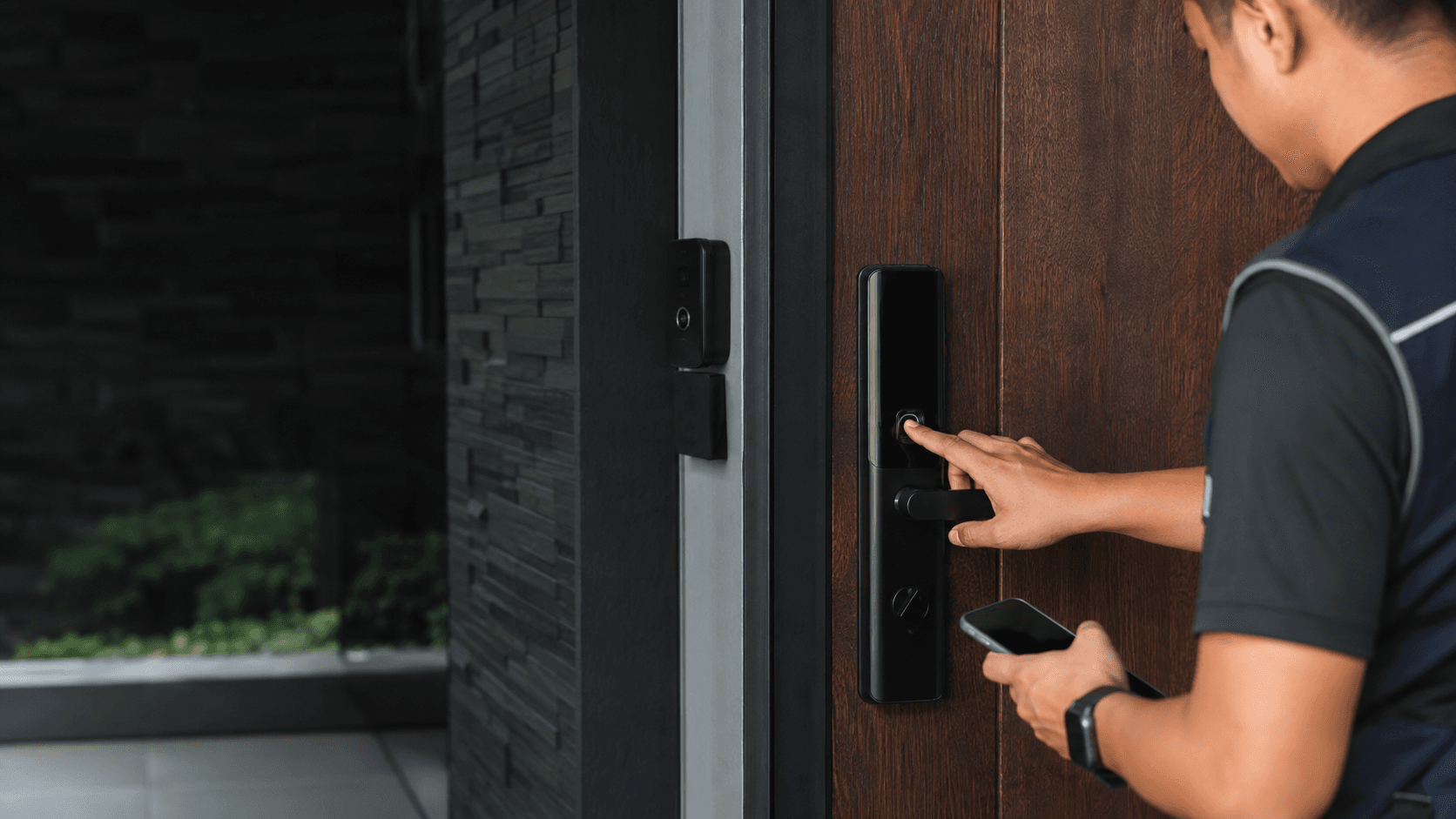
The term covers a specific product family rather than a generic category. Kwikset's own pages describe Halo Touch as a fingerprint deadbolt with Wi-Fi connectivity, and third-party retail listings describe the same lock as a fingerprint smart deadbolt with app-based management. Readers in Malaysia searching for a kwikset smart lock fingerprint are usually trying to work out whether that kind of lock fits a local door, who gets enrolled, and what happens when a finger fails to read.
What the term Kwikset Smart Lock Fingerprint covers
Kwikset Smart Lock Fingerprint is not a single universal model name. It describes a group of Kwikset products built around a fingerprint reader on the exterior of a deadbolt, sold under the Halo Touch name in Traditional and Contemporary hardware styles. The lock is marketed as Wi-Fi enabled, meaning it can connect directly to a home network rather than requiring a separate hub.
Two things sit at the centre of the product: the fingerprint reader itself and the deadbolt mechanism it controls. Kwikset's product pages also reference SmartKey Security, a re-keying feature, and BHMA residential grade durability language. Those are manufacturer claims about the lock's construction, not independent test results, and they should be read as such.
The practical distinction readers should hold onto is that a fingerprint lock is still a lock. The biometric reader is an additional credential alongside a keypad, an app, or a physical key. It does not replace the need for a working door, a correctly aligned strike plate, and a plan for the day the electronics stop responding.
How fingerprint entry works on a Kwikset Smart Lock Fingerprint
Fingerprint entry works by enrolling a finger once, storing that template in the lock, and matching a live finger against the stored template at the door. Kwikset's support material describes an enrollment process carried out through the lock and the Kwikset app. Retail listings for the Halo Touch Traditional describe enrollment of up to 100 fingerprints across 50 users, with fingerprints created, disabled, and deleted from a smartphone.
That capacity figure comes from a reseller listing rather than a Kwikset specification page in the supplied evidence, so it should be treated as indicative rather than confirmed. The mechanism it describes is the important part: fingerprints are managed as records, not as fixed hardware. A record can be added when someone joins a household or a staff team, and removed when they leave.
Three operational realities follow from that design.
- Enrollment is a deliberate act. A finger must be registered before it opens anything, so the person setting up the lock controls who is in the system from the first day.
- Removal is the security event that matters most. A fingerprint that stays enrolled after a tenant, helper, or staff member departs is an open door with a polite name.
- Reads depend on the finger and the reader. Wet hands, worn ridges, cuts, and heavy dust all affect optical and capacitive readers, which is why a backup credential is not optional.
Kwikset's own support pages also reference IFTTT integration for automating smart locks, including scheduled actions. Automation is a convenience layer on top of the credential system, not a substitute for it.
Backup entry is part of the design, not an afterthought
Every fingerprint lock needs at least one non-biometric way in. The Halo Touch line is described as supporting keyed entry, and app-based control is part of the product's stated function. For a Malaysian home, that usually means a physical key kept somewhere outside the house, plus a phone that is charged and connected. For a shop or office, it means a named person who holds the override credential and knows where it is.
The failure case to plan for is mundane: a dead phone, a wet hand, and a locked door at the end of a working day. A lock with no tested backup path turns that into a locksmith call.
Door and user checks before a Kwikset Smart Lock Fingerprint is installed
Smart locks work best when the door condition, user roles, and backup method are reviewed before installation. That is Eyonic's own stated position on smart lock door access, and it applies directly to fingerprint models because the reader adds a component that must sit flush and stay clean.
The checks below are the ones that change the outcome. They are ordered because each one can rule out the next.
- Door condition. Check that the door closes squarely, that the existing deadbolt bore and backset match what the new lock expects, and that the frame is not swollen or warped. A fingerprint deadbolt on a door that needs a shoulder to close will keep reporting false states.
- User roles. Decide who gets a fingerprint, who gets a code, and who gets a key. In a home this is family and regular help. In a shop it is opening and closing staff. In an office it is often a smaller group than expected, because most visitors never need a credential at all.
- Backup entry method. Confirm the physical key path, the app path, and who holds each. Test both before the lock becomes the only way in.
- Daily operation review. Walk through a normal day: first person in, deliveries, staff breaks, closing, and after-hours access. Note where a fingerprint read is faster than a code and where it is slower.
For business premises, the honest question is whether a standalone smart lock or an access-control panel is more appropriate. A standalone fingerprint deadbolt suits a single controlled entrance with a small, stable user group. A panel-based system suits multiple doors, shift patterns, and audit requirements. Choosing the wrong one shows up as workarounds within weeks.
What cannot be confirmed from available evidence
Several figures that buyers reasonably want are not present in the supplied material. There is no verified fingerprint capacity, user count, battery life, wireless band, or certification figure for any Kwikset model in the evidence set. There is no verified Malaysian pricing, stock availability, warranty term, or distributor detail. There is no verified compatibility list for the Kwikset app, voice assistants, or hub requirements, and no verified installation requirement for Malaysian door thickness, mortise type, or gate hardware.
Those gaps matter because they are exactly the details that decide a purchase. They should be confirmed against current manufacturer documentation and a local supplier before any commitment, not assumed from a product page written for a different market.
Kwikset Smart Lock Fingerprint in Malaysian homes, offices and shops
Malaysian door stock varies more than product pages assume. Condominium units, terrace houses, shophouses, and converted offices often carry different door thicknesses, different deadbolt backsets, and different frame materials. A lock that installs cleanly on one unit may need additional preparation on the next.
Climate adds a second variable. Humidity, rain exposure on an uncovered gate or porch, and dust from nearby roads all affect how a reader performs over time. A fingerprint reader on a sheltered entrance door behaves differently from one on an exposed exterior gate. Placement and shelter are worth reviewing before the lock is chosen, in the same way that actual lighting conditions are checked before confirming camera placement on a surveillance job.
For homes, the appeal is straightforward: no key to carry, no code to share with a delivery rider, and a clear record of who came in. For offices and shops, the appeal is narrower and more operational. A fingerprint lock reduces key duplication and makes staff turnover easier to manage, but it does not by itself produce an access log that satisfies an audit, and it does not control a second entrance.
Eyonic's project work in Sarawak has centred on movement through real buildings rather than on hardware for its own sake. The Kuching Immigration Office project focused on arrival flow, staff areas, visitor movement, and dependable daily operation. The KTA Sarawak Sdn Bhd project addressed staff movement, visitor handling, tidy cabling, and clearer daily site control. Both are useful reference points for how a single entrance decision fits into a wider access pattern.
Installation handover and daily operation
Eyonic's installation process runs through site survey, system proposal, installation, and handover. Applied to a fingerprint lock, that sequence matters because the survey is where door condition and user roles get settled, and the handover is where enrollment and backup entry get tested with the people who will actually use them.
Handover is the step most often rushed. A lock is only as good as the number of people who know how to add a fingerprint, remove one, and get in when the reader will not cooperate. If only the installer knows, the site is dependent on a phone call.
Daily operation then settles into a rhythm. Most users read on the first or second attempt. A minority need a second enrolled finger. A small number will always prefer a code, and that preference should be accommodated rather than argued with, because a user who cannot get in reliably will prop the door.
Maintenance is light but not zero. The reader surface needs occasional cleaning, batteries need replacing on a schedule rather than on failure, and the enrolled user list needs a periodic review. That review is the single highest-value habit for any fingerprint lock, at home or at work.
Questions to settle before ordering
Four questions resolve most of the uncertainty. Does the existing door accept the lock without structural work? Who is enrolled on day one, and who removes a fingerprint when someone leaves? What is the tested backup entry path, and who holds it? And is this entrance better served by a standalone lock or by a wider access-control setup?
Answers to the first three are usually available on site. The fourth depends on how many entrances need control and how much record-keeping the site requires. A single home entrance rarely justifies a panel. A shophouse with a staff door, a customer door, and a rear access point often does.
Where a fingerprint lock is the right fit, the practical next step is a site review that confirms door condition, user roles, and backup entry before anything is ordered. Eyonic handles smart lock door access alongside CCTV, alarm, autogate, and intercom work across Sarawak, and can advise on whether a standalone lock or a panel-based approach suits a specific entrance. Share the location, property type, and required system on WhatsApp at +60 11-5111 7959 to move the decision forward.