
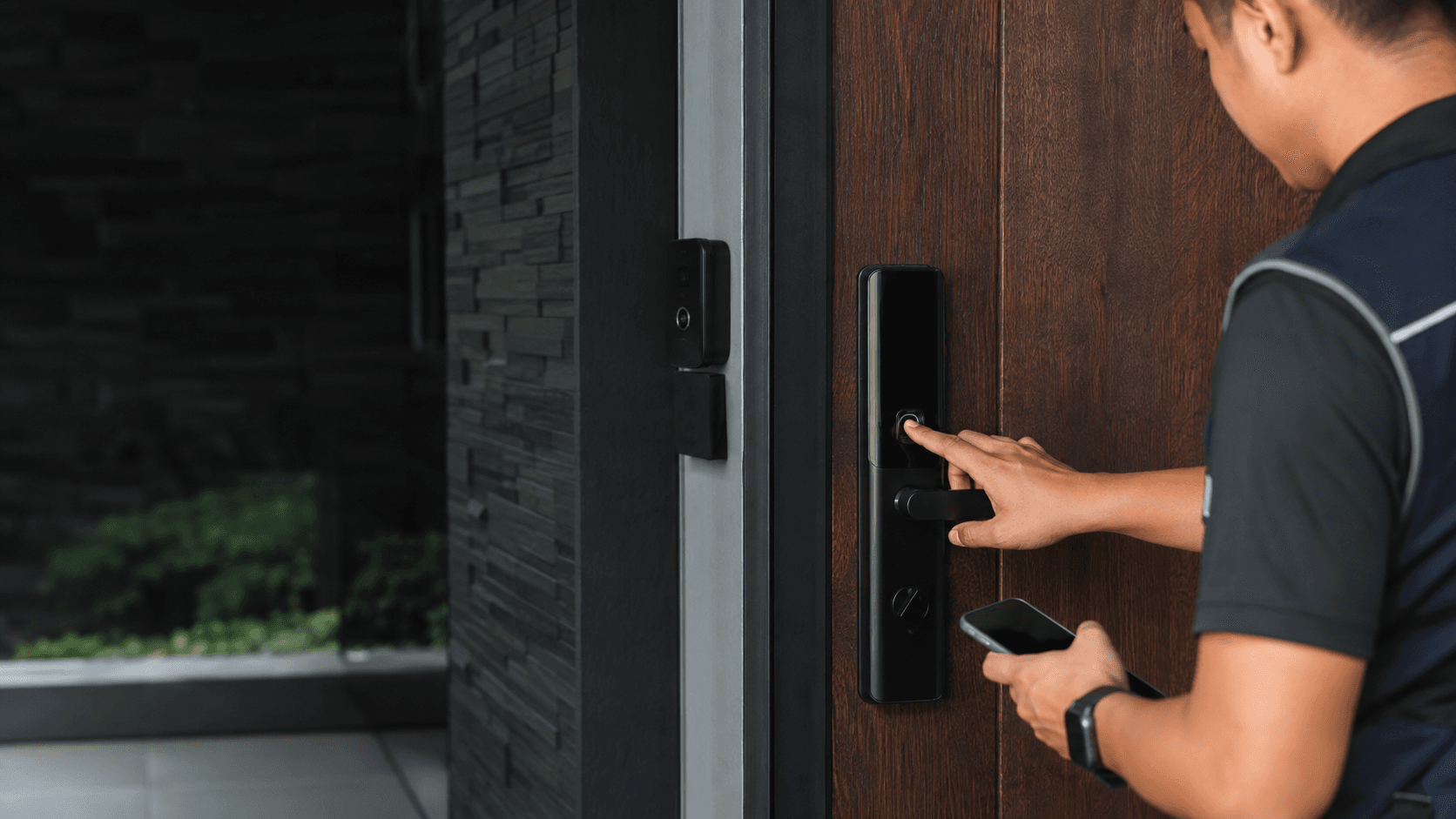
The term covers a category of door hardware rather than a single product. Korean manufacturers built a domestic market around keypad and fingerprint entry for apartment doors, and that design lineage now reaches Malaysian buyers through imported units, supplier catalogues and installation services. The practical question for a Malaysian property is not where the lock was designed, but whether the door, the users and the backup entry method suit the way the building is actually used.
Korean Smart Door Lock. what the term covers
A Korean smart door lock sits in the same family as any digital door lock. The difference is emphasis. Korean-market designs tend to combine a keypad, a fingerprint reader and a mortise-style locking body in one unit, with the electronics built into the door rather than bolted on as an accessory.
That combination is why the phrase appears so often in supplier listings and manufacturer pages. Competitor coverage in this category clusters around premium digital door locks, fingerprint recognition, IoT connectivity, and hotel or RFID lock systems. The common thread is a lock that decides entry electronically and records who entered.
Three terms get used loosely and are worth separating:
- Digital door lock — any lock opened by code, card or credential instead of a mechanical key alone.
- Smart door lock — a digital lock that also supports app control, remote status or integration with other systems.
- Access control — the wider discipline of deciding who may pass a door, when, and under what conditions. A smart lock can be one component of an access control setup, or it can stand alone.
Eyonic's own product review position is that smart locks work best when the door condition, user roles and backup method are reviewed before installation. For business use, the same review checks whether a standalone smart lock or an access-control panel is the more appropriate choice. That distinction matters more than the country of origin.
Korean Smart Door Lock features buyers compare
Feature lists across this category repeat a small number of items. Buyers compare entry methods, the locking body, connectivity, and what happens when power or credentials fail.
Entry methods and fingerprint recognition
Fingerprint recognition is the headline feature on most units in this category. It removes the need to carry a key or remember a code, and it ties each entry to a specific finger rather than a shared secret. The trade-off is enrolment. every user who needs access must be registered on the lock, and that register has to be maintained when people leave a household or a staff team.
Keypad entry usually sits alongside the fingerprint reader as a fallback for visitors, contractors or anyone whose fingerprint will not read cleanly. Keyless entry is the outcome, not a separate mechanism — the lock still needs at least one credential type that works reliably in local conditions.
The locking body and door condition
Korean designs commonly use a mortise body that sits inside the door edge, with hooks or bolts that extend into the frame. That body has to fit the door. Door thickness, the existing cutout, the frame material and whether the door is timber, metal or glass all affect whether a given unit can be fitted without modification.
This is the single most common reason a lock that looks suitable online turns out to be unsuitable on site. A door that already carries a mortise cutout for a different lock body may need the opening reworked, and a door that is too thin or too thick for the unit's stated range cannot be adapted by adjustment alone.
Connectivity and what it actually adds
Bluetooth and Wi-Fi appear across manufacturer material in this category. Connectivity changes three things in practice: whether entry can be managed remotely, whether entry history can be reviewed without standing at the door, and whether the lock can be tied into a wider system.
For a single home door, connectivity is convenience. For an office, a shop or a site with staff and visitors, it becomes part of how movement is recorded and reviewed. The decision point is whether anyone will actually use the remote functions, because an unused app adds cost and a support surface without changing daily operation.
Korean Smart Door Lock checks before installation
Eyonic's installation process for security systems runs through site survey, system proposal, installation and handover. The same sequence applies to a smart lock, and the survey stage is where most of the risk sits.
- Check the door condition. Confirm the door material, thickness, existing cutout and frame alignment before selecting a lock body. A lock that does not fit the door cannot be made to fit by configuration.
- Define user roles. Decide who needs permanent access, who needs temporary access, and who needs none. For business premises, this is also the point at which a standalone smart lock is compared against an access-control panel.
- Agree the backup entry method. Every electronic lock needs a way in when the primary method fails. That may be a mechanical key, a secondary code, an external power point or a documented procedure for the person who manages the door.
- Test at handover. Walk through each credential type, confirm the lock reports correctly, and make sure the people who will manage users know how to add and remove them.
The backup entry decision is the one most often deferred and most often regretted. A lock with no practical fallback turns a flat battery or a failed reader into a locksmith call, and in a commercial setting it can stop a shift from starting.
in Malaysian homes and offices
Malaysian doors vary more than a single product listing can accommodate. Apartment entrance doors, landed-property timber doors, office glass doors and shopfront grilles each present different constraints, and a lock suited to one is not automatically suited to another.
For a home, the usual fit is a single entrance door with a small number of regular users. Fingerprint and keypad entry cover most daily movement, and the main planning questions are the door cutout and the backup method.
For an office, a shop or a site, the questions change. Staff movement, visitor handling and the ability to review who entered become part of daily operation. Eyonic's work for the Kuching Immigration Office focused on arrival flow, staff areas, visitor movement and dependable daily operation, and its work for KTA Sarawak Sdn Bhd supported staff movement, visitor handling and clearer daily site control. Those projects show the pattern. door hardware is judged by how it handles the people passing through, not by its feature list.
Where a site has multiple controlled doors, a standalone smart lock on each door can become harder to manage than a coordinated access control arrangement. Where there is one door and a small user group, a standalone lock is usually the simpler answer.
support and handover
Support is where imported hardware separates itself from locally supplied hardware. A lock bought online and fitted by the buyer has no local handover, no one to call when a reader stops responding, and no documented procedure for the next person who has to manage users.
Eyonic supplies and installs security systems in Sarawak, including smart locks alongside CCTV and ELV work, and its installation process ends with handover rather than at the point the hardware is fixed to the door. Handover is where user permissions get set, the backup method gets demonstrated, and the person responsible for the door learns how to add or remove access.
Eric Yong, founder of Eyonic Security Systems, has worked in technical installation of digital security solutions for commercial businesses in Sarawak for more than 10 years. That experience is relevant to the part of the decision that specification sheets do not cover: whether a given door, user group and building routine will actually work with the lock being considered.
For buyers comparing options, the practical test is whether the supplier will survey the door before recommending a unit, and whether they will return after installation. A lock is a long-term fixture on a door that gets used every day.
questions to settle early
Does the lock fit the existing door? This is answered by inspection, not by a product page. Door thickness, cutout dimensions and frame alignment determine whether a unit can be fitted without reworking the door.
Who manages the user list? Someone has to add new users and remove old ones. If that responsibility is unclear, access tends to accumulate rather than get reviewed.
What happens when the battery runs out or the reader fails? The answer should be a method that works without dismantling the lock, and it should be known to more than one person.
Is a standalone lock enough, or is access control needed? One door with a few users usually suits a standalone lock. Multiple doors, staff turnover or a need to review entry history usually points toward a wider access control arrangement.
Who supports it after installation? Local supply and installation means a local point of contact for faults, user changes and replacement parts.
Buyers in Malaysia comparing a Korean smart door lock against other digital locks are really comparing three things: whether the hardware suits the door, whether the user model suits the building, and whether there is local support when something needs attention. Settling those three before purchase removes most of the risk from the decision.
Share your location, property type and required system with Eyonic on WhatsApp at +60 11-5111 7959 for the next practical step.