
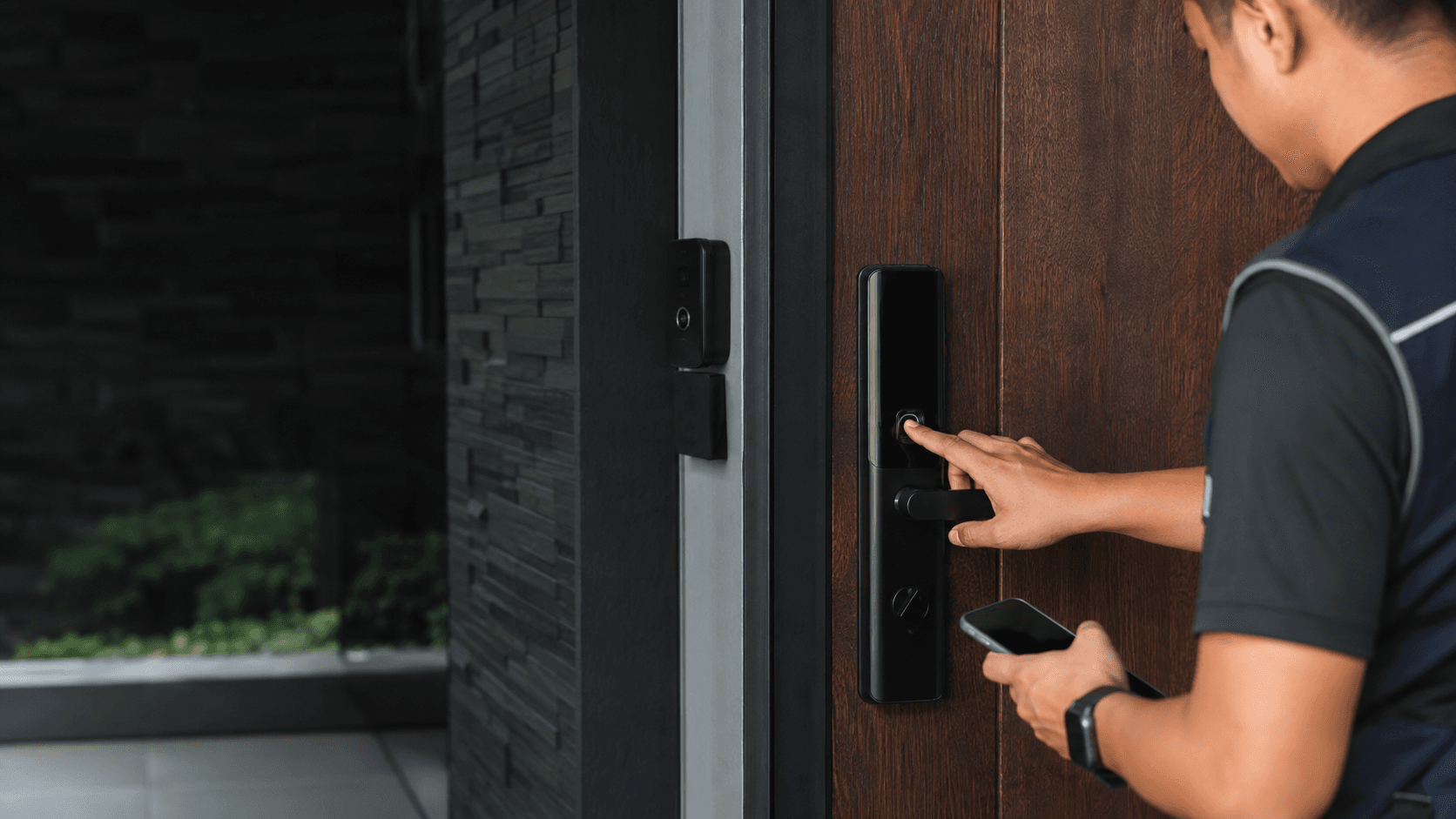
The phrase covers two different things, and mixing them up causes most of the confusion around this product. One is a lock sold as part of an ADT home security package, where the lock is one device on a wider monitored system. The other is a lock that carries the ADT name on the box but works as a standalone keypad deadbolt. Which one applies changes what the lock can do, who installs it, and what happens when the batteries run out.
Adt Smart Door Lock. what the name covers
ADT does not manufacture locks. The company sells lock hardware made by established lock brands as part of its security equipment line, and the lock is positioned as one component of a monitored system rather than a standalone purchase.
That distinction matters because a lock bought inside a security package is usually tied to a monitoring plan. The lock reports its status to the same system that handles alarm sensors and door contacts, so a door left unlocked can appear alongside other system events. A lock bought on its own has no such link.
Coverage of this category on ADT's own site has been inconsistent. Several ADT product and resource pages returned HTTP 403 errors during research for this article, so current model listings could not be confirmed from the manufacturer's own pages. Third-party reviews and reseller pages describe the hardware, but those are secondary sources and their details may lag behind what ADT currently sells.
Which lock hardware sits behind the ADT name
Across the pages reviewed, the lock models most consistently associated with ADT are the Yale Assure Lock 2 Touch and Kwikset deadbolts, including the Kwikset 914 and Kwikset 910. Yale and Kwikset are lock manufacturers; ADT is the security brand the locks are sold under.
The Yale Assure Lock 2 Touch appears in ADT product listings and in third-party reviews of ADT lock equipment. It is a touchscreen deadbolt, and one version includes a fingerprint reader. Kwikset models appear in ADT-compatible equipment listings and in reseller catalogues, generally as keypad deadbolts with a keyed override.
Because ADT's own product pages could not be retrieved, treat any specific model name as a starting point for verification rather than a confirmed current listing. Lock lines change, and a model sold under the ADT name two years ago may no longer be offered.
How an Adt Smart Door Lock connects to a monitored system
The connection runs over Z-Wave, a wireless protocol used for low-power home devices. Z-Wave is the link that lets a lock appear inside a security system's app and automation rules rather than only on its own keypad.
In practice, the lock pairs with a hub or control panel, and that panel passes lock events to the monitoring service and to the mobile app. Locking and unlocking from a phone, checking whether a door is secured, and triggering other devices when the door opens all depend on that hub being present and online.
Two constraints follow from this. First, a Z-Wave lock without a compatible hub loses the remote features and behaves like an ordinary keypad deadbolt. Second, the lock's range depends on distance and wall construction between the lock and the hub, so a lock on a distant rear door may need a repeater or may not pair reliably at all.
ADT has also promoted a feature that links door access to camera recognition, where a known face at the door can trigger an unlock. That kind of automation sits on top of the same hub and app layer, so it inherits the same dependency.
Keyless entry, user codes and backup entry
Keyless entry on these locks works through a keypad or touchscreen, with each person assigned a code. Code capacity varies by model, and reseller listings for ADT-compatible locks have cited figures up to 30 numeric codes, which is enough for a household plus regular visitors but tight for a busy office.
Backup entry is the part most buyers underestimate. A keyed override cylinder lets a physical key open the door if the keypad fails or the batteries die, and a fingerprint reader adds a second credential that does not depend on remembering a code. A lock with no keyed override and no external power option leaves the door dependent on battery health.
Before choosing between a standalone smart lock and an access-control panel, four checks decide the answer:
- Door condition. confirm the door thickness, the existing bore hole, and whether the frame will accept a deadbolt without modification.
- User roles. count how many people need access and whether access must be granted and revoked on a schedule rather than by sharing a code.
- Backup entry method. decide whether a keyed override, a fingerprint credential, or an external power point is the fallback when the primary entry fails.
- Network or hub requirement. establish whether a hub or panel is present, and whether the lock sits close enough to pair reliably.
Those four answers separate a home installation from a commercial one. A household with four regular users and a keyed override is a straightforward standalone lock. A site with rotating staff, contractors, and a need to audit who entered when is an access-control problem, and a single smart lock will not solve it.
| Consideration | Standalone smart lock | Access-control panel |
|---|---|---|
| Door condition | Fits a standard deadbolt bore on a sound door | Suits doors and frames prepared for controlled entry hardware |
| Number of users | Suited to a household or small team within the model's code limit | Built for larger and changing user groups |
| Backup entry | Keyed override or fingerprint credential | Depends on the panel and reader design |
| Who manages permissions | The property owner or occupier through an app or keypad | A designated administrator managing credentials centrally |
What an Adt Smart Door Lock costs to own
No supplied evidence confirms ADT smart door lock pricing, monitoring plan pricing, or contract terms, so no figure is quoted here. Third-party reviews of ADT lock equipment have referenced monthly monitoring charges, but those figures come from secondary sources, are tied to specific markets, and should not be treated as current or applicable outside those markets.
The cost structure is worth understanding even without numbers. A lock bought inside a security package usually carries a monitoring subscription, and that subscription is the recurring part of ownership. A standalone lock has no subscription but also no monitoring, no professional response, and no integration with alarm sensors.
Installation is the other variable. A lock that replaces an existing deadbolt in the same bore is a short job. A door that needs re-boring, a frame that needs adjustment, or a lock that must pair with an existing panel adds labour. Where a panel is already installed, adding a lock is mostly a pairing and configuration task.
For comparison, published package pricing on the Eyonic site lists RM 1,599 for a Hikvision CCTV package, RM 1,599 for a Hikvision alarm system, and RM 1,599 for an autogate package. Those prices cover CCTV, alarm, and autogate work respectively and are not smart lock pricing. Larger commercial work sits in a different range: an office project in Kuching was budgeted at approximately RM 8,000 to RM 18,000, and a public office project at approximately RM 12,000 to RM 28,000.
Planning an Adt Smart Door Lock in Malaysia
Availability is the first question, and no supplied evidence confirms whether ADT monitoring or installation is offered in Malaysia. ADT's own product pages could not be retrieved during research, and the reseller and review pages that describe the locks are oriented to other markets. Anyone planning around an ADT-branded lock in Malaysia should confirm availability directly before building a plan on it.
The practical alternative is a locally supplied smart lock with the same keyless entry and access-control behaviour. The functional requirements do not change: a keypad or reader, assigned user codes, a backup entry method, and a decision about whether the lock stands alone or reports into a wider system.
Eyonic, a security system supplier in Sarawak, lists smart lock door access among its product lines and describes smart locks as good for controlled convenience when user permissions and backup entry are planned properly. The company's stated approach is to check door condition, user roles, and backup method before installation, and for business use to establish whether a standalone smart lock or an access-control panel is the more appropriate choice.
That review step is the same one the four checks above describe, and it is where most installations are decided. A lock specified without checking the door and the user list tends to be replaced within a year.
Eyonic's installation work follows a site survey, system proposal, installation, and handover sequence, and the company has completed projects including the Kuching Immigration Office, where the focus was arrival flow, staff areas, visitor movement, and dependable daily operation. That project context is relevant because it shows the same planning questions — who moves through a door, when, and how access is managed — applied at building scale rather than at a single lock.
For a property in Malaysia weighing an ADT-branded lock against a locally supplied equivalent, the deciding factors are usually availability, who services the lock when it fails, and whether the lock needs to integrate with an existing alarm or camera system. A lock that cannot be serviced locally is a liability regardless of its feature list.
Share your location, property type and required system with Eyonic on WhatsApp at +60 11-5111 7959 for the next practical step.