
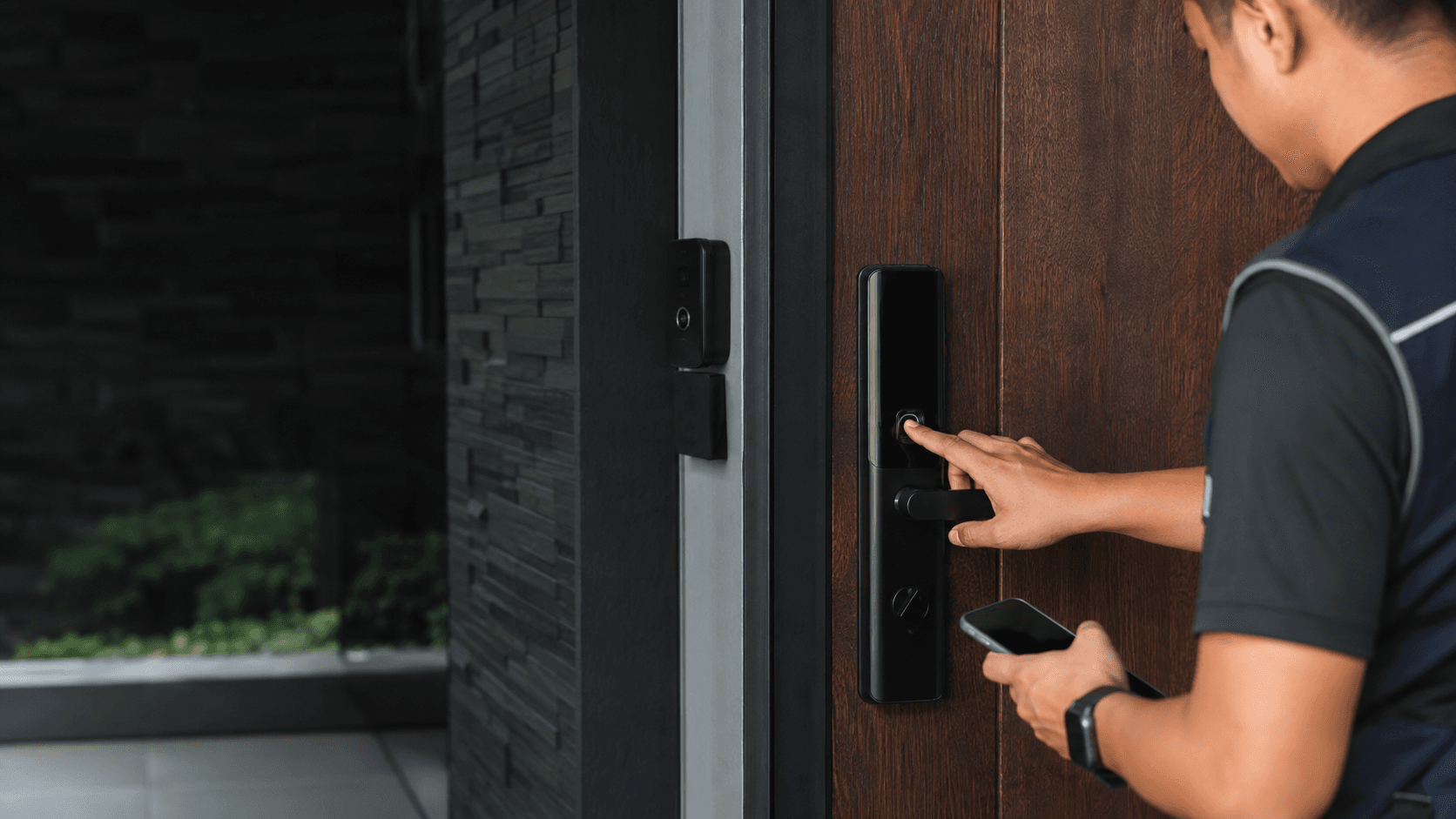
The exact-match query yale wifi door lock describes a category rather than a single product. Yale builds several lock families, and the Wi-Fi part usually comes from a module, a bridge or a built-in radio rather than from the deadbolt itself. That distinction matters in Malaysia, where doors, gate frames and daily routines vary far more than product listings suggest.
Eyonic Sdn Bhd plans, supplies and installs security and ELV systems in Sarawak, and its own smart lock review states that smart locks work best when door condition, user roles and backup method are reviewed before installation. That review also notes that for business use, the choice between a standalone smart lock and an access-control panel is usually checked first. Those three checks are the practical core of this page.
What a Yale Wifi Door Lock adds to a door
A Yale Wifi Door Lock changes how a door is operated, not how it is built. The lock still needs a door that closes squarely, a deadbolt or latch that lines up with its strike, and a frame that does not shift with the weather.
What the Wi-Fi layer adds is distance. A lock with a network connection can be checked and operated from elsewhere, and access can be issued to other people without cutting a physical key. That is the whole appeal. fewer keys in circulation and a clearer record of who was given access.
What it does not add is a stronger door. A smart lock is a control layer on top of existing hardware. If the door frame is soft, the strike plate is short, or the door has swollen and stopped latching cleanly, a connected lock will simply report the same problem more conveniently.
Yale's own product pages describe Wi-Fi and Bluetooth models that work with the Yale Access app, and describe keypad, touchscreen and fingerprint entry options across the Assure range. Those are product-family descriptions from the manufacturer, not a statement about which variants are stocked or supported in Malaysia.
Door condition and fit come before the model
Door condition decides whether a Yale Wifi Door Lock is a straightforward swap or a small renovation. The checks below are the ones that change the answer most often.
- Check that the door closes and latches without lifting, dragging or a shoulder push. A lock cannot fix an alignment problem.
- Check the existing bore and backset against the replacement hardware, and confirm whether the door already has a deadbolt cutout or only a knob latch.
- Check the door material and thickness, because hollow-core, thin panel and metal doors behave differently from solid timber.
- Check the frame and strike side for rot, cracks or a shallow plate that would need reinforcing.
- Check the door's exposure to rain and direct sun if it is an outer door, since not every lock body is intended for exposed positions.
- Check whether the door is a fire door or forms part of a required exit route, because that restricts what may be fitted.
Retrofit and full-replacement locks fail in different ways. A retrofit unit that sits over an existing deadbolt depends on that deadbolt being sound and correctly aligned. A full replacement depends on the door having enough sound material around the bore to hold the new body. Both depend on the door being able to swing and latch on its own.
Malaysian homes add a few local edge cases. Metal gate frames, grille doors and double-leaf entrance doors often have no standard bore at all, and a lock designed for a timber door may have nothing to mount to. Where a gate is involved, the access question usually belongs with the gate motor and intercom rather than with the door lock.
Users, permissions and backup entry
User roles decide how much lock is actually needed. A two-person household and a shop with rotating staff look identical on a product page and completely different in daily use.
For a home, the useful questions are how many people need regular access, whether anyone needs time-limited access, and whether children or elderly family members need a method that does not depend on a phone. For a business, the questions shift to whether access should be revoked the moment someone leaves, whether entries need to be attributable to a person, and whether the site needs a record that survives a lost phone.
Backup entry is the check most often skipped. Every electronic lock needs a way in when the battery is flat, the phone is lost, the network is down or the app account is locked out. A mechanical key override, a keypad code held by someone off-site, or a second entrance are all valid answers. Having none of them is not.
Eyonic's smart lock review puts backup method alongside door condition and user roles as a pre-installation check, and notes that business sites are usually assessed for whether a standalone smart lock or an access-control panel fits better. A panel makes sense when many doors, many users and a central record are involved. A standalone lock makes sense when one door and a small group of people are involved.
Wi-Fi, app control and daily reliability
Wi-Fi at the door is a coverage question before it is a product question. Signal strength at an entrance is often much weaker than in the room where the router sits, and a metal door, a thick wall or a gate pillar can reduce it further.
The practical test is to stand at the door with a phone and check whether the network is usable there, not in the hallway. If coverage is marginal, the options are usually to move or add an access point, or to accept that remote features will be unreliable and rely on local keypad or key entry instead.
Daily reliability also depends on what the lock is asked to do. Auto-lock, scheduled codes and remote unlock all consume battery and all depend on the network. A lock that is checked remotely many times a day behaves differently from one that is used twice a day.
Two failure modes are worth planning for. The first is a flat battery at an inconvenient hour, which is why the backup method matters more than the battery figure. The second is a network or power interruption, which affects remote control but should not affect a keypad or a mechanical key. Any claim about how a specific model behaves in those situations should come from the manufacturer's documentation for that model, not from a general description.
Where a Yale Wifi Door Lock fits in a wider setup
A door lock is one access point. Most properties have several, and the useful question is whether they should be managed together or separately.
On a small site, a standalone lock on the main entrance is usually enough, with the gate handled by its own motor and remote. On a larger site, mixing a door lock, a gate, an intercom and cameras into one access picture tends to reduce the number of separate apps and the number of people holding keys.
Eyonic's project work shows the pattern. At the Kuching Immigration Office, the focus was arrival flow, staff areas, visitor movement and dependable daily operation. At KTA Sarawak Sdn Bhd, the focus was staff movement, visitor handling, tidy cabling and clearer daily site control. Both are access questions first and equipment questions second, and both were scoped through a site survey, a system proposal, installation and handover.
That sequence applies to a single door as much as to a building. The survey confirms the door, the users and the backup method. The proposal states what will be fitted and what will not. Installation and handover confirm that the people who need access actually have it, and that someone knows what to do when the battery runs out.
Where a lock is part of a wider access or monitoring setup, it is worth confirming that the door hardware, the network and the recording or alarm side are planned together rather than added in separate visits. Eyonic's own review guidance for camera work makes the same point in a different context: confirm the actual conditions on site before fixing a placement, rather than assuming the standard case applies.
For readers comparing options, the honest position is that a Yale Wifi Door Lock is a reasonable choice when the door is sound, the user list is small and stable, and a backup entry method exists. It is a poor fit when the door does not latch, when dozens of people need individually revocable access, or when no one can get in without a working phone.
Share the location, property type and required system with Eyonic on WhatsApp at +60 11-5111 7959 for the next practical step.