
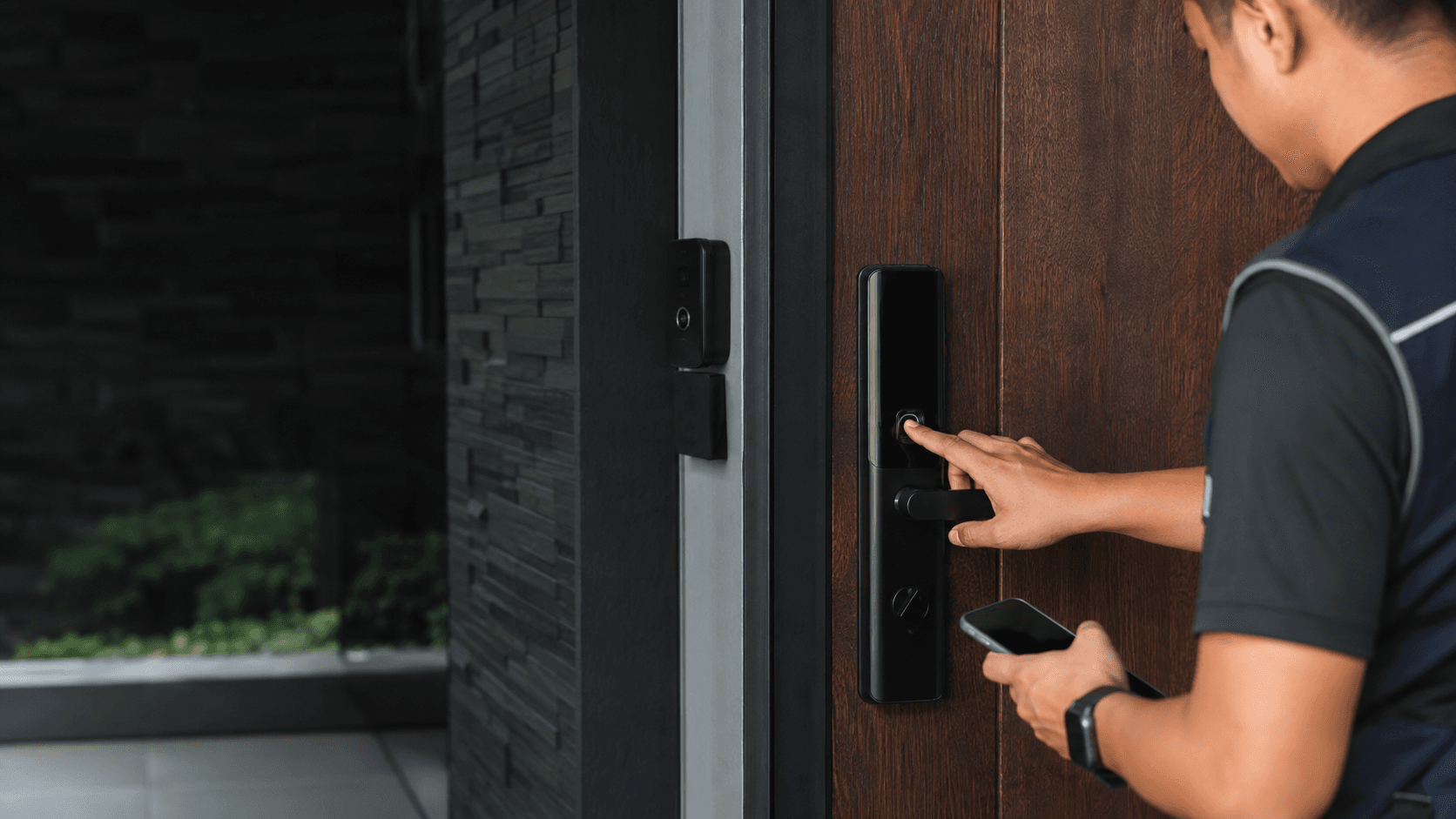
Most Malaysian homes already have a door that works. The question is whether that door can carry a smart lock without drilling, whether everyone in the house can still get in when the battery dies, and who fixes it when something goes wrong. Those three questions decide more than the brand on the box.
Eyonic Sdn Bhd plans, supplies and installs security and ELV systems for homes, offices, shops and industrial sites in Sarawak, and lists smart lock door access among its product reviews. The company's own review guidance is blunt: smart locks work best when door condition, user roles and backup method are reviewed before installation, and for business use the choice between a standalone smart lock and an access-control panel is usually settled at that stage.
What Home Automation Door Locks change about daily entry
A conventional lock gives one answer to every entry: a key. Home automation door locks split that into several answers. A fingerprint, a keypad code, a phone app, a card, or a physical key can each open the same door, and each can be given to a different person.
That matters most in households with a changing cast. A domestic helper who leaves, a contractor doing renovation work, a tenant, a family member who keeps losing keys — each one is a separate credential that can be issued and withdrawn without changing the lock cylinder.
The practical gain is not convenience for its own sake. It is that access becomes something that can be reviewed. A keypad code can be deleted. A copied key cannot.
Where the convenience stops
Automated entry adds a power dependency. A lock that runs on batteries will eventually run flat, and a lock that runs on mains power will stop during an outage. Any plan that does not name a backup entry method is incomplete, which is why Eyonic's own review guidance puts backup method alongside door condition and user roles as a pre-installation check.
Network dependency is the second limit. Remote unlocking, activity logs and app notifications all rely on a connection. If the lock is the only way in and the connection drops, the household is relying on whatever local method the lock still supports.
Door condition, user roles and backup entry come first
Before any model is discussed, three things decide whether the job is straightforward or awkward.
- Site survey — the door, frame and existing hardware are inspected on site.
- System proposal — the lock type and access method are matched to how the household or office actually moves through the door.
- Installation — the lock is fitted and configured.
- Handover — users are shown how to operate the lock and how to get in when the primary method fails.
That sequence is the one Eyonic documents for its CCTV installation work in Sarawak, and the same logic applies to door hardware: the survey comes before the proposal, and the handover comes last.
Door condition
Door thickness, the existing bore hole, the backset distance, and whether the door is timber, metal or glass all affect what will fit. A door that has already been cut for one lock may not accept another without modification. A metal door or a fire-rated door raises different questions again, and those are best answered by looking at the door rather than by reading a product page.
This is the single most common reason a lock purchase goes wrong. The lock is fine; the door is not compatible with it.
User roles
A two-person household and a shop with rotating staff need different things. Homes usually want a small number of permanent credentials plus a temporary one for visitors or help. Businesses usually want to know who entered and when, and to remove access the day someone leaves.
Eyonic's review guidance notes that for business use, the choice between a standalone smart lock and an access-control panel is usually reviewed at this point. A single door with a handful of users can sit on a standalone lock. Multiple doors, staff turnover and a need for records tend to push toward a panel-based setup.
Backup entry
Every plan needs a second way in. Options include a mechanical key override, a keypad that still works without a network, or a separate entrance that is not automated. The backup method should be decided before installation, not after the first lockout.
compared with a wider access control setup
A standalone smart lock and an access-control panel solve overlapping problems at different scales. The trade-off is between simplicity and control.
A standalone lock is self-contained. It needs no central panel, it is faster to install, and it suits a single door with a small number of users. Its limits appear when the door count grows: managing ten separate locks means ten separate sets of credentials.
An access-control panel centralises that. Credentials, schedules and logs sit in one place, which is why it tends to be the choice for offices, shops and sites with staff movement to manage. The cost is a larger installation and a system that needs its own planning.
Eyonic's completed work in Kuching shows the kind of brief that pushes toward the wider setup. The Kuching Immigration Office project focused on arrival flow, staff areas, visitor movement and dependable daily operation — a public building where entry is not a single-door question. A separate project for KTA Sarawak Sdn Bhd covered staff movement, visitor handling, tidy cabling and clearer daily site control at an engineering consultancy office.
Neither project is evidence about door lock pricing or lock specifications. They are evidence about the type of brief where a wider access-control approach is considered rather than a single standalone lock.
When a standalone lock is enough
A single home entrance, a small household, and no requirement to review entry records. In that case the extra cost and complexity of a panel buys little.
When it is not
Multiple doors, staff who join and leave, a need to know who entered and when, or a building where visitors move through several areas. At that point a standalone lock on one door solves a fraction of the problem.
What a Sarawak installation visit covers
Eyonic is based in Sarawak and works across Kuching and the surrounding areas. A door lock job follows the same shape as the company's other installation work.
The survey looks at the door itself, the frame, the existing lock, and how the household or staff actually use that entrance. It also looks at where power and network are available if the chosen lock needs either.
The proposal then names the lock type, the access methods, and the backup entry arrangement. Installation fits and configures the hardware. Handover covers daily operation and the failure cases — flat battery, lost credential, no network.
One habit from Eyonic's camera work carries over: checking actual conditions on site before confirming a placement. For a lock, the equivalent is checking the actual door before confirming a model.
Costs evidence gaps and the next practical step
Eyonic publishes three packages at RM 1,599 each: a Hikvision CCTV package covering camera supply and setup, basic recording configuration and mobile viewing handover; a Hikvision alarm system covering control panel and sensors, siren and zone setup, and user testing and handover; and an autogate package covering motor recommendation, remote-control setup, and safety testing and handover.
None of those three packages covers door locks. There is no published supply-and-install price for home automation door locks, and no verified specification sheet for any specific lock model in the current evidence. Anyone quoting a firm figure for a lock job before seeing the door is guessing.
For scale, Eyonic's completed project budgets sit in a different bracket entirely: the Kuching Immigration Office work was in the region of RM 12,000 to RM 28,000, and the KTA Sarawak Sdn Bhd office setup in the region of RM 8,000 to RM 18,000. Those figures describe multi-area commercial fit-outs, not a single residential door lock, and should not be read as a lock price.
Several other things remain unverified and are worth naming rather than glossing over. There is no confirmed warranty or service interval for door lock work, no confirmed list of which smart-home ecosystems or voice assistants a given lock supports in Malaysia, and no Malaysian market data on lock adoption. Where a supplier states those details, they should be checked against the specific model being quoted.
The practical next step is to describe the door and the household. Location, property type and the required system are the three things Eyonic asks for before a job can be scoped, and they can be shared on WhatsApp at +60 11-5111 7959.
Questions that come up before a lock is chosen
Will it fit the existing door? That depends on door thickness, the existing bore hole and the backset. It is a survey question, not a catalogue question.
What happens when the battery runs out? The answer should be a named backup method decided before installation. If a supplier cannot describe one, the plan is incomplete.
Can access be removed when someone leaves? With a keypad or app credential, yes. With a copied mechanical key, no — which is the main reason households move to automated entry in the first place.
Is a smart lock the right choice for a shop or office? For one door and a few users, often yes. For multiple doors and staff turnover, an access-control panel is usually the better fit, and that comparison is worth making before buying hardware.