
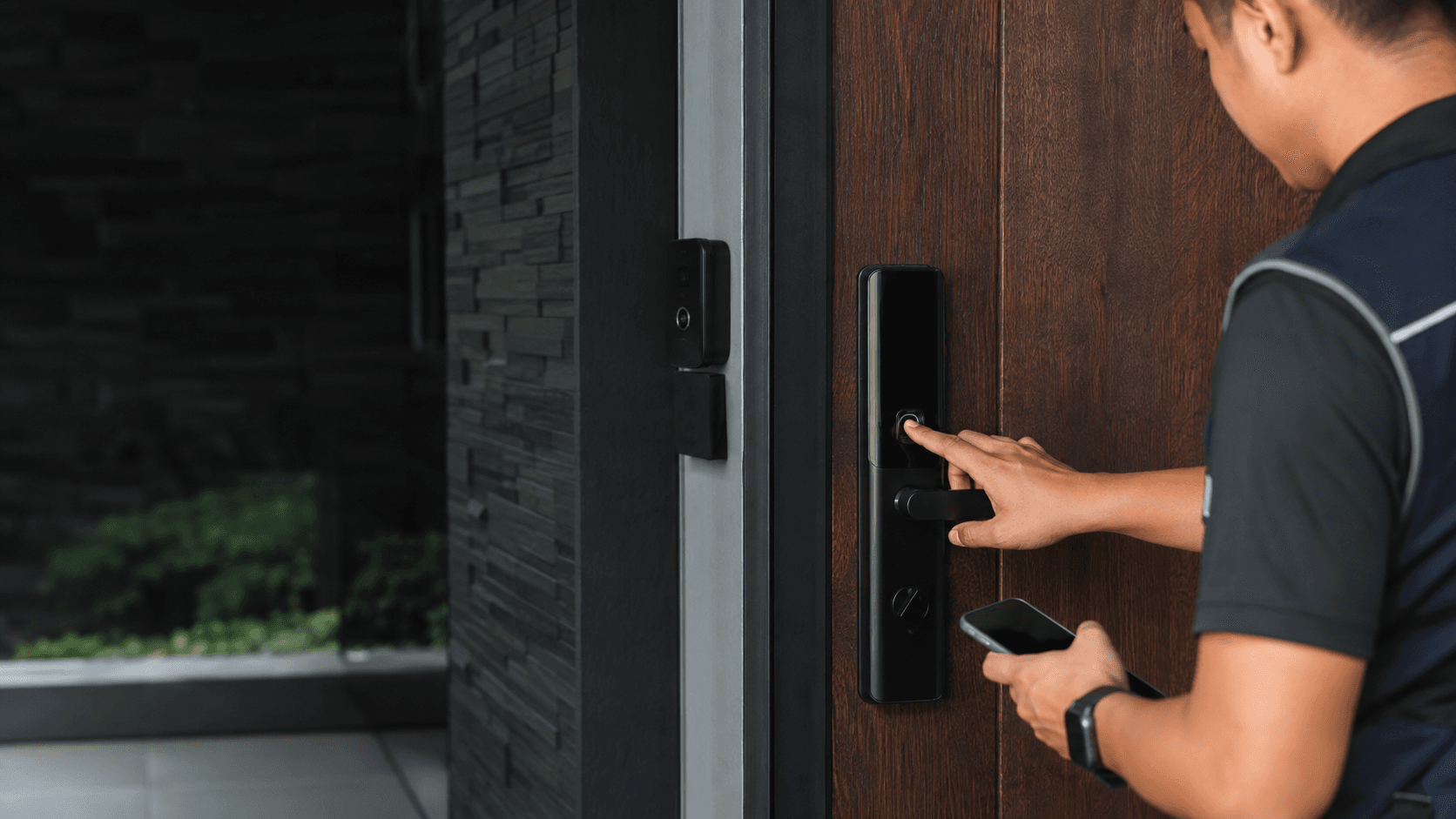
The term covers a family of products rather than a single specification. Some units are standalone handles with a built-in keypad. Others add a fingerprint reader, a Wi-Fi radio, or both. A few are sold as part of a matched handle-and-deadbolt set. What they share is the form factor: the operating part sits where a conventional lever or knob would, so the door keeps its existing look more closely than a full deadbolt replacement usually does.
Buyers researching a digital door handle in Malaysia are usually weighing three things at once: whether the hardware fits the door, who needs to get through it, and what happens when the electronics stop working. Those three questions decide more outcomes than brand comparisons do.
Digital Door Handle. What the Term Covers
A digital door handle is best understood by what it replaces. A deadbolt swap changes the locking mechanism above or below the handle. A handle swap changes the part a hand actually touches, and the lock moves with it.
That distinction shapes the product categories readers encounter:
- Keypad handles unlock with a numeric code. No phone, no app, no network required for basic entry.
- Fingerprint handles read a stored print. Convenient for regular users, less useful for one-off visitors.
- Wi-Fi or app-connected handles add remote status, temporary codes, or entry logs, and depend on a network and a charged device.
- Handle-and-deadbolt sets pair a digital handle with a separate deadbolt, which changes the installation scope.
Each category carries a different failure mode. A keypad with no network still works during an internet outage. An app-only handle does not. That single difference matters more in daily use than most feature lists suggest.
How a Digital Door Handle Differs From a Deadbolt Lock
The practical difference is installation scope and door preparation. A deadbolt replacement works with the existing bore holes in most cases, because the deadbolt sits in its own cutout. A handle replacement has to match the latch backset, the door thickness, and the existing handle footprint, or the door needs new preparation.
Eyonic's own product review notes that smart locks work best when door condition, user roles, and backup method are reviewed before installation, and that for business use the choice between a standalone smart lock and an access-control panel is usually checked first. That is the same logic that applies to a handle-style unit.
Three trade-offs separate the two approaches:
- Door condition and thickness — the existing cutout, latch backset, and door material decide whether a handle-style unit drops in or needs modification.
- Existing handle or deadbolt configuration — a door that already has a separate deadbolt may only need the handle replaced, or may need both parts changed together.
- Number of users and roles — a household of four and an office with rotating staff need different permission structures.
- Preferred access method — keypad, fingerprint, or app entry each suit different users and different habits.
- Backup entry method — a mechanical key, an external power point, or a second entry route should be confirmed before the unit is fixed to the door.
- Power or battery expectations — who monitors the battery, and what the routine is when it runs low.
That list is a set of checks, not a sequence. Skipping any one of them tends to surface later as a fit problem or an access problem.
Door and User Checks Before Choosing a Digital Door Handle
Fit comes first because it is the hardest thing to change afterwards. A handle that does not match the door's existing preparation cannot be made to fit by configuration.
Door checks worth completing before any purchase:
- Measure the door thickness at the latch edge, not at the face.
- Note the latch backset, which is the distance from the door edge to the centre of the handle spindle.
- Confirm whether the door is solid timber, hollow-core, metal, or glass, since each accepts different fixing methods.
- Check whether the door closes against a frame that can take a strike plate change.
- Confirm the door is not a fire-rated assembly, where hardware substitution is usually restricted.
User checks matter just as much. A single-occupant bedroom door and a shop's staff entrance have almost nothing in common beyond the hardware. The bedroom needs one reliable code and a simple backup. The shop needs a way to add and remove people without reissuing keys, and a record of who entered.
For business premises, the standalone-versus-panel question is worth settling early. A standalone digital door handle suits a single controlled door. A multi-door site with staff movement and visitor handling is usually better served by an access-control approach, which is the same distinction Eyonic applies when reviewing smart lock door access for commercial clients.
Access Methods, Backup Entry and Daily Reliability
Access method determines who can enter without help. Keypad entry works for anyone who can be told a code. Fingerprint entry works for enrolled users only, which is a strength for a fixed team and a limitation for guests. App-based entry works for anyone the account holder chooses to admit remotely, and stops working when the network or the phone does.
Backup entry is the part most buyers under-plan. A handle with no mechanical override and no external power option leaves one route in: the battery. Where a door is the only way into a property, that is a real constraint rather than a minor inconvenience.
Daily reliability comes down to three habits:
- Replacing batteries on a schedule rather than waiting for a low-battery warning.
- Keeping at least one mechanical key or override stored somewhere other than inside the locked space.
- Reviewing the user list periodically so former staff or tenants no longer hold valid credentials.
Eyonic's review of smart lock door access describes the technology as good for controlled convenience when user permissions and backup entry are planned properly. That phrasing is deliberate. the convenience is real, and it depends on the planning.
Where a Digital Door Handle Fits in Malaysia Properties
Handle-style entry suits doors where the existing hardware is already a lever or knob and the owner wants keyless entry without changing the door's appearance. That covers a large share of residential interior doors, many office doors, and shop back entrances.
It suits less well where the door is part of a wider access-control requirement. A site with multiple entry points, staff shifts, and visitor logging needs a system that ties those doors together, not a series of independent handles.
Eyonic's completed work in Sarawak illustrates the difference in scope. The Kuching Immigration Office project focused on arrival flow, staff areas, visitor movement, and dependable daily operation. The KTA Sarawak Sdn Bhd project covered staff movement, visitor handling, tidy cabling, and clearer daily site control. Both are multi-zone environments where individual door hardware is one component of a larger arrangement.
Eyonic's installation process follows a site survey, system proposal, installation, and handover sequence, which is the same order that applies when a digital door handle is part of a wider security scope rather than a single-door purchase.
Practical Next Step With Eyonic
Eyonic Sdn Bhd plans, supplies, and installs security and ELV systems for homes, offices, shops, and industrial sites in Sarawak. The company's founder, Eric Yong, has worked in technical installation of digital security solutions for commercial businesses in Sarawak for more than 10 years.
For a single door, the useful information to prepare is the door thickness, the existing handle or deadbolt configuration, the number of people who need access, and the preferred backup entry method. For a multi-door site, the useful information is the number of entry points, how staff and visitors move through them, and whether entry records are needed.
Share your location, property type and required system with Eyonic on WhatsApp at +60 11-5111 7959 for the next practical step.