
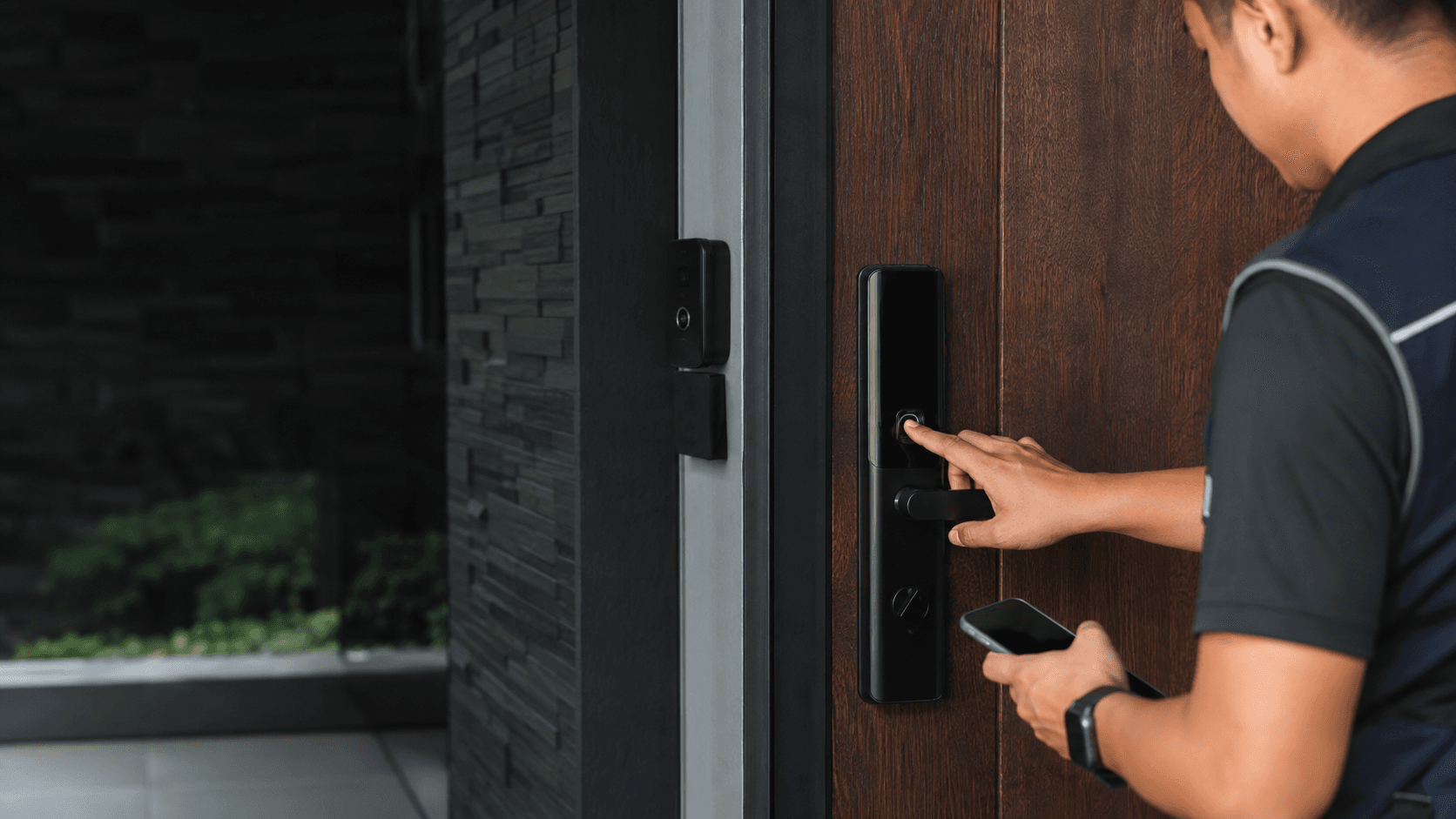
Malaysia's market for keyless security door locks spans a wide range of buildings, from terrace houses in Kuching to shoplots and industrial units. The hardware itself is only part of the decision. What determines whether a keyless lock works well in daily use is whether the door can carry it, whether the people using it have the right credentials, and whether there is a reliable way in when the electronics do not cooperate.
Eyonic Sdn Bhd, a security system supplier based in Sarawak, treats keyless security door locks as one part of a wider access and ELV setup rather than a standalone purchase. The company's own review guidance notes that smart locks work best when door condition, user roles, and backup method are reviewed before installation, and that for business use the choice between a standalone smart lock and an access-control panel should be checked first.
Keyless Security Door Locks. What They Replace
A conventional lock depends on a cut key and a mechanical cylinder. Keyless security door locks remove that dependency and substitute an electronic credential: a numeric code entered on a keypad, a card or fob presented to a reader, a fingerprint or other biometric marker, or a command sent from a phone or access-control panel.
The practical effect is that entry rights become something that can be issued, changed, and withdrawn without cutting new keys. A tenant who leaves does not take a copy of the building's key with them. A contractor who needs access for one week can be given a credential that stops working after that week. A staff member who loses a fob can be removed from the system without rekeying the whole premises.
That said, keyless entry does not automatically mean stronger security. A keyless lock on a hollow-core door with a weak frame offers less resistance than a well-fitted mechanical lock on a solid door. The electronic credential changes how entry is granted; it does not change the physical strength of the door, frame, or strike plate.
How Code, Card, Fob and Biometric Entry Differ
Each credential type suits a different pattern of use, and the differences matter more in practice than in marketing.
Code access is the simplest to deploy. A shared or individual PIN is entered on a keypad. It works well for a small household, a single office door, or a shop entrance where a handful of people need regular access. The weakness is that codes can be shared or observed, so a code that is not changed regularly loses its value as a control.
Card or fob access is common in offices, clinics, and commercial premises where more than a few people need entry. Each person carries a credential, and the system can be set so that a lost card is cancelled individually. This is the credential type that most naturally pairs with an access-control panel rather than a standalone lock, because the panel manages the list of who is allowed in and when.
Biometric entry uses a fingerprint or similar physical marker. It removes the need to carry anything and cannot be lent to another person. The trade-offs are that enrolment takes time, some users have fingerprints that read inconsistently, and a biometric reader on an external door in a humid climate needs to be chosen with that environment in mind.
Many keyless security door locks combine two or more of these methods, so a code can be used day to day and a card or fingerprint as a secondary route. The combination is useful, but it also means more than one credential type has to be managed and kept current.
Door Condition and User Roles Before Installation
Before any keyless lock is specified, two questions decide most of the outcome: can the door carry the hardware, and who actually needs to get through it.
Door condition covers the material and thickness of the door leaf, the existing cutout and backset, the frame, and whether the door closes squarely. A lock that fits a standard timber door may not fit a metal grille, a glass door, or a fire-rated door without additional hardware. A door that does not close cleanly will cause problems for any electronic lock, because the lock depends on the door sitting in the correct position for the bolt to engage.
User roles determine the credential model. A family home with four regular users and occasional visitors needs something different from a shop with rotating staff, a clinic with patient-facing areas, or an office where cleaners arrive outside working hours. The number of people, how often the list changes, and whether entry needs to be time-limited all point toward either a standalone smart lock or a panel-based system.
Eyonic's own guidance on smart lock door access makes this distinction directly: for business use, the company usually checks whether a standalone smart lock or an access-control panel is more appropriate. A standalone lock is simpler and cheaper to install, but it manages credentials on the lock itself. A panel-based system costs more and needs more planning, but it centralises control across multiple doors and users.
These are the practical checks that should happen before committing to an installation:
- Confirm the door material, thickness, and existing cutout, and check whether the frame and strike will accept the new lock.
- Check that the door closes squarely and that the bolt will engage reliably without forcing.
- List every person who needs entry, how often that list changes, and whether any access should be time-limited.
- Decide the credential type or combination: code, card or fob, biometric, or a mix.
- Agree the backup entry method and confirm it works independently of the main electronics.
- Decide whether a standalone smart lock is sufficient or whether an access-control panel is needed for multiple doors or tighter user management.
Backup Entry and Daily Operation
Every keyless lock needs a way in when the primary credential fails. That could be a mechanical key override, a battery terminal that accepts an external power source, or a second credential type that does not depend on the same component.
The backup method should be tested before the installation is signed off, not discovered during a lockout. It should also be stored somewhere that is genuinely accessible, because a mechanical override key kept inside the locked premises is not a backup.
Daily operation raises its own questions. Batteries need replacing on a schedule, and a lock that gives no warning before the battery dies creates exactly the kind of disruption keyless entry is meant to avoid. Doors that are exposed to rain or direct sun need hardware suited to that position. Doors that are used heavily, such as a shop entrance or an office main door, put more cycles on the mechanism than a residential back door.
For premises with several doors, the question of whether each door operates independently or reports to a central point becomes important. Independent locks are simpler but harder to audit. A connected setup gives a clearer picture of who entered and when, at the cost of more infrastructure and more to maintain.
Keyless Security Door Locks in Malaysian Buildings
Malaysian buildings present a few conditions that affect how keyless security door locks perform. Humidity is high year-round in most states, which places demands on any electronic hardware mounted on an external door. Direct sun on a keypad or reader can affect both the hardware and the user's ability to read it. Heavy rain during monsoon periods means external doors and gate areas need hardware rated for exposure, or protection from a porch or awning.
Building type also shapes the choice. A terrace house or apartment typically needs one or two locks with a small user list. A shoplot needs a lock that survives frequent daily use and a credential model that handles staff turnover. An office may need several doors under one management system. An industrial site often needs a mix of pedestrian doors and vehicle or gate access, which is a different problem from a door lock.
Eyonic's project work in Sarawak illustrates the kind of planning involved. For the Kuching Immigration Office, the focus was arrival flow, staff areas, visitor movement, and dependable daily operation. For KTA Sarawak Sdn Bhd, an engineering consultancy, the requirement was a practical office setup supporting staff movement, visitor handling, tidy cabling, and clearer daily site control. Both projects show that access hardware is chosen around how a building is actually used, not around the hardware alone.
Where a site needs access control alongside other systems, it is worth checking how the lock fits with existing CCTV, alarm, or intercom infrastructure. A keyless lock that operates in isolation is fine for a single door. A lock that needs to sit alongside cameras and an alarm panel benefits from being planned as part of the same installation rather than added later.
Planning Supply and Installation
The sequence for a keyless lock installation follows the same pattern Eyonic uses for its other security work: site survey, system proposal, installation, and handover. The survey is where door condition, user roles, and backup entry get confirmed against the actual door rather than assumed from a description.
Supply and installation are usually handled together for this reason. A lock bought separately may not match the door's cutout, may not suit the credential model the site needs, and may leave the question of who configures the user list unanswered. Having the same party survey, supply, install, and hand over keeps those decisions connected.
Handover matters as much as installation. Someone on site needs to know how to add and remove users, how to change a code, what to do when the battery warning appears, and how the backup entry works. A keyless lock that nobody on site can administer will generate support calls and, eventually, workarounds that undermine the security it was meant to provide.
For sites in Sarawak and across Malaysia, the practical next step is to share the location, property type, and required system with Eyonic on WhatsApp at +60 11-5111 7959. That gives enough context to judge whether a standalone smart lock or a panel-based access-control setup fits the door and the building.