
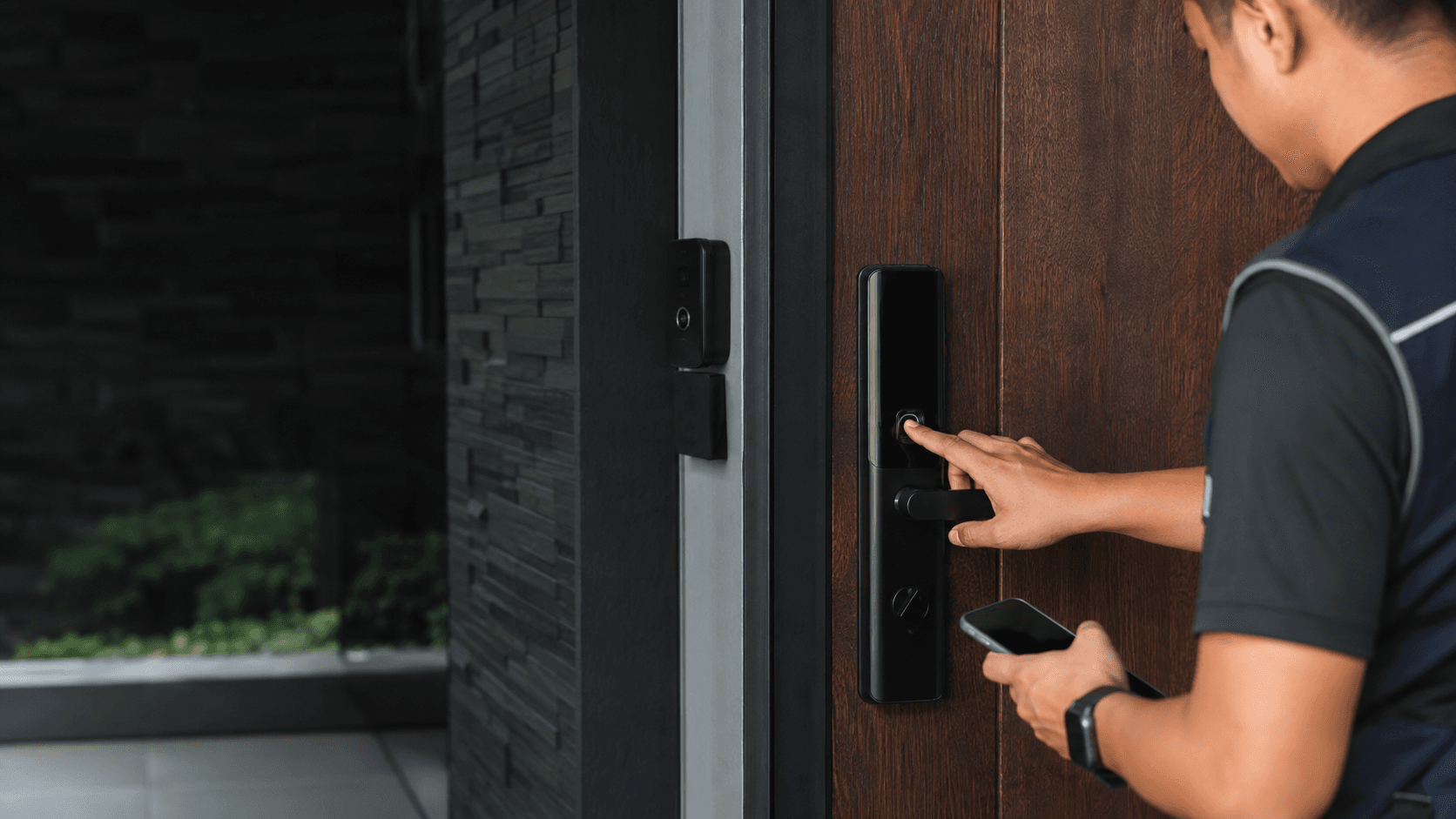
The appeal is simple. the original key still works, and the hardware already on the door stays where it is. That matters for renters, for older doors, and for anyone who does not want to cut, drill, or swap a lock cylinder to gain app control and code entry.
What follows is a planning guide rather than a hands-on review. It covers what the device changes, how installation over existing hardware works, which unlock methods and accessories shape daily use, and what to check before committing on a Sarawak property.
What a Switchbot Door Lock changes about an existing door
The device sits on the interior face of the door and turns the existing thumb turn. Nothing about the exterior trim, the keyway, or the strike plate has to change. The door keeps its original lock, and the retrofit unit adds a motorised layer on top of it.
That single design decision drives most of the trade-offs. Because the original lock stays in place, the physical key remains a working backup entry method even if the smart layer loses power or connectivity. Because the retrofit unit is surface-mounted rather than mortised into the door, installation is reversible, which suits rental units and properties where the door hardware should stay untouched.
The limits follow the same logic. A retrofit unit can only turn what the existing lock allows it to turn. If the thumb turn is stiff, misaligned, or the door has dropped on its hinges, the motor has to fight that resistance on every cycle. A door that already needs a shoulder to close is a poor candidate until the alignment is corrected.
How a Switchbot Door Lock is installed over existing hardware
Installation is a mounting and calibration job, not a lock replacement. The unit is fixed to the interior door surface, positioned so its mechanism engages the existing thumb turn, and then calibrated through the app so the device learns the locked and unlocked positions.
Two mounting realities matter. First, the interior face of the door needs enough clear flat area for the unit to sit without colliding with the thumb turn, a handle backplate, or door trim. Second, the mounting method has to suit the door surface, because adhesive mounting and screw mounting behave very differently on a painted timber door, a hollow-core door, and a metal or fire-rated door.
Calibration is where most problems surface. If the thumb turn does not move freely through its full travel, the device will report errors, drain power faster, or fail to complete a lock cycle. Correcting the underlying door alignment before installation is cheaper than correcting it afterwards.
Unlock methods and accessories that shape daily use
The unlock method determines who can get in and how easily. App control, keypad codes, and the original physical key cover most household needs, and the physical key is the one method that does not depend on power, network, or a working phone.
Accessories change the experience more than the lock itself. A keypad mounted outside removes the need to carry a phone to the door, which matters for children, domestic helpers, and short-stay guests. A hub extends control beyond short-range wireless, enabling remote status checks and remote unlocking. Without a hub, remote access is generally not available, so a household that expects to unlock the door from another city should plan for the hub rather than assume it.
For a rental or short-stay property, temporary codes are the practical feature. A code can be issued for a guest's stay and withdrawn afterwards, which avoids handing over a physical key that may be copied. For a family home, the more useful pattern is a permanent code for residents and a separate code for recurring visitors such as a cleaner or gardener.
Door condition, user roles and backup entry before choosing
Eyonic's own product guidance on smart lock door access states that smart locks work best when the door condition, user roles and backup method are reviewed before installation, and that for business use the choice between a standalone smart lock and an access-control panel should be checked first. That sequence applies directly to a retrofit unit.
Door condition is the first filter. A door that closes cleanly, holds alignment, and has a thumb turn that moves without effort is a good candidate. A door that swells in wet weather, drags on the frame, or has a loose hinge is not, because the retrofit motor inherits every one of those problems.
User roles are the second filter. A home with three or four residents needs simple code management. A shop with staff arriving in shifts, or an office with visitors passing through a controlled entrance, needs a clearer picture of who holds access and when it changes. At that point a standalone smart lock may still work, but an access-control panel becomes the more appropriate comparison.
Backup entry is the third filter, and it is the one most often skipped. The original key should remain available and stored somewhere other than inside the property. If the smart layer fails while the building is empty, the key is the only way back in.
Four checks cover the practical groundwork before any purchase or installation decision:
- Confirm the existing lock type and door condition, including thumb turn travel, door alignment, and whether the interior face has clear mounting space.
- Decide who needs access and at what permission level, separating permanent residents, recurring visitors, and one-off guests.
- Confirm a backup entry method, keeping the original physical key available and stored outside the property.
- Confirm the installation and handover sequence, including who tests the lock, who is shown code management, and what happens if a code needs to be revoked.
Where a Switchbot Door Lock fits in a Sarawak property
In Sarawak, the retrofit approach suits three common situations. The first is a rented house or apartment where the door hardware belongs to the landlord and should not be altered. The second is an older landed property where the existing lock is sound but the door has never been set up for keyless entry. The third is a small office or shop where staff and visitors move through one controlled door and the owner wants a record of access without a full access-control build.
Eyonic's project work in Kuching shows how access planning is handled on larger sites. At the Kuching Immigration Office, the focus was arrival flow, staff areas, visitor movement and dependable daily operation. A separate Kuching office project for KTA Sarawak Sdn Bhd covered staff movement, visitor handling, tidy cabling and clearer daily site control. Both are access-planning problems rather than lock problems, and both illustrate why user roles and movement patterns get reviewed before hardware is chosen.
For a single residential door, that level of planning is unnecessary. For a business entrance with staff shifts and public visitors, it is the difference between a lock that works and a lock that creates arguments about who has a code.
One local consideration is worth stating plainly: a retrofit unit is only as reliable as the door it is fitted to. In properties where humidity affects timber doors through the year, a door that binds in one season may not bind in another. Checking the door under its normal conditions, rather than on a single dry afternoon, gives a more honest answer about whether the retrofit will hold up.
Practical next step with Eyonic
Eyonic Sdn Bhd plans, supplies and installs security and ELV systems in Sarawak, and its installation process runs through site survey, system proposal, installation and handover. That sequence is the same one that applies to a smart lock door access decision, because the survey is where door condition, user roles and backup entry get checked against the actual door.
Eyonic's smart lock door access work is multi-brand and covers both standalone smart locks and access-control panels, so the recommendation can follow the door rather than a fixed product line. For a single home door, the survey is short. For a shop or office entrance, it is where the standalone-versus-panel question gets answered.
Share your location, property type and required system with Eyonic on WhatsApp at +60 11-5111 7959 for the next practical step.