
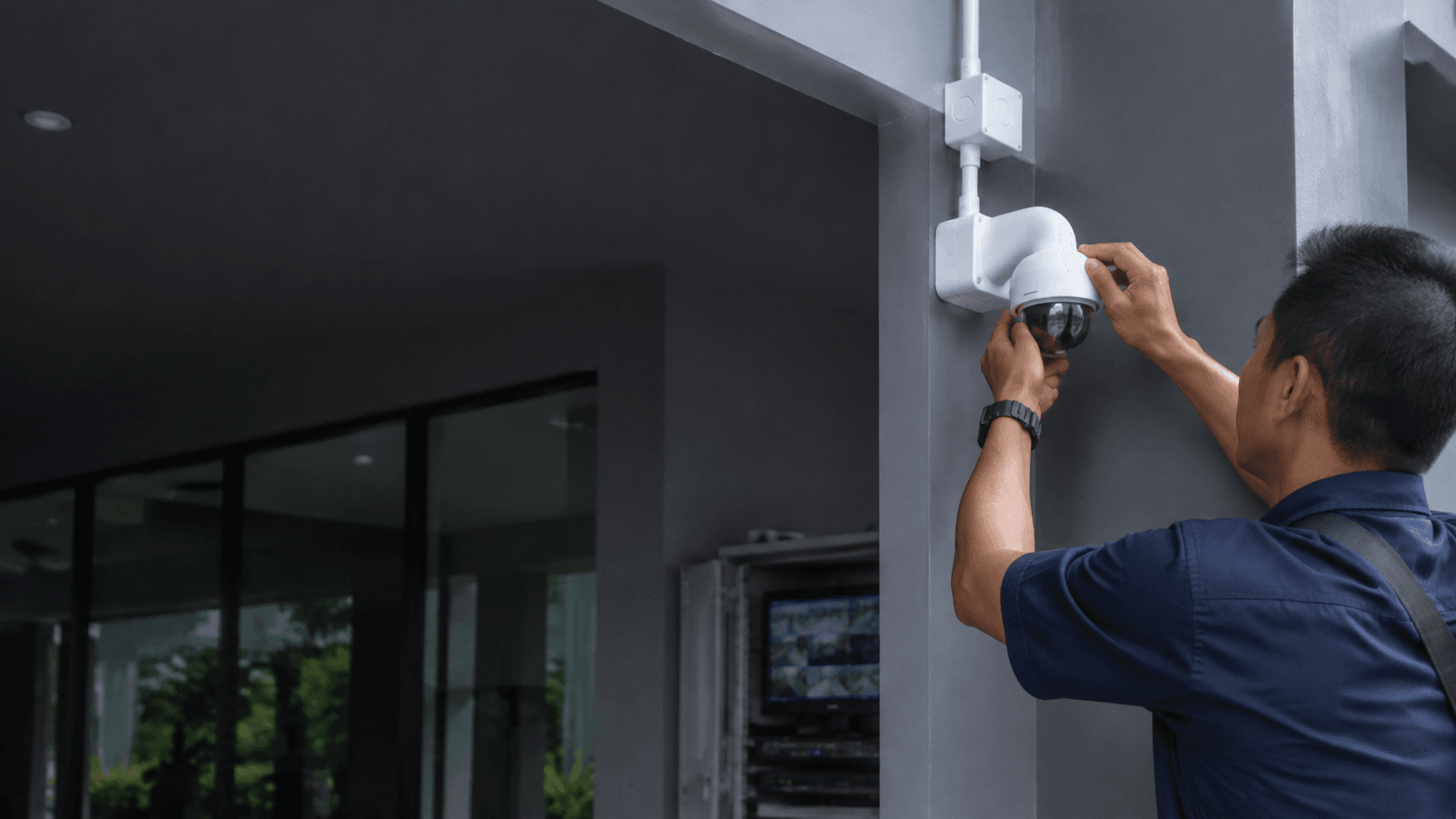
The term describes a category rather than one product. Dahua builds network cameras in several body shapes, and each shape suits a different viewing angle, mounting height and lighting condition. Buyers in Malaysia usually weigh three things before committing: what the camera must see, how it connects to the recorder, and who handles the physical work.
What a Dahua IP camera is used for
A network camera turns a scene into a digital video stream. That stream travels over the same kind of cabling and switching equipment used by office networks, then lands on a recorder or a viewing app. This is the practical difference from older analogue systems, where video travelled on dedicated coax runs to a DVR.
Typical uses split into a few clear jobs:
- Watching an entrance so staff can see who arrives before opening a door.
- Covering a perimeter, car porch or loading area where activity happens at night.
- Recording a counter, till or service window where disputes occasionally arise.
- Monitoring a corridor, stairwell or back-of-house route that has no natural oversight.
Eyonic's own project work follows the same logic. The Kuching Immigration Office engagement focused on arrival flow, staff areas, visitor movement and dependable daily operation. That is a useful template. cameras were placed around how people actually move through a building, not scattered evenly across a floor plan.
Camara Dahua Ip form factors and placement
Body shape decides where a camera can go and what it can realistically see. The common shapes are dome, turret, bullet, cube and PTZ. Dome units sit flush and are harder to redirect by hand, which suits indoor ceilings and shop interiors. Turrets give a wider field of view from a compact housing and are common on exterior walls. Bullets mount on long brackets and reach further down a driveway or fence line. Cubes are small indoor units for a desk, shelf or room corner. PTZ units pan, tilt and zoom, so one unit can cover a large open area at the cost of a higher price and a more complex setup.
Placement matters more than model choice in most residential jobs. Three constraints decide the final position:
- Height and angle — mount high enough to resist tampering but low enough to capture a recognisable face rather than the top of a head.
- Light — check the actual lighting at the exact spot at the exact hour the camera must work, because a position that looks fine at noon can be useless after dark.
- Cable route — confirm a practical path back to the recorder before drilling, since a camera with no clean cable run becomes an expensive ornament.
Eyonic applies the lighting check directly. Its review guidance for ColorVu-style cameras recommends confirming real lighting conditions before locking in a placement, because low-light performance claims on a listing page rarely match a specific wall, tree or streetlamp.
Indoor versus outdoor positions
Indoor positions face softer problems: reflections from glass, backlight from windows, and ceilings too low for a wide-angle view. Outdoor positions face rain, direct sun, insects around the lens and the risk of a camera pointing into a neighbour's window. A position that solves one problem often creates another, which is why a walk-through beats a floor plan.
Camara Dahua Ip setup and network basics
Setup starts before the camera is powered. A network camera needs an address on the local network, a username and password, and a recording destination. Most installations use PoE, which carries both power and data on one Ethernet cable. That removes the need for a separate power point at each camera position, which is often the single biggest cost saver on a retrofit.
The practical sequence for a new camera is straightforward:
- Connect the camera to the network and confirm it appears in the configuration tool.
- Set a strong password and record it somewhere the site owner controls.
- Assign a fixed address so the recorder can always find the camera.
- Set resolution, frame rate and recording schedule to match the storage available.
- Add the camera to the recorder and confirm the live view and playback both work.
- Test remote viewing from outside the local network before handover.
Two constraints catch people out. First, a camera on a different subnet from the recorder will not be found without reconfiguration. Second, a password set once and forgotten becomes a support problem later, so credentials should be handed to the site owner rather than kept only by the installer.
PoE, switches and cable runs
PoE has a distance limit. A single Ethernet run carries power and data reliably up to roughly 100 metres, and beyond that the signal degrades. Long driveways, multi-storey buildings and detached guardhouses therefore need either an intermediate switch or a different approach. Cable quality also matters. a thin or damaged run may pass data but fail to deliver enough power, which shows up as a camera that reboots at night.
Camara Dahua Ip recording and remote viewing
Recording is where a camera system becomes useful rather than decorative. A network video recorder stores the streams, manages retention, and provides the search interface used after an incident. Retention depends on three variables: how many cameras, what resolution they record at, and how many days of footage the site wants to keep. Raising any one of those raises storage requirements.
Remote viewing lets a site owner check a property from elsewhere. It depends on a stable internet connection at the site, correct port or cloud configuration, and an app that matches the recorder. Remote access should be tested from outside the local network, because a view that works on the office Wi-Fi proves nothing about access from another city.
There is a trade-off worth naming. Continuous recording captures everything but fills storage quickly. Motion-triggered recording saves space but can miss the seconds before an event, which are often the most useful. Many sites settle on continuous recording at a lower frame rate for main areas and motion recording for low-traffic zones.
What to check before trusting remote access
Confirm the site's upload speed, not just its download speed, since video leaves the premises. Confirm the recorder's storage health, because a failed drive is silent until someone needs footage. Confirm who holds the account credentials, because a system tied to one installer's account creates a problem when that relationship changes.
installation in Malaysia
Installation quality decides whether a system still works in year three. In Malaysia, outdoor equipment faces heavy rain, high humidity and strong afternoon sun, so mounting height, cable protection and drainage around the mounting point all matter. Cabling run through exposed conduit degrades faster than cabling run under eaves or inside trunking.
Eyonic's CCTV installation process follows four stages:
- Site survey — walk the property, check lighting at the relevant hours, and identify realistic cable routes.
- System proposal — match camera types, recorder capacity and storage to the actual site rather than a generic package.
- Installation — mount, cable, configure and label the system.
- Handover — confirm live view, playback and remote access, and pass credentials to the site owner.
The Kuching Immigration Office project shows how that plays out on a public building, where arrival flow, staff areas and visitor movement all needed coverage without creating blind spots at the entrance. The KTA Sarawak Sdn Bhd project followed a similar pattern for an engineering consultancy office in Kuching, covering staff movement, visitor handling and tidy cabling.
Budget expectations vary widely with camera count, recorder size and cable distance. Eyonic's published project budgets for comparable office work sit in the RM 8,000 to RM 18,000 range for a consultancy office and RM 12,000 to RM 28,000 for a public office, which gives a realistic sense of scale for commercial installations. Eyonic's basic packages for Hikvision CCTV, alarm systems and autogate work are each listed at RM 1,599, covering supply, setup and handover.
Choosing an installer in Sarawak
Ask what happens after handover. A system that nobody can log into, adjust or troubleshoot becomes a liability. Ask whether the installer surveys the site before quoting, because a quote given without seeing the property usually changes once cabling reality appears. Ask who owns the credentials and the recorder account.
Eric Yong, founder of Eyonic Security Systems, has worked in the industry for more than ten years and specialises in technical installation of digital security solutions for commercial businesses in Sarawak. That background matters most on sites where camera placement, network configuration and cabling all interact.
For a specific property, share the location, property type and required system with Eyonic on WhatsApp at +60 11-5111 7959 to move from general information to a practical plan.