
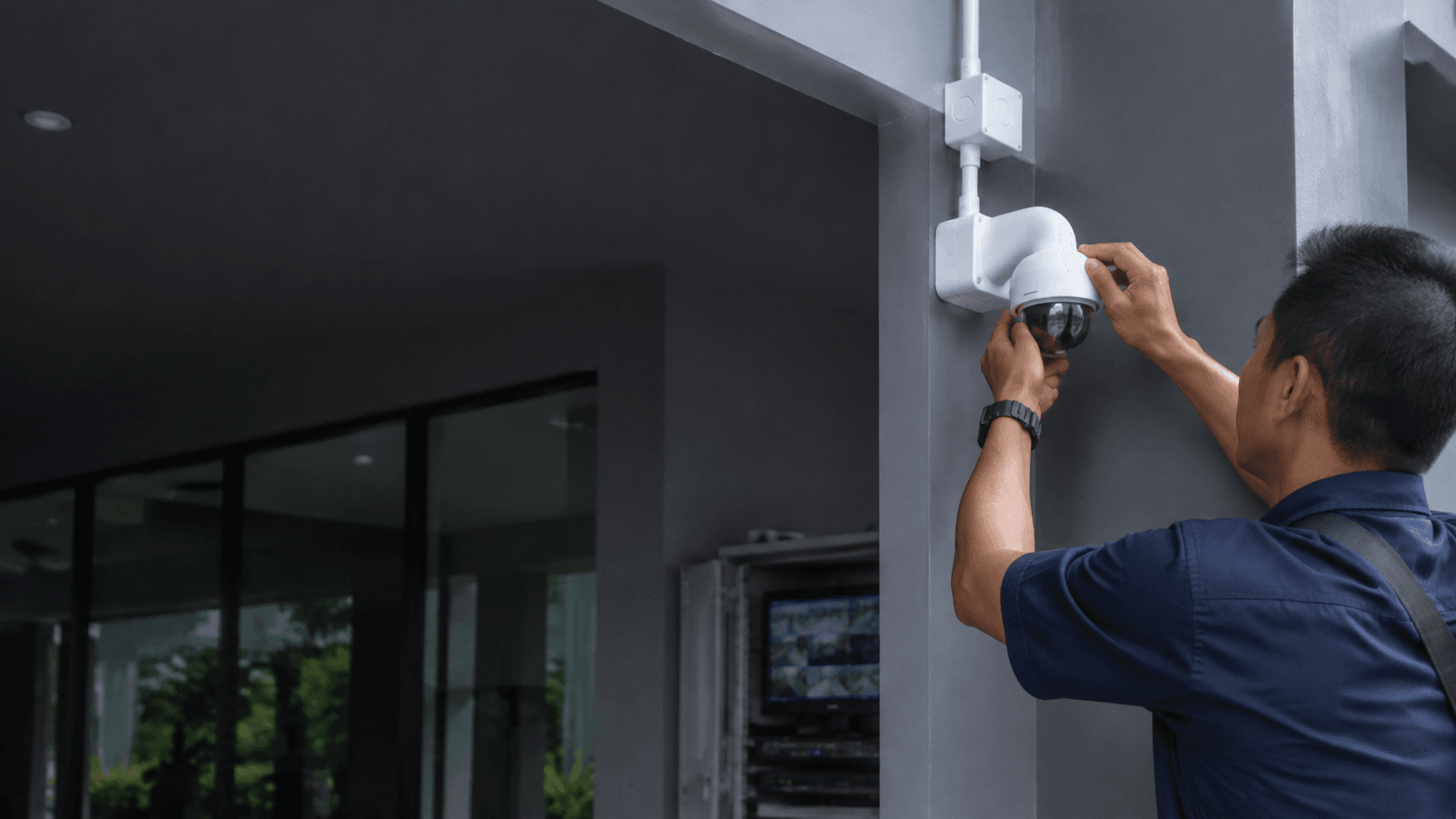
The exact-match query "adt camera system" describes a specific commercial product family, not a generic category of surveillance hardware. That distinction matters because ADT does not manufacture every camera it sells, and the platform chosen determines who installs the equipment, how video is stored, and what monthly cost applies.
This guide covers what the ADT camera system includes, how the two platforms differ, what the published pricing evidence shows, and where a locally installed alternative such as a Hikvision-based setup from Eyonic in Sarawak fits into the decision.
ADT Camera System. What Matters Before Choosing
ADT sells cameras through two separate platforms, and the platform choice drives almost every other decision. Published reviews describe ADT Pro Install as the professionally installed track built around Google Nest cameras, while ADT Blu is the DIY track built around ADT-branded 2K cameras. A buyer comparing an ADT camera system against any other option is really comparing two different products that happen to share a brand name.
The practical consequences of that split are concrete. Pro Install brings a technician to the property and ties cameras into professional monitoring. ADT Blu ships equipment for self-installation and pairs with a lower monthly tier. Neither track offers local storage on the camera itself, which is a recurring criticism in published reviews and a genuine constraint for anyone who wants footage to remain on-site.
Contract terms are the other structural issue. ADT monitoring agreements are typically multi-year, and published reviews consistently flag termination fees as a downside. That makes the total cost of an ADT camera system a multi-year figure rather than a hardware price.
Choosing the Right ADT Camera System
Camera selection inside either platform comes down to placement, power, and how much detail the scene requires. The published lineup covers indoor wired cameras, outdoor wired cameras, battery cameras that work indoors or outdoors, floodlight cameras, and a doorbell camera.
A short decision sequence helps narrow the field:
- Decide whether professional installation or self-installation suits the property, since that determines the platform.
- Identify each location that needs coverage and note whether power and network cabling already reach it.
- Match the camera type to the location: wired indoor for interior rooms, wired or battery outdoor for perimeter coverage, floodlight models where existing exterior lighting is weak, and a doorbell camera for the entry point.
- Check the actual lighting at each location before confirming placement, because night performance depends on what light is already present.
- Confirm the monitoring tier and contract length, then compare the multi-year total against alternatives.
Step four deserves emphasis. Lighting conditions vary enormously between a covered porch and an open car park, and a camera that performs well in one location can underperform in another. Eyonic makes the same point about ColorVu-style cameras, recommending that actual lighting conditions be checked before placement is confirmed. The principle applies to any camera purchase, including an ADT camera system.
What is adt camera system?
An ADT camera system is a camera and monitoring package sold under the ADT brand, delivered through either the professionally installed ADT Pro Install platform with Google Nest cameras or the self-installed ADT Blu platform with ADT-branded 2K cameras. Video is viewed through the ADT+ app, and monitoring is billed monthly on a contract.
The phrase is often used loosely to mean any camera ADT sells, which is why comparisons between an ADT camera system and a competitor system can be misleading. Two ADT customers may own entirely different hardware, different installation experiences, and different monthly bills.
ADT Home Security Cameras | Wireless Indoor & Outdoor
The published camera lineup splits cleanly by mounting environment. Indoor options include wired cameras for fixed interior positions. Outdoor options include wired cameras for permanent exterior mounting, battery cameras for locations without power, and floodlight cameras that combine illumination with recording. A doorbell camera covers the entry.
Wireless and battery models solve the cabling problem but introduce a charging or battery-replacement routine. Wired models avoid that routine but require a cable run to each position. Neither approach is universally better; the right answer depends on whether the property can accept new cabling and whether someone is available to maintain battery-powered units.
Resolution and detection features vary by model within the lineup, so published specifications should be checked per camera rather than assumed across the range. Smart detection and alert behaviour also differ between the two platforms, and the ADT+ app is the common viewing layer.
Outdoor Security Cameras | ADT Security
Outdoor coverage is where most buyers focus, and it is also where the platform split matters most. A wired outdoor camera on Pro Install is positioned and connected by a technician. A battery outdoor camera on ADT Blu is positioned by the property owner, which means placement quality depends on the owner's judgement about angle, height, and light.
For properties in Malaysia and similar climates, outdoor cameras face heat, humidity, and heavy rain. Ingress protection ratings and housing quality become practical concerns rather than specification trivia. Any outdoor camera choice should be checked against the actual weather exposure at the mounting point.
Practical Considerations for ADT Camera System
Cost structure is the first consideration. Published pricing evidence for ADT shows equipment costs, installation fees, and monthly monitoring charges as separate line items, with monitoring commonly cited in the range of roughly USD 25 to USD 50 per month depending on tier. Those figures are published in US market reviews and should be treated as indicative rather than as a Malaysian price.
Availability is the second consideration. ADT's service footprint is concentrated in the United States and Canada. For a buyer in Malaysia, an ADT camera system is not a locally installed product with local support; it is an imported or unavailable option depending on the channel. That is a hard constraint, not a preference.
The third consideration is storage. Published reviews note the absence of local storage on ADT cameras, with footage held in the cloud under a subscription. Buyers who need on-site recording, or who want footage to remain available without an active subscription, will find that limitation significant.
For readers in Sarawak, the practical comparison is usually between an imported subscription-based system and a locally installed one. Eyonic, a security system supplier based in Sarawak, plans, supplies, and installs CCTV systems with camera placement, recording, and remote viewing for homes, offices, shops, and industrial sites. The company's installation process runs through site survey, system proposal, installation, and handover, which is a different commercial model from a subscription camera platform.
Local installation also brings documented project experience. Eyonic completed work for the Kuching Immigration Office focused on arrival flow, staff areas, visitor movement, and dependable daily operation, and a separate project for KTA Sarawak Sdn Bhd covering staff movement, visitor handling, tidy cabling, and clearer daily site control. Those projects illustrate the kind of requirement — multi-area coverage with tidy cabling and daily reliability — that a subscription camera platform handles differently from a locally specified system.
Budget expectations differ too. Eyonic publishes a Hikvision CCTV package at RM 1,599 covering camera supply and setup, basic recording configuration, and mobile viewing handover. Larger multi-area projects sit in a different bracket; the Kuching Immigration Office project carried an approximate budget of RM 12,000 to RM 28,000, and the KTA Sarawak project an approximate budget of RM 8,000 to RM 18,000. Those figures describe project scope rather than a camera-only price.
Making an Informed Choice About
The decision usually resolves into three questions. Is ADT serviceable at the property's location? Is a multi-year monitoring contract acceptable? And does cloud-only storage meet the requirement?
If all three answers are yes, the ADT camera system is a coherent choice, and the remaining decision is which platform fits: Pro Install for professional installation and deeper monitoring integration, or ADT Blu for self-installation and a lower monthly tier.
If any answer is no — particularly the availability question outside North America — a locally installed system becomes the more practical route. In Sarawak, that means a supplier who can survey the site, propose camera positions based on actual lighting and cabling conditions, install the system, and hand it over with recording and remote viewing configured.
Either way, the same discipline applies. Confirm what is being installed, where each camera will sit, how footage is stored, what the recurring cost is, and what happens at the end of any contract term. Those five points separate a system that works for years from one that becomes a maintenance problem.
Readers who want to move forward on the local route can share their location, property type, and required system with Eyonic on WhatsApp at +60 11-5111 7959.