
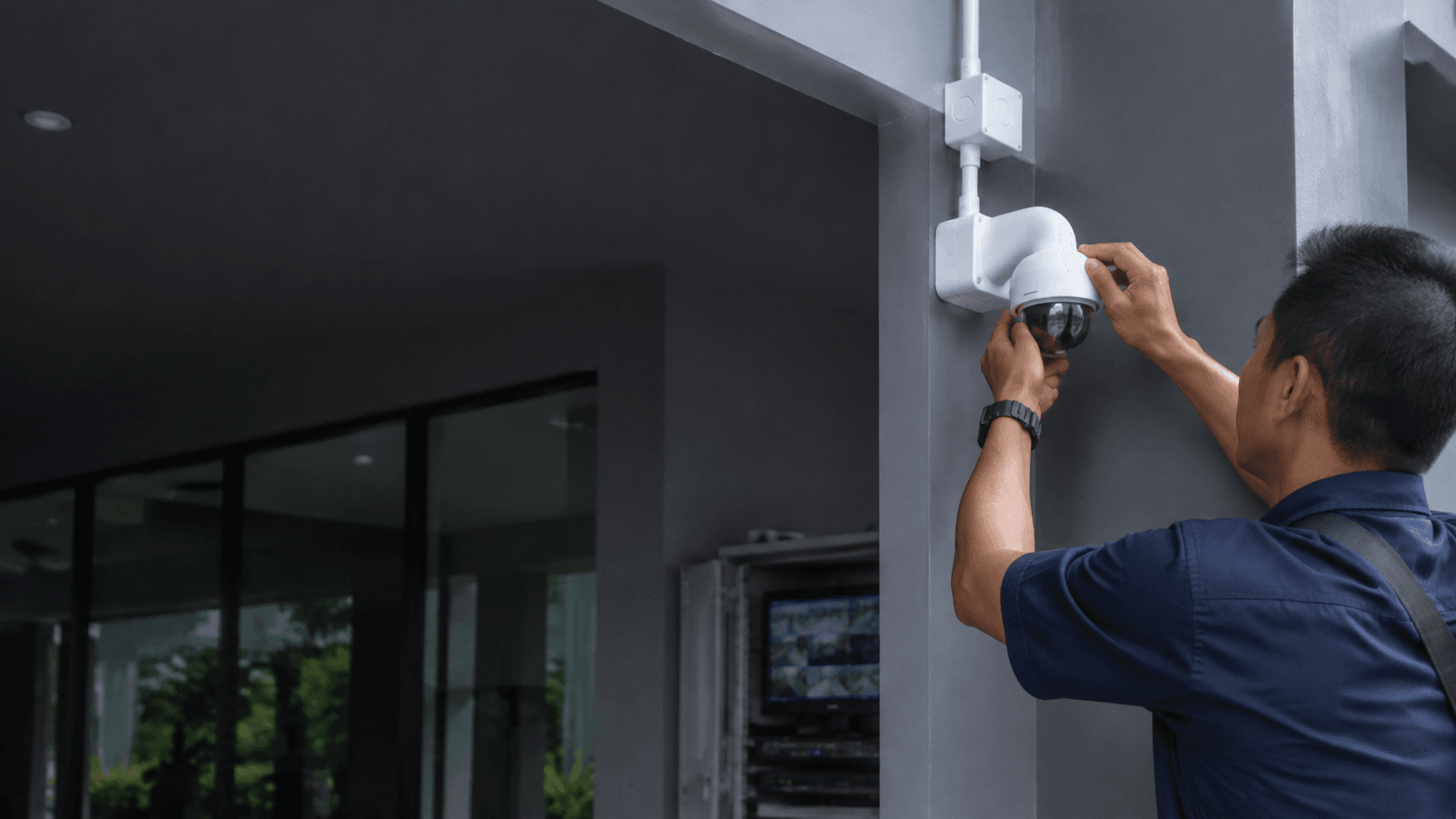
The entrance is the one part of a property that every visitor, delivery and stranger must pass through. A doorbell security system puts monitoring at that single point, which is why it often comes up before a full camera layout is planned. The sections below cover what the device actually does, when it fits a Malaysian home or business, what to compare, and how it sits alongside CCTV, alarms and access control.
Doorbell Security System. What It Covers at the Entrance
A doorbell security system combines a doorbell button with a camera and, in most designs, two-way audio. Pressing the button triggers a chime inside the property and a notification to a phone or monitor. Many units also record when motion is detected near the door, so a visitor who never presses the button still appears on footage.
The coverage is deliberately narrow. The camera looks at the approach to one door, not the whole compound. That narrow view is the point. a face at the door is captured close up, at a distance where identification is realistic, rather than as a small figure at the edge of a wide-angle frame.
Three functions usually sit inside the same device:
- Visitor alerting, so someone inside knows a person is at the door.
- Video capture of the entrance area, either on button press, on motion, or continuously.
- Two-way audio, so the person inside can speak to the visitor without opening the door.
What the device does not do is replace a recording system for the rest of the property. A gate, a car porch, a side lane and a rear entrance all sit outside its field of view. Treat entrance monitoring as one layer, not the whole plan.
When a Doorbell Security System Suits a Malaysian Property
Entrance monitoring earns its place when the door is the main point of contact with the public and someone inside needs to decide whether to open it. That describes a lot of Malaysian properties.
For a landed home, the common case is a front door that is set back from the gate. Someone in the living room or upstairs cannot see who is at the door without walking to it. A doorbell security system answers that specific problem: the visitor is visible and speakable before the door is unlocked.
For a shop or office, the entrance is where walk-in traffic, deliveries and appointment visitors arrive. A camera at the door gives staff a moment to prepare, and it records who came in during a disputed delivery or an incident. Eyonic's work for the Kuching Immigration Office centred on arrival flow, staff areas and visitor movement, which is the same category of problem at a larger scale.
It fits less well in three situations. A property where the gate, not the door, is the real decision point may get more value from a camera at the gate. A rented unit where the door cannot be modified may rule out wired units. And a property that already has a camera covering the door from a good angle may only need the chime and intercom function, not a second camera.
What to Compare Before Choosing a Doorbell Security System
Most published comparisons of this product category are written for the United States, where brand rankings, subscription plans and retailer pricing dominate the page. Those details do not transfer to a Malaysian purchase. What transfers is the set of physical questions that decide whether the installation works at all.
Power is the first fork. A wired unit draws from existing doorbell wiring and runs continuously. A battery unit avoids wiring but needs charging, and the interval depends on how often motion is triggered. A property with no doorbell wiring and no easy route to a power source is a battery case; a property with existing wiring is usually a wired case.
Recording and storage is the second fork, and it is where subscription assumptions cause the most confusion. Some units store footage locally on a card or recorder, some rely on a paid cloud plan, and some do both. The right question is not which brand is best but where the footage will live and who can retrieve it. If footage needs to be kept for a business record, that requirement should be settled before the unit is chosen, not after.
Network coverage is the third. A unit that streams to a phone needs a stable signal at the door. A door at the far end of a large house, or behind a thick wall, is a common weak point. This is a site condition, not a product specification, and it is one reason a survey before purchase saves rework.
Before confirming any unit, work through these checks in order:
- Inspect the door and frame for condition, material and whether drilling or mounting is acceptable.
- Check the lighting at the entrance at the times of day the door is actually used, including after dark.
- Confirm whether existing doorbell wiring is present and usable, or whether a battery unit is required.
- Decide where recorded footage will be stored and how long it needs to be kept.
- Agree who inside the household or business needs access to the live view and the recordings.
- Confirm any building, landlord or management requirement that applies to cameras at the entrance.
Eyonic's own guidance on ColorVu-style cameras makes the same point about lighting: actual conditions at the site should be checked before placement is confirmed, because a camera chosen on a specification sheet can still produce a poor image under the real light at that door.
How Entrance Monitoring Fits With CCTV, Alarms, and Access Control
These four systems answer different questions, and the entrance is where they overlap.
CCTV covers area. It watches the gate, the porch, the lane and the interior, and it records continuously or on schedule. A doorbell security system covers a point. It watches one door closely and is built around the moment a visitor arrives. Where a CCTV camera already looks at the door from a suitable angle, the doorbell unit adds the chime, the two-way audio and the close-up view rather than duplicating coverage.
An alarm system covers intrusion. It reacts to a door or window opening, or to motion inside, and it raises a siren or a notification. It does not identify a visitor, and it does not help decide whether to open the door. The two systems are complementary: the alarm handles the event after entry is forced, the entrance camera handles the decision before the door is opened.
Access control covers permission. A smart lock or an access-control panel decides who can open the door and records when it was opened. Eyonic's own review guidance notes that smart locks work best when door condition, user roles and a backup entry method are reviewed before installation, and that for business use the choice between a standalone smart lock and an access-control panel should be checked first. The same logic applies at the entrance: if the door needs to be opened remotely for a delivery, that is an access-control decision, and it should be planned with the camera rather than added afterwards.
For a business entrance, the practical combination is a camera at the door, an alarm on the perimeter, and an access method that records who entered. For a home, the camera and chime alone often cover the need, with the alarm handling the rest of the property.
Installation Checks That Decide Whether the View Works
The view is decided by placement, not by the box. A unit mounted too high looks down at the top of a visitor's head. A unit mounted where a wall or pillar blocks the approach captures an empty step. A unit facing a bright street or a reflective surface at night can lose the face entirely.
Eyonic's installation process for CCTV runs through site survey, system proposal, installation and handover. The survey stage is where the entrance questions get answered: where the camera can see the approach, where power and network reach, and how the cabling will be routed tidily. The handover stage is where the people who will use the system learn how to view the entrance and retrieve footage.
Two constraints are worth naming. First, the entrance camera sees the public side of the door, so the field of view may include a neighbour's doorway or a shared corridor. Second, a wired installation involves drilling and routing, which is a decision for the property owner, not only the occupant. Neither is a reason to avoid the system, but both are reasons to settle placement before the unit is fixed to the wall.
Evidence Gaps and What Still Needs Verification
Several details that appear on imported comparison pages cannot be confirmed for the Malaysian market from the available evidence, and they should be verified against official product documentation and the actual site rather than assumed.
Specific doorbell camera models, resolutions, night vision performance, field of view and power options are not confirmed here. Subscription costs, cloud storage terms and local storage capacity for any doorbell product are not confirmed. Pricing for a doorbell security system is not confirmed; the published RM 1,599 packages cover a Hikvision CCTV package, a Hikvision alarm system and an autogate package, not doorbells. Warranty terms, product certifications and brand authorisations for doorbell hardware are not confirmed. Malaysian regulatory, strata and landlord requirements for entrance cameras are not confirmed and depend on the specific property.
Eyonic's confirmed scope is CCTV and ELV work, including alarm systems, autogate, keyphone intercom and related installation, with planning, supply and installation for homes, offices, shops and industrial sites. Whether a specific doorbell unit is supplied and installed, and how it would integrate with existing CCTV or alarm work, is a question for the supplier rather than an assumption to make from a product page.
Share your location, property type and required system with Eyonic on WhatsApp at +60 11-5111 7959 for the next practical step.