
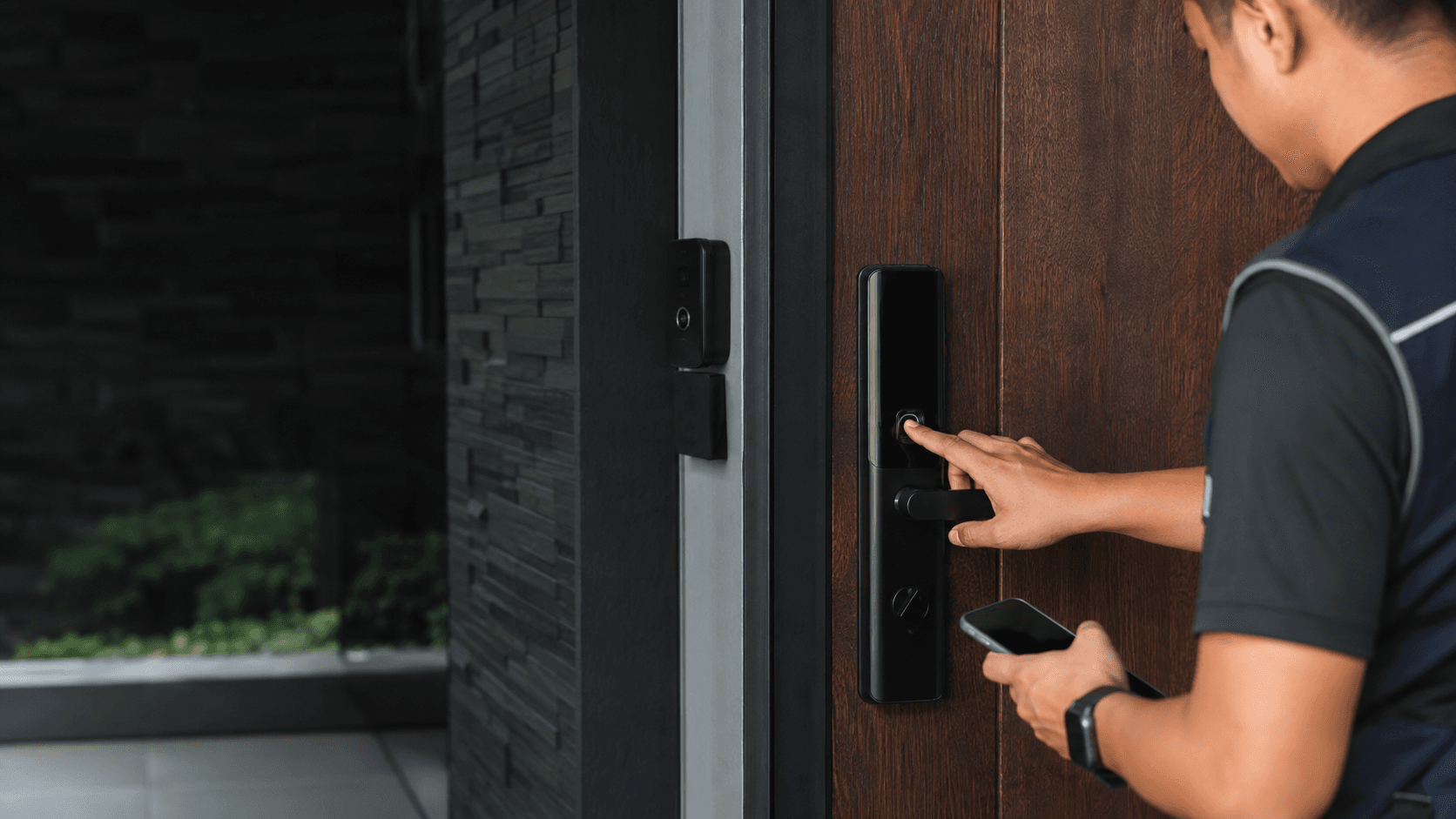
Bluetooth reaches roughly one room. A gateway sits within that short range, holds a Wi-Fi connection of its own, and passes commands between the lock and the app. That single relay is what turns a lock that only responds at the door into one that responds from anywhere.
What the Smonet Gateway actually does
A Bluetooth smart lock talks directly to a phone. Stand outside the door with the phone in hand and the lock opens. Walk away and the link breaks, because Bluetooth does not travel across a city.
The Smonet Gateway solves that distance problem. It stays paired to the lock over Bluetooth and joins the local Wi-Fi network at the same time. When a command arrives from the app, the gateway forwards it to the lock. When the lock reports a status change, the gateway sends it back. The lock itself never needs a Wi-Fi radio.
This is why the device is often described as a bridge or hub rather than a lock. It carries no keypad and no deadbolt. Its whole job is translation between two radio standards that do not speak to each other directly.
Why the lock cannot simply use Wi-Fi
Battery life drives the design. A lock that maintains a Wi-Fi connection draws far more power than one that wakes briefly for a Bluetooth handshake. Keeping Wi-Fi in a mains-powered gateway and Bluetooth in the battery-powered lock separates the heavy radio work from the part that must run for months on cells.
The trade-off is a second device to power and place. The benefit is a lock that stays responsive without frequent battery changes.
When a Smonet Gateway is required and when it is not
A gateway is needed when the lock must be operated from outside Bluetooth range. That covers remote unlock for a visitor, checking whether a door is locked while away from the property, issuing or revoking codes without standing at the door, and any voice-assistant control that depends on an internet connection.
It is not needed for entry at the door. Keypad codes, fingerprint reads, physical keys, and phone-in-hand Bluetooth unlocking all work without a gateway, because each of those happens within arm's reach of the lock.
Three situations make the gateway optional rather than essential:
- A single home where every user arrives in person and unlocks on the spot.
- A property with no reliable Wi-Fi at the door, where a gateway would have nothing to connect to.
- A site where remote access is deliberately avoided for security policy reasons.
Two situations make it close to mandatory: short-stay rentals where guests arrive without a handover, and offices where staff or contractors need entry outside office hours without someone present.
Does every Smonet lock need one?
Not every lock in a range requires a gateway, and the pairing depends on the specific model. The safe check is the product documentation for the exact lock, which states whether a gateway is supported and which app manages it. Buying a gateway before confirming that pairing risks a device that cannot join the lock.
What to check before choosing a gateway
Most gateway problems trace back to something that was not checked before purchase. Working through the following in order avoids the common failures.
- Confirm the lock model supports a gateway and note which app controls it, since app and gateway must match.
- Check the Wi-Fi band at the door. Gateways in this category typically work on 2.4 GHz, and a 5 GHz-only network will not connect.
- Measure the distance between the intended gateway position and the lock, keeping the gateway inside Bluetooth range with as few walls between them as possible.
- Identify a power point near that position, because the gateway needs continuous power rather than occasional battery attention.
- Decide the backup entry method before installation, so a flat battery or network outage does not lock out the people who need access.
- Map user roles in advance, separating permanent residents, recurring staff, and one-time visitors so codes can be issued and revoked cleanly.
- Test the door itself. Alignment, strike plate position, and door thickness affect whether a smart lock fits and latches reliably.
Item two causes the most support calls. A router broadcasting only on 5 GHz looks healthy on a phone and still refuses the gateway. Splitting the network or enabling the 2.4 GHz band resolves it.
Where the gateway should sit
Placement is a range decision, not a convenience decision. A gateway on the other side of a reinforced wall may pair during setup and drop later. Metal doors, thick concrete, and dense shelving all shorten Bluetooth range. A position with clear line of sight to the lock is more reliable than one chosen purely because a socket was free.
How the fits a wider access plan
A gateway is one component in a door-access decision. The wider question is whether a standalone smart lock is the right tool at all, or whether the site needs an access-control panel with centralised records.
For a home or small shop, a smart lock plus gateway is usually proportionate. For a site with many doors, staff shifts, and a need to review who entered where, a panel-based system handles that better. The gateway extends one lock to the internet; it does not turn a set of locks into a managed access-control system.
Eyonic, a security system supplier in Sarawak, reviews door condition, user roles, and backup entry method before recommending smart lock installation, and checks whether a standalone lock or an access-control panel suits the site. That review matters more than the gateway choice itself, because a gateway cannot fix a door that does not latch or a permission structure nobody has thought through.
Access planning at this scale is familiar work locally. Eyonic supported the Kuching Immigration Office on arrival flow, staff areas, visitor movement, and dependable daily operation, and completed an office setup for KTA Sarawak Sdn Bhd covering staff movement, visitor handling, and tidy cabling. Both projects show the same principle: the entry hardware follows the movement pattern, not the other way round.
Where the gateway stops being enough
Three limits are worth stating plainly. A gateway depends on the internet connection at the property, so an outage removes remote control even though local entry still works. It manages the lock it is paired to, not every lock on site. And it does not create an audit trail comparable to a managed access-control platform.
If any of those three matter, the gateway is a partial answer and the wider system deserves a separate look.
Questions to settle before buying
These are the points that decide whether the purchase works in practice.
Will the gateway connect to the existing router? Check the band first. A 2.4 GHz network is the usual requirement, and a dual-band router that separates the two bands gives the cleanest result.
What happens during a power cut? The gateway loses power and remote access stops. The lock keeps working through its own keypad, key, or fingerprint reader, which is why the backup method is decided before installation rather than after.
Can one gateway serve several locks? Capacity varies by model and should be confirmed against documentation for the specific device rather than assumed from a product listing.
Who manages the codes? Remote access means someone holds the ability to issue and revoke entry. Naming that person, and a second person as cover, prevents a situation where nobody can grant access when it is needed.
Is the door suitable? A lock that binds against a misaligned frame will keep reporting faults regardless of how well the gateway performs.
For properties in Sarawak, sharing the location, property type, and the system required with Eyonic on WhatsApp at +60 11-5111 7959 gives a practical starting point for the next step.