
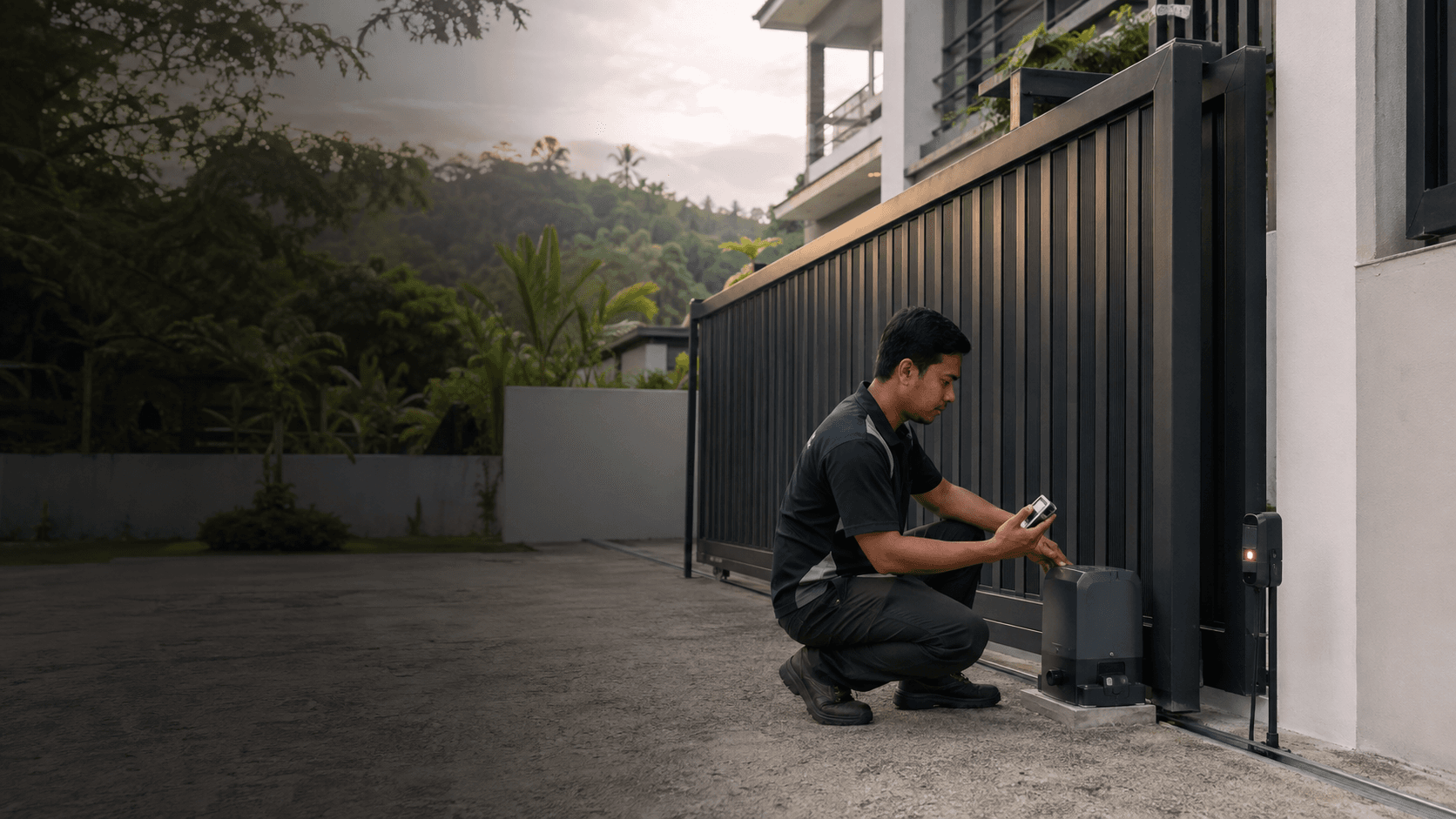
Auto Gate Installation. What Matters Before You Choose
Auto gate installation begins with understanding the property's physical constraints rather than selecting a motor first. The gate type, available space, power source, and daily usage pattern determine which system will operate reliably over time. A sliding gate suits properties with limited driveway depth, while swing gates need clearance for the gate leaf to arc outward. Measuring the opening width, gate weight, and available mounting surfaces before any purchase prevents costly mismatches between the motor capacity and the actual gate structure.
The decision between professional installation and a DIY approach depends on the existing infrastructure. Properties with no nearby power supply may need solar-ready systems or battery backup, which adds complexity to the auto gate installation process. Local soil conditions affect post footing depth for sliding gate tracks, and uneven driveways require additional ground preparation. These site-specific factors explain why most manufacturers publish detailed installation manuals while still recommending professional assessment for unusual layouts.
Choosing the Right Auto Gate Installation
Selecting the correct system for auto gate installation requires matching the operator mechanism to the gate's physical characteristics and the property's security needs. The table below compares the main automatic gate types based on their operational requirements and typical applications.
| Gate Type | Space Required | Best Fit | Key Trade-Off |
|---|---|---|---|
| Sliding gate | Lateral space along fence line | Long driveways, limited depth | Needs level track and regular debris clearing |
| Swing gate | Forward clearance for leaf arc | Wide entrances, residential use | Requires space for arc; dual motors for heavy leaves |
| Vertical pivot gate | Headroom above opening | High-security sites, flood-prone areas | More complex mechanism; higher installation cost |
| Cantilever sliding | No ground track | Uneven ground, heavy gates | Higher hardware cost; precise engineering needed |
Swing gates suit most residential properties where the driveway opens onto a road with adequate clearance. Sliding gates become necessary when the driveway slopes upward from the road or when the property line sits close to the entrance. Vertical pivot gates appear more often in commercial and government settings where security requirements outweigh convenience considerations. The gate weight and wind exposure in open areas also influence whether a single motor or dual motors are required for reliable operation.
What is auto gate installation?
Auto gate installation is the process of fitting an automated operator to a gate so it opens and closes without manual effort. The work involves mounting the motor mechanism, running power and control wiring, installing safety sensors, and programming remote access devices. A complete installation also includes testing the system's safety features, such as obstacle detection and manual release mechanisms, before the gate enters daily service.
The scope of work differs significantly between a basic residential swing gate and a commercial sliding gate with access control integration. Residential systems typically use a single motor, two remote controls, and basic safety sensors. Commercial installations often add keypads, intercom systems, card readers, and integration with CCTV monitoring. Understanding this range helps property owners communicate their requirements clearly when requesting proposals from installation providers.
Practical Considerations for Auto Gate Installation
Site preparation often determines the long-term reliability of an auto gate installation more than the quality of the motor itself. The gate structure must move freely by hand before any motor is attached; a gate that binds or drags will strain the operator and fail prematurely. Concrete footings need adequate curing time before mounting brackets are secured, and underground conduit should be laid before driveways are paved if wiring will cross the entrance.
Power supply planning affects both installation cost and system resilience. A dedicated circuit with proper weatherproofing protects the motor and control board from electrical surges. Battery backup systems keep gates operational during power outages, which matters for properties where the gate is the primary security barrier. Solar-powered options reduce ongoing electricity costs but require careful panel placement to maintain consistent charging throughout the year.
Safety features are not optional additions but core components of any professional auto gate installation. Photoelectric sensors detect obstacles in the gate's path and reverse the motion before contact occurs. Pressure-sensitive edges provide a secondary safety layer on swing gates. Emergency release mechanisms allow manual operation during power failures or motor faults. These systems must be tested regularly, and property owners should understand how to operate the manual release in an emergency.
Working With an Installation Provider
Professional auto gate installation providers typically follow a structured process that begins with a site survey rather than a price quote. The survey assesses the gate's condition, available power, soil type, and security requirements. Following the survey, the provider presents a system proposal that specifies the motor type, safety features, and access control options suited to the property. Installation work proceeds only after the proposal is approved, and a handover session explains system operation and maintenance to the owner.
This structured approach mirrors the process used by security system integrators for related installations. Eyonic, a security system supplier in Sarawak, Malaysia, applies the same site survey, proposal, installation, and handover sequence to its CCTV and autogate installation services. The company's completed projects include practical support for the Kuching Immigration Office, where the focus was on arrival flow, staff areas, visitor movement, and dependable daily operation. This example illustrates how professional installation providers assess operational needs before recommending specific equipment.
Making an Informed Choice About Auto Gate Installation
Comparing auto gate installation options requires looking beyond the initial hardware price to consider the total cost of ownership. A cheaper motor that cannot handle the gate's weight or duty cycle will fail sooner, requiring replacement labour that exceeds the initial savings. Conversely, an oversized motor adds unnecessary expense without improving performance for a lightweight residential gate. The gate's expected usage frequency matters: a home entrance used a few times daily needs a lighter-duty system than a commercial facility with constant vehicle traffic.
Warranty terms and after-sales support differ between brands and installation providers. Some manufacturers offer extended warranties when certified installers perform the work, while DIY installations may void coverage. Local support availability affects repair turnaround times when faults occur. Property owners should confirm who responds to service calls and what response time is guaranteed before committing to a particular provider.
The decision sequence below outlines the practical steps for evaluating an auto gate installation project:
- Measure the gate opening width, gate leaf weight, and available space for the operator mechanism.
- Identify the power source location and whether underground wiring or solar power is more practical.
- Assess the gate's current condition, including hinges, wheels, and ground level, to determine if repairs are needed first.
- Define the access control requirements, such as remote controls, keypads, intercoms, or smartphone integration.
- Request site surveys from installation providers and compare their proposed systems, not just their prices.
- Confirm safety features, warranty coverage, and after-sales support before approving the installation.
Property owners in Sarawak considering auto gate installation can share their location, property type, and required system with Eyonic on WhatsApp at +60 11-5111 7959 for the next practical step. The company's experience spans residential and commercial security installations, including projects for government offices and engineering consultancy firms in the Kuching area.