
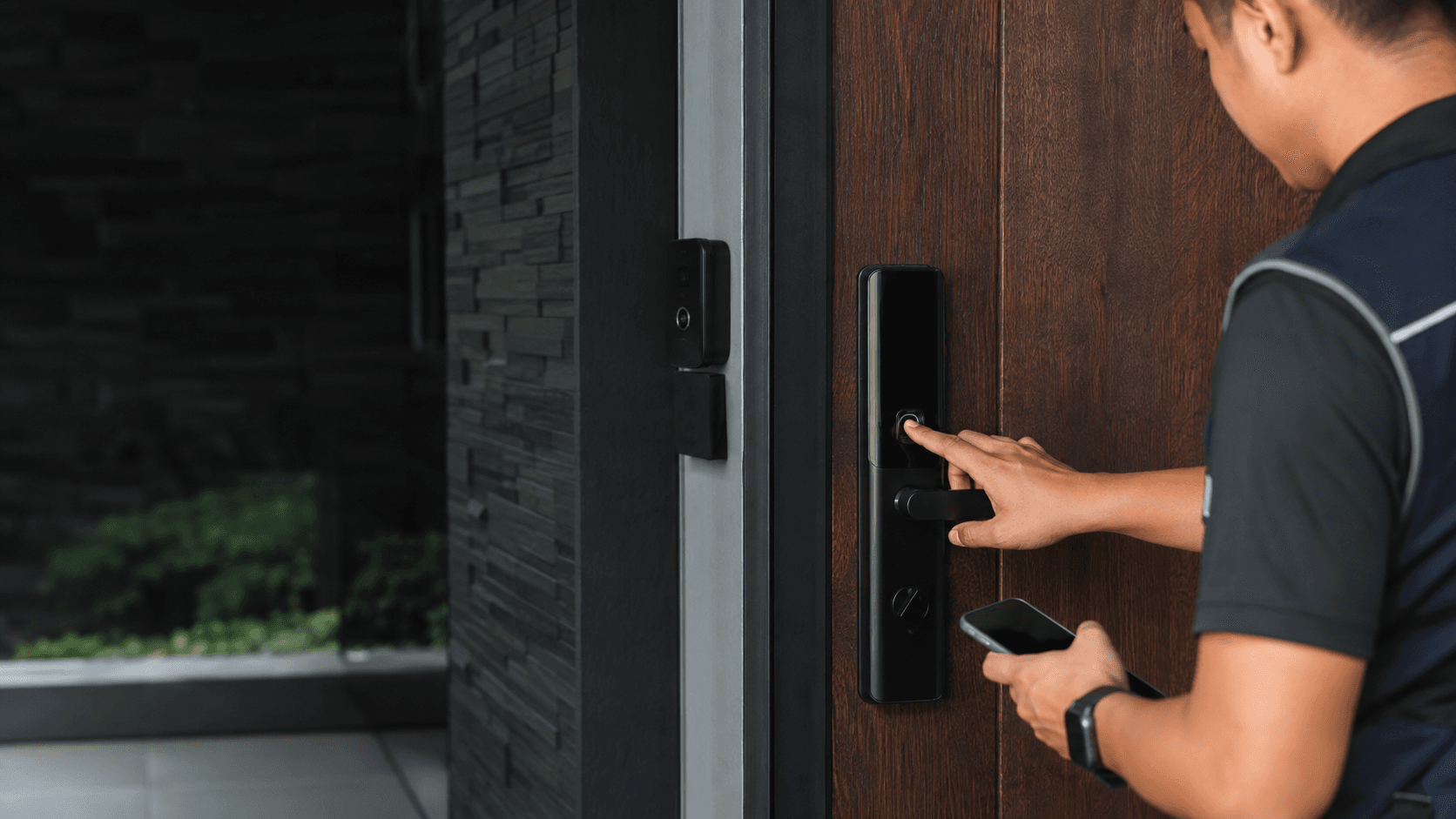
The term covers a narrow product: a deadbolt body that throws a bolt into the door frame, driven by an electronic keypad instead of a key turn. It is not a handle set, not a lever lock, and not the same thing as a full access-control panel with card readers and door controllers. A keypad deadbolt usually keeps a mechanical keyway as a fallback, so the door still opens with a key if the electronics fail.
Most models in this category share the same basic parts. There is an exterior keypad, an interior assembly holding the motor and batteries, a bolt that extends into the strike plate, and a cylinder for the backup key. Some units add Bluetooth or Wi-Fi, some add fingerprint readers, and some are standalone with no network connection at all. The differences that matter at a doorway are usually mechanical rather than digital.
Electronic Keypad Deadbolt Door Lock: what the term covers
A keypad deadbolt is a powered bolt, not a powered handle. The keypad sends a signal to a small motor, the motor retracts the bolt, and the door swings free once the handle is turned. Because the bolt does the security work, the lock's resistance to physical attack depends on the bolt, the strike, and the frame, not on the keypad itself.
That distinction matters when comparing products. A keyless entry lock with a keypad on a lever handle looks similar in photographs but behaves differently: the latch is spring-loaded and easier to slip, while a deadbolt is a solid bar. For a main entrance, the deadbolt is the part that resists forced entry.
Standalone keypad deadbolts store codes on the lock itself. Networked versions push codes to a hub or app, which allows remote changes and audit logs. The standalone version keeps working when the internet is down; the networked version adds convenience and record-keeping but depends on a stable connection and a power source for the hub.
How keypad entry and user codes work in daily use
A user code is a short number assigned to one person or one purpose. The lock stores a set of these codes, and each code unlocks the door independently. When someone leaves, that person's code is deleted without changing anyone else's.
Daily use usually settles into a few patterns. Family members get permanent codes. A cleaner, contractor or delivery contact gets a temporary code that expires. A single shared code is used for a gate or a back door where individual tracking is not needed. The lock's own capacity sets the ceiling on how many of these can exist at once.
Auto-lock is the feature that most changes behaviour. With auto-lock on, the bolt re-extends after a set delay once the door closes, so the door cannot be left unlocked by accident. The trade-off is that anyone still moving through the doorway needs enough time, and a door that does not close fully can trigger a lock against an open frame.
Two practical habits reduce most day-to-day problems. First, keep at least one code that is not shared with visitors, so the household always has a working entry. Second, review the code list when circumstances change rather than waiting for a problem. A code list that nobody has audited for a year is usually carrying entries for people who no longer need access.
Door condition and installation checks before buying
Most keypad deadbolt problems are door problems. The lock is a precision mechanism mounted on a surface that may be out of alignment, swollen, or bored to a different standard than the lock expects. Checking the door first prevents a purchase that cannot be fitted properly.
- Confirm door thickness and backset, because the bolt and mounting hardware are sized to a specific door depth and to the distance from the door edge to the bore hole.
- Confirm handing, since a lock that is not reversible must match whether the door opens to the left or the right.
- Confirm the existing bore and latch, including the cross-bore diameter and whether the current cut-out matches the new bolt.
- Confirm user roles and code sharing, so the number of codes and the need for temporary access are known before a model is chosen.
- Confirm the backup entry method, including whether a mechanical keyway is required and who holds the key.
- Confirm power or battery expectations, including how the lock is powered, how low battery is signalled, and what happens when power runs out.
Door thickness and backset are the two measurements that most often decide whether a lock fits at all. A door that has been bored for a different backset may need the hole adjusted, and a thin or hollow door may not carry the bolt securely. Handing matters on non-reversible models, and the existing bore determines whether the new lock drops in or requires carpentry.
Frame condition belongs on the same checklist. A strike plate screwed into a soft frame, or a frame that has moved with the building, will let a locked door move under pressure. Reinforcing the strike is often more valuable than upgrading the lock.
Backup entry, power and access planning
Every electronic lock needs a plan for the day it does not open. The most common backup is a mechanical key, which means a key must be stored somewhere other than inside the property. A second option is an external power point, where a battery can be touched to the terminals to wake a flat lock. A third is a second entrance that is not electronically controlled.
Battery behaviour deserves a decision before installation, not after. Locks signal low battery in different ways, and the warning period varies. A lock on a busy shop door will drain faster than one on a home's side entrance, so the replacement interval is a property-specific number rather than a fixed one.
Access planning is the part that separates a convenient lock from a frustrating one. A home with two or three regular users needs very little structure. A shop with staff turnover, deliveries and after-hours access needs a written rule for who gets a code, how long it lasts, and who removes it. Where individual accountability matters, a networked lock with an audit trail answers questions that a standalone keypad cannot.
For business doors, the choice is often between a standalone smart lock and an access-control panel. A standalone lock is simpler and cheaper to run. A panel supports multiple doors, central control and reporting. The deciding factor is usually the number of doors and whether records are needed, not the lock itself.
Electronic Keypad Deadbolt Door Lock for homes, offices and shops
A home entrance is the simplest case. One door, a small number of users, and a backup key held by a neighbour or family member covers almost every situation. The main risks are a door that does not close cleanly and a battery that runs flat without warning.
An office door adds staff movement and visitor handling. Codes need to change when people join or leave, and a shared code for a main entrance weakens any record of who entered. Where a site already has staff and visitor flows to manage, the lock is one part of a wider arrangement rather than a standalone fix.
A shop door adds trading hours, deliveries and after-hours access. A keypad deadbolt removes the need to hand out keys, but it does not by itself record who came in or when. Shops that need that record are usually better served by a networked lock or a small access-control setup.
Eyonic's work at the Kuching Immigration Office focused on arrival flow, staff areas, visitor movement and dependable daily operation, which is the same set of questions a keypad deadbolt raises at a single door. The scale differs; the planning questions do not.
Where Eyonic fits for supply and installation
Eyonic Sdn Bhd plans, supplies and installs security and ELV systems in Sarawak, covering homes, offices, shops and industrial sites. The company's smart lock door access review notes that smart locks work best when door condition, user roles and backup method are reviewed before installation, and that business use often requires checking whether a standalone smart lock or an access-control panel is the better fit.
That review step is the same one described above. A site survey establishes the door, the users and the backup requirement; a proposal sets out what will be supplied and fitted; installation follows; and handover covers how the lock is used day to day. Eyonic's published installation process for its other systems follows that sequence of site survey, system proposal, installation and handover.
Eyonic's published packages cover Hikvision CCTV, alarm systems and autogate at RM 1,599 each. Those packages are separate products and do not represent keypad deadbolt pricing, which is not published. Anyone comparing a door lock against a wider security setup should treat them as different purchases with different scopes.
For a property in Sarawak, the practical next step is to describe the door, the property type and who needs access. Share your location, property type and required system with Eyonic on WhatsApp at +60 11-5111 7959 for the next practical step.