
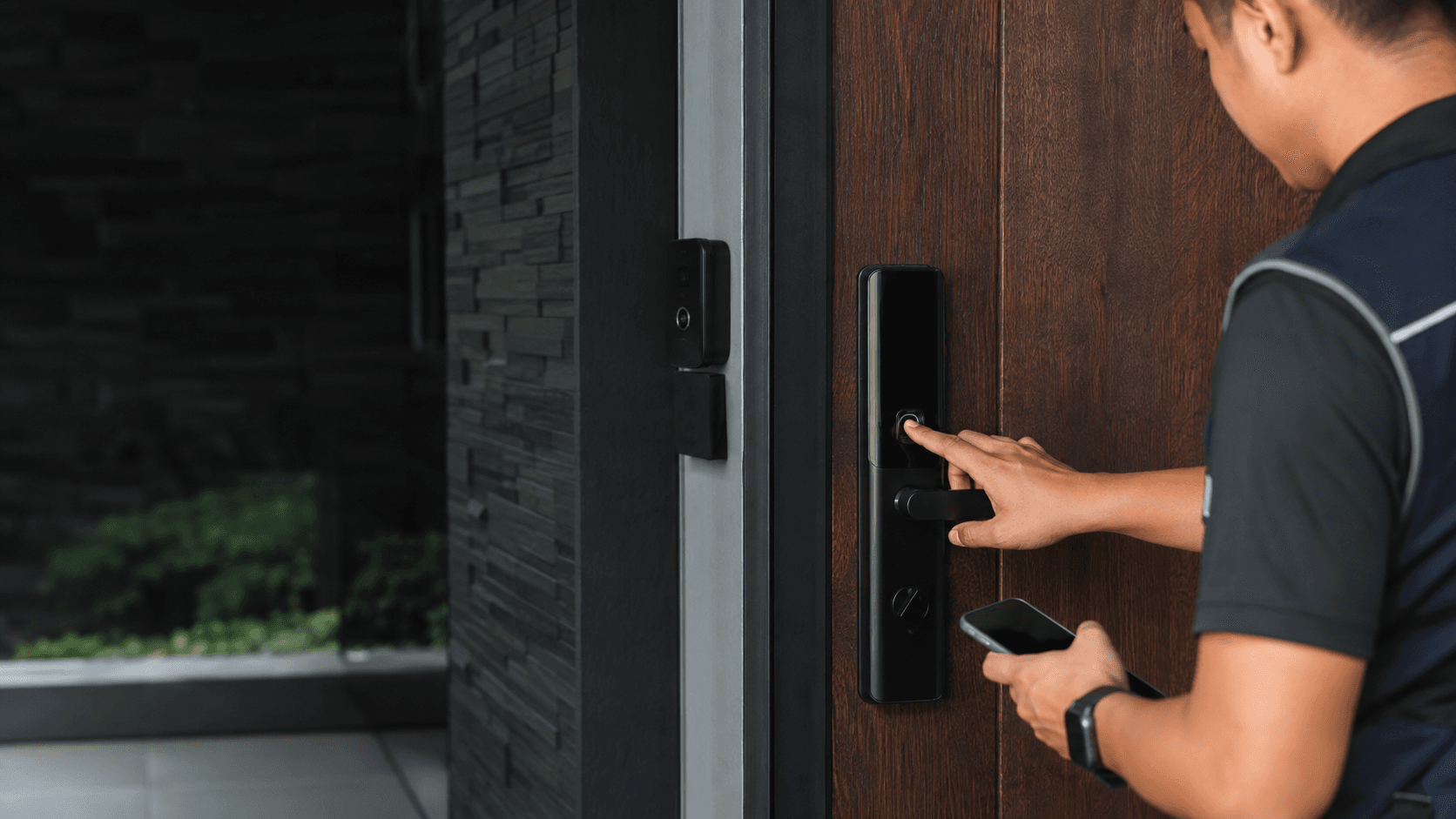
The term covers two separate tests. One is the lock's own electronic and mechanical durability. The other is the fire test of the whole door assembly — leaf, frame, hinges, closer, and lock — as a single unit. A lock that passes the first test but was never included in the second cannot be described as fire rated.
That distinction matters most in Malaysia, where fire doors appear in shophouses, offices, hotels, hospitals, and industrial buildings, and where the lock is often the last item installed. Replacing a mechanical lockset with a digital one changes the hardware inside a tested assembly, so the certification has to follow the specific model, not the brand.
Fire Rated Digital Lock. What Matters Before You Choose
Three things decide whether a fire rated digital lock is the right purchase: the door's existing certification, the lock's own certification, and the way people need to enter. Get the order wrong and the lock may fit perfectly while invalidating the door.
Fire doors are rated in minutes of resistance. Common ratings are 30-minute and 60-minute assemblies, and the rating is printed on a serial label fixed to the door leaf or frame. That label is the starting point, because the lock must be certified for at least the same duration as the door it sits on.
Certification bodies test door hardware against recognised standards. In the United Kingdom and Europe, EN 1634-1 is the fire resistance test for doors and shutters. In the United States, UL 10C covers positive pressure fire tests of door assemblies. Singapore's SCDF guidance for digital locksets on fire-rated doors refers to SS 332 and EN 1634-1 and requires a Certificate of Conformity that names the brand, model, product details, and test standards.
That last point is the practical one. A certificate that names a model number is useful. A certificate that names only a manufacturer is not, because it does not confirm the exact unit on the door.
Choosing the Right Fire Rated Digital Lock
The decision sequence below follows the order that avoids the most expensive mistakes. Each stage produces a fact needed by the next.
- Read the fire door serial label and record the rating in minutes and the door type.
- Confirm the door is a genuine fire door assembly, not a solid door fitted with a fire label after the fact.
- Identify the lock type the door currently takes — mortise, tubular latch, or deadlock — and the door thickness.
- Shortlist only models whose certification names that lock type and matches or exceeds the door rating.
- Check the certificate details. brand, model, tested standard, and rating duration.
- Confirm the entry methods needed — PIN, card, app, fingerprint, or key override — and whether a key override is required for emergency access.
- Verify the power and backup arrangement, including what happens during a power failure.
- Plan installation so the door's closing, latching, and self-closing behaviour is retested after fitting.
Step six deserves emphasis. A fire door exists to hold back fire and smoke, and it also has to let people out. Any lock that cannot be released from the inside without a code or a phone is a life-safety problem, not a convenience problem.
What is fire rated digital lock certification actually proving?
Certification proves that a specific lock model was tested as part of a door assembly and did not cause the assembly to fail before its rated time. It does not prove the lock is more secure, more durable, or better made than an uncertified equivalent. Those are separate qualities.
It also does not transfer between models. Two locks from the same range can carry different ratings, and a lock certified on a timber door may not be certified on a steel door. The certificate is the evidence; the product page is not.
Fire-Rated Digital Locks Singapore | Certified & Secure
Singapore is the clearest worked example of how this is regulated, and the pattern is instructive for buyers elsewhere in the region. The SCDF publishes guidance for digital locksets on fire-rated doors, and since 1 March 2024 uncertified digital locksets installed on fire-rated doors fall outside that guidance.
Under the Singapore framework, a digital lockset needs a Certificate of Conformity issued by a recognised product certification body. The certificate must carry the brand and model, product details, and the test standards applied. Suppliers are expected to show the certificate on request, and the certificate is checked against the actual unit on the door.
Singapore's HDB and MCST contexts add a second layer, because the door may be a flat entrance door in a block where the fire door forms part of the escape route. That is why the guidance is written for the door, not for the lock alone.
Malaysia does not publish an equivalent public listing in the sources reviewed here, so the practical approach is to ask for the same evidence a Singapore buyer would ask for: a certificate naming the model, the tested standard, and the rating duration, matched against the door's own label.
Practical Considerations for Fire Rated Digital Lock Installation
Installation is where a compliant purchase becomes a compliant door. The lock has to sit in the prepared cutout without enlarging it beyond what the certification allows, and the door must still close and latch under its own weight.
Three conditions commonly cause problems after fitting. The first is a door that no longer self-closes because the added hardware changed its balance. The second is a strike plate that needs adjustment so the latch engages fully. The third is a gap at the head or sides of the door that lets smoke past, which is a door issue rather than a lock issue but is often discovered at the same time.
Power and backup deserve their own check. Mains-powered locks need a defined behaviour during an outage, and battery-powered locks need a replacement schedule that someone actually owns. A lock that fails locked during a power cut is a different risk from one that fails open, and the right choice depends on whether the door protects a store room or an escape route.
User permissions matter in commercial settings. A standalone digital lock suits a small office where each person is enrolled individually. A larger site with staff turnover, visitor access, and audit requirements usually needs an access-control panel instead, because permissions and records are managed centrally rather than at the door.
Eyonic, a security system supplier in Sarawak, reviews door condition, user roles, and backup method before recommending a standalone smart lock or an access-control panel for business use. The same review applies to fire-rated doors, where the door's certification adds a constraint that a standard door does not have.
Where fire rated digital locks fit and where they do not
They fit flat entrance doors, office suite doors, hotel and serviced-apartment doors, and any fire door where key management has become a burden. They suit buildings where staff or residents change often and rekeying mechanical locks is slow.
They fit less well on doors that are already non-compliant, on doors where the cutout cannot accommodate the lock body, and on doors where no certified model exists in the required lock type. In those cases the honest answer is a certified mechanical lockset, which is a smaller compromise than an uncertified digital one.
Making an Informed Choice About
The purchase decision reduces to evidence. A fire rated digital lock is worth buying when the certificate names the model, the rating matches the door, the lock type fits the existing cutout, and the entry methods match how people actually move through the building.
Cost is real but secondary. A certified lock that does not fit the door is a loss, and an uncertified lock that fits perfectly is a liability on a fire door. The certificate is the cheaper of the two checks.
For buyers in Sarawak and across Malaysia, the practical next step is to photograph the door's serial label, note the door thickness and current lock type, and confirm the rating in minutes before shortlisting any model. That information determines which locks are even eligible.
Eyonic handles security and ELV work across Sarawak, including a completed project for the Kuching Immigration Office covering arrival flow, staff areas, visitor movement, and dependable daily operation, and an office setup for KTA Sarawak Sdn Bhd supporting staff movement, visitor handling, and tidy cabling. Share the door label details, property type, and required entry methods with Eyonic on WhatsApp at +60 11-5111 7959 for the next practical step.