
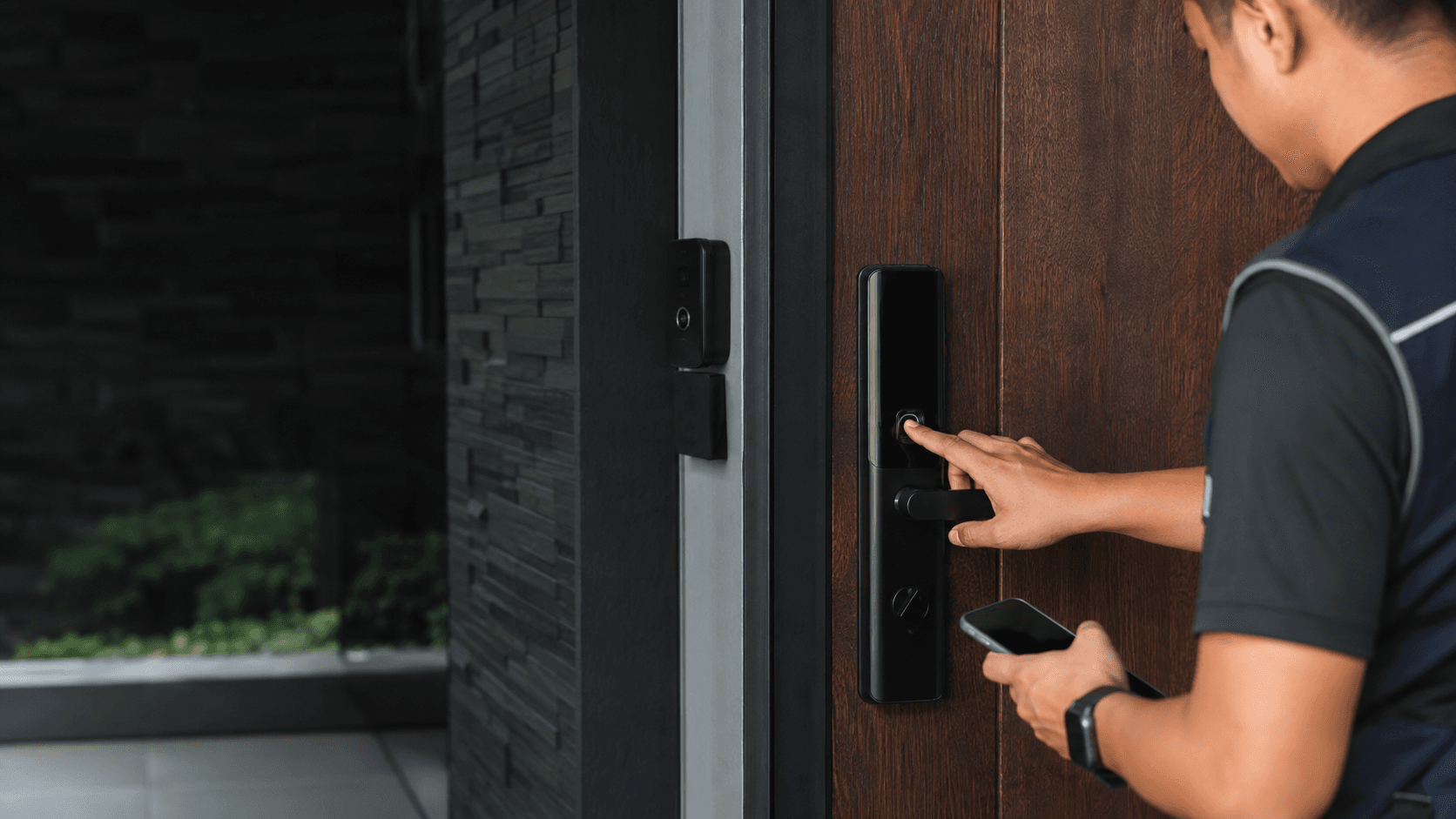
That combination matters because a deadbolt is the single point most people trust on a front door, and moving it from a mechanical key to electronic credentials changes how a household or a small office hands out and withdraws access. The Ultraloq U Bolt Smart Deadbolt sits in that category: a retrofit-style deadbolt body with several credential types built into one unit.
Buyers in Malaysia usually arrive at this model after deciding that keys are the problem — lost keys, copied keys, staff turnover, tenants who leave, family members who need entry at odd hours. The evaluation then narrows to three questions: what the lock actually does, whether the door will accept it, and who supports it after installation.
What the Ultraloq U Bolt Smart Deadbolt is built to do
The lock is designed around multiple ways to unlock one door. Fingerprint access removes the need to carry anything. A keypad code lets a visitor or staff member enter without a phone or a fingerprint enrolment. A smartphone app handles remote management and credential sharing. A mechanical backup key covers the case where electronics fail or batteries run flat.
Those four routes serve different people at the same door. A resident uses the fingerprint reader daily. A cleaner or part-time staff member gets a code that can be withdrawn later. A delivery or guest situation can be handled with a temporary credential rather than a physical key that never comes back.
The practical value is not the number of unlock methods. It is that access can be issued and revoked without changing a cylinder or collecting a key. For a rented property or a small business with rotating staff, that is the whole argument for the product.
Door and user conditions that decide the fit
A smart deadbolt is a mechanical product first. It has to sit in an existing bore hole, align with the strike plate, and throw a bolt into a frame that has not warped. A door that sticks, a frame that has shifted, or a mortise cut that does not match the lock body will cause problems that no amount of app configuration can fix.
Door condition is the first thing to check, and it is the reason a site survey exists. The deadbolt cross-bore, the backset distance from the door edge, the door thickness, and the clearance between door and frame all determine whether a retrofit lock drops in or requires carpentry. None of those measurements can be confirmed from a product listing alone.
User roles decide the second half of the fit. A home with four residents needs four reliable credentials and a simple way to add a fifth. A small office with staff, a cleaner and occasional contractors needs role separation — who can enter, when, and what record exists afterwards. A standalone smart lock handles the first case comfortably. The second case sometimes points toward an access control panel instead, because a panel manages many doors, many users and a central log in a way a single deadbolt does not.
Backup entry is the third condition. Any electronic lock can fail. A mechanical key kept off-site, or a second entry route, prevents a lockout from becoming a building-access problem. This is a planning decision, not a product feature.
How the Ultraloq U Bolt Smart Deadbolt compares with other access options
The realistic alternatives are a conventional keyed deadbolt, a standalone smart lock, and a networked access control system.
A conventional deadbolt costs the least and has no batteries, no app and no firmware. It also cannot revoke a copied key, and it cannot tell anyone who entered and when.
A standalone smart lock such as the Ultraloq U Bolt Smart Deadbolt adds credential management to one door without pulling cable or installing a controller. It suits a home, a shop front, a single office entrance, or a rental unit where one door is the access point that matters.
A networked access control system suits a building with several controlled doors, a reception desk, and a requirement to review movement across a site. It costs more, needs cabling and a controller, and is usually planned alongside other low-voltage systems rather than bought as a single item.
The trade-off is scope against simplicity. One door with electronic credentials is a smart lock decision. Many doors with shared rules is an access control decision. Choosing the wrong one usually shows up as either an under-specified single door or an over-built single door.
Installation and handover steps
Installation quality decides whether a smart deadbolt is reliable. The sequence below reflects how a security system supplier typically scopes and completes this kind of work, from the initial survey through to the point where the people using the door know how to use it.
- Site survey. inspect the door, frame, existing deadbolt cut, door thickness and closing alignment, and confirm which entry points need controlled access.
- System proposal. match the lock type to the door and to the user roles, and decide whether a standalone smart lock or an access control panel is the better fit.
- Installation. fit the deadbolt, align the strike, test the bolt throw, and configure credentials, codes and app access.
- Handover. walk through unlocking methods, add and remove users, explain battery and backup-key handling, and confirm the door operates correctly under normal use.
Handover is the step most often skipped and the one that causes the most support calls. A lock that works but whose users do not know how to remove a departed staff member's code has not delivered its main benefit.
Where local support and evidence still need checking
Availability, pricing, warranty terms and distributor status for this specific model in Malaysia are not confirmed here. Those details change, and they should be verified with the supplier handling the purchase rather than assumed from an overseas listing.
Technical specifications — dimensions, door-thickness limits, battery life and certification details — should come from the manufacturer's current documentation for the exact model being quoted. Model names in this family have varied over time, and specifications do not always carry across variants.
Local installation experience on Malaysian door types is worth asking about directly. Door construction, frame materials and typical deadbolt cuts differ between markets, and a supplier who has fitted this class of lock locally can say quickly whether a given door needs modification.
Eyonic Sdn Bhd plans, supplies and installs security and low-voltage systems in Sarawak, including smart lock door access, and has completed projects such as the Kuching Immigration Office and KTA Sarawak Sdn Bhd. Smart lock work is reviewed against door condition, user roles and backup method before installation, and for business use the choice between a standalone smart lock and an access control panel is checked first. Share your location, property type and required system with Eyonic on WhatsApp at +60 11-5111 7959 for the next practical step.