
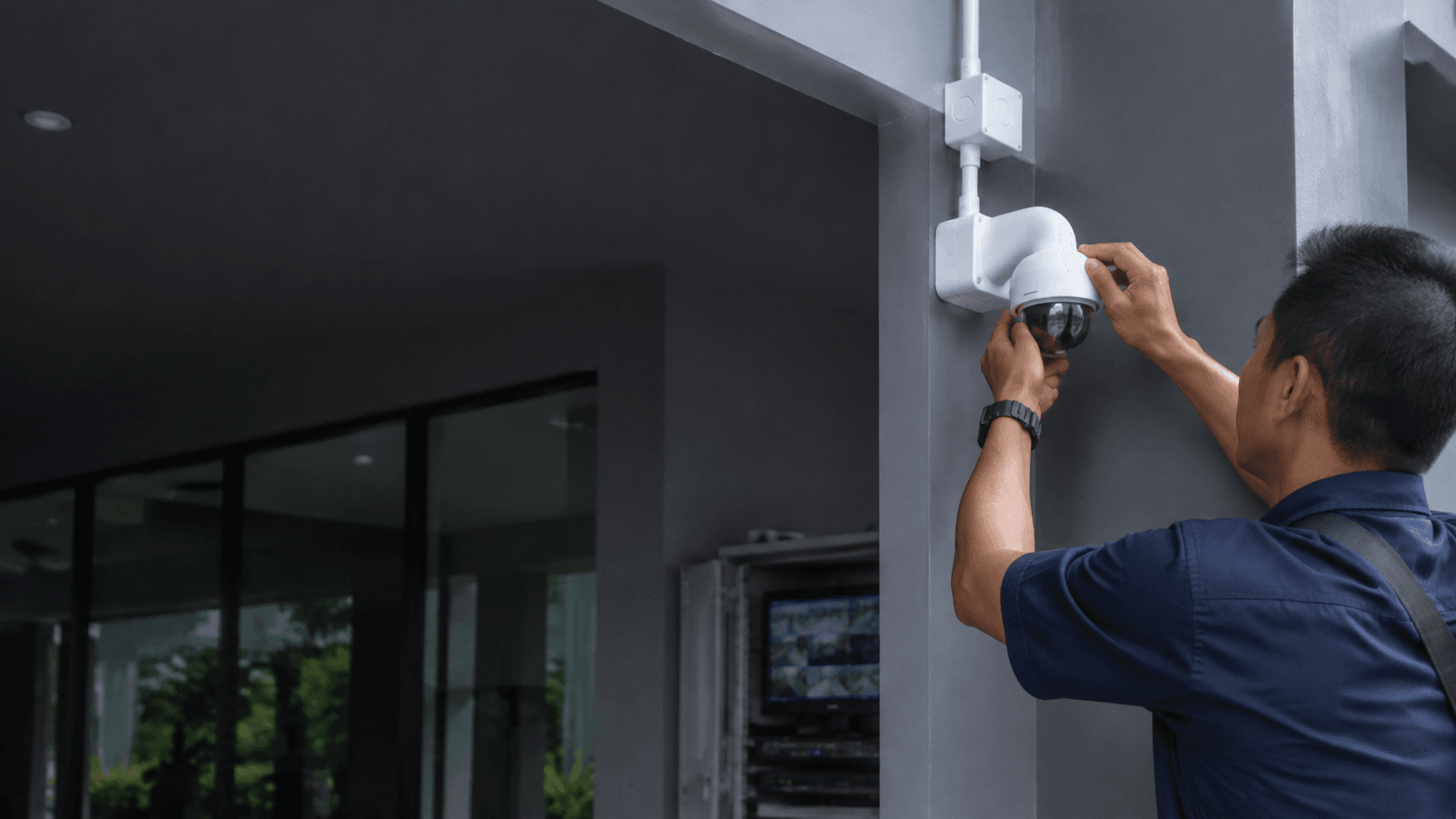
The term describes a supplied-and-installed system rather than a box of hardware. Eyonic plans, supplies and installs monitoring systems with camera placement, recording and remote viewing for homes, offices, shops and industrial sites, so the package is a service outcome: cameras positioned for the site, a recorder configured to store footage, and a working view on a phone before the job closes.
That distinction matters in Malaysia because most search results for a hikvision cctv package are product listings. Across nine analysed pages, exact-match use of the query was zero on every page and the median word count was 92 words, which means the pages ranking today describe hardware far more than they describe what happens on site.
Hikvision CCTV Package. what the term covers in Malaysia
A hikvision cctv package in Malaysia normally bundles three things: cameras, a recorder, and the labour that puts both into service. The hardware side is Hikvision cameras and either an NVR or DVR depending on whether the site runs on network cabling or older analogue cabling. The service side is the part buyers underestimate, because a camera on a bracket records nothing useful until someone decides where it points, how long footage is kept, and who can watch it remotely.
Eyonic's own service description names four elements: camera placement, recording, remote viewing, and the planning and supply that precede them. Those four elements are the practical definition of a package. A cart full of cameras is not a package until placement and configuration are attached to it.
Site type changes the shape of the package more than brand does. A single-storey shop in Kuching with one entrance and a cashier counter needs fewer viewpoints than a public office with an arrival flow, staff areas and visitor movement. The Kuching Immigration Office project is the clearest local example of the second case, where the requirement was dependable daily operation across several distinct zones rather than coverage of one doorway.
What a Hikvision CCTV Package includes from survey to handover
Eyonic's CCTV installation process runs through four stages: site survey, system proposal, installation, and handover. Each stage produces something the next stage depends on, which is why skipping the survey tends to surface as a camera pointing at a blank wall or a recorder with too little storage.
- Site survey. The property is walked to identify entry points, blind spots, existing cabling routes, power availability, and the lighting conditions each camera will actually face.
- System proposal. The survey findings become a proposed camera count, placement plan, recorder configuration and viewing setup, matched to the site rather than to a standard kit list.
- Installation. Cameras are mounted and aimed, cabling is run, and the recorder is configured so footage is captured and retained as agreed.
- Handover. Mobile viewing is set up and demonstrated, so the person responsible for the site can open the live and recorded view without assistance.
The handover stage is where the package either works or does not. Camera supply and setup, basic recording configuration, and mobile viewing handover are the three items Eyonic lists against the RM 1,599 package, and mobile viewing handover is the one that determines whether the system gets used after the installers leave.
What sits outside the listed package contents
The published package contents stop at camera supply and setup, basic recording configuration, and mobile viewing handover. Cabling, mounting hardware and recording storage are not named in that list, and no verified statement confirms whether they fall inside or outside the RM 1,599 figure. That is a question to settle in writing before confirming a package, because storage capacity in particular changes the cost of a job and the length of footage history a site can keep.
Hikvision CCTV Package pricing and what RM 1,599 covers
Eyonic lists the Hikvision CCTV Package at RM 1,599, the same figure as its Hikvision Alarm System and Autogate Package. The RM 1,599 price attaches to camera supply and setup, basic recording configuration, and mobile viewing handover.
Larger scoped work sits in a different bracket. The Kuching Immigration Office project carries an approximate budget of RM 12,000 to RM 28,000, and the KTA Sarawak Sdn Bhd office project carries an approximate budget of RM 8,000 to RM 18,000. Those two figures show the gap between a standard package and a multi-zone commercial installation, and they are the most useful pricing reference points available for a buyer trying to place a site on the scale.
Three numbers therefore frame the decision: RM 1,599 for the standard package, RM 8,000 to RM 18,000 for a practical office setup, and RM 12,000 to RM 28,000 for a public office with arrival flow, staff areas and visitor movement. The jump between them is driven by camera count, cabling distance, and how many distinct zones need coverage, not by the brand of camera.
Why a package price and a project price differ
A package price assumes a bounded scope: a defined number of cameras, a straightforward cable run, and a single recorder location. A project price absorbs the variables that a package cannot, such as long cable runs between buildings, multiple recorder locations, or a site that must keep operating while installation happens. The Kuching Immigration Office requirement for dependable daily operation is exactly the kind of constraint that pushes work from package pricing into project pricing.
Camera placement and lighting checks before a Hikvision CCTV Package is confirmed
Placement is decided on site, not on a floor plan alone. Eyonic recommends checking actual lighting conditions before confirming placement for ColorVu-style cameras, because a camera chosen for low-light performance still needs its position tested against the light that will actually reach it at night.
Three placement questions tend to change a proposal. The first is what the camera must identify rather than merely detect: a face at a gate, a number plate at an entrance, or movement along a corridor each implies a different position and angle. The second is what light exists after dark, including street lighting, security lighting, and the glare from a bright source aimed toward the lens. The third is whether the camera can be reached for cleaning and adjustment without scaffolding or a ladder on a slope.
Lighting checks also expose the difference between a site that suits a standard package and one that does not. A shop with a lit entrance and a covered walkway is a straightforward placement job. An industrial yard with deep unlit corners is not, and the honest answer there may be more cameras or different camera positions rather than a single unit expected to cover everything.
Placement decisions that are hard to reverse
Cable routes are the least reversible part of an installation. Once a route is chosen through a wall, ceiling void or conduit, moving a camera later means re-running cable rather than adjusting a bracket. That is why the survey stage carries more weight than it appears to: it fixes the positions that the rest of the job is built around.
A Kuching project showing how a is scoped
The Kuching Immigration Office project shows what scoping looks like when a site has more than one job to do. The requirement was practical support for a public office in Kuching, focused on arrival flow, staff areas, visitor movement and dependable daily operation.
Four separate concerns appear in that description. Arrival flow means the point where people enter and queue. Staff areas means internal space that is not public. Visitor movement means the path between the two. Dependable daily operation means the system has to keep working on ordinary days, not just perform well on the day it is installed. A package scoped against those four concerns looks different from one scoped against a single entrance.
The KTA Sarawak Sdn Bhd project shows a smaller version of the same logic: a practical office setup in Kuching to support staff movement, visitor handling, tidy cabling and clearer daily site control. Tidy cabling appears as a requirement in its own right, which is a reminder that how an installation looks and how easily it can be maintained are part of the brief rather than finishing touches.
Both projects sit well above the RM 1,599 package figure, and both were scoped around how a site operates rather than around a fixed camera count. That is the pattern a buyer should expect when a property has multiple zones, public and private areas, or a need to keep running during installation.
Questions to settle before confirming a
Most disputes after an installation trace back to something that was never written down. Settling these points before confirming a package removes the ambiguity.
What is inside the price. Camera supply and setup, basic recording configuration, and mobile viewing handover are confirmed. Cabling, mounting hardware and recording storage are not named in the published contents, so they need explicit confirmation rather than assumption.
How long footage is kept. Recording storage determines how far back footage can be reviewed. The package covers basic recording configuration, but the retention period depends on storage capacity, which is not specified in the published contents.
Who can view the system and from where. Mobile viewing handover is part of the package, so the number of users and the devices they will use should be agreed before installation rather than added afterwards.
What happens after handover. Warranty terms and post-installation support scope are not published, so they need to be confirmed directly rather than inferred from the package description.
Whether the site suits a standard package at all. A property with multiple buildings, long cable runs, or unlit areas may need a scoped proposal instead. The two Kuching projects show what that looks like in practice.
Eyonic Sdn Bhd is a security system supplier in Sarawak working across CCTV and ELV systems, with founder Eric Yong bringing more than 10 years in the industry and experience in technical installation for commercial businesses in Sarawak. Sharing the location, property type and required system with Eyonic on WhatsApp at +60 11-5111 7959 is the practical next step for a site that needs a scoped answer rather than a standard package.