
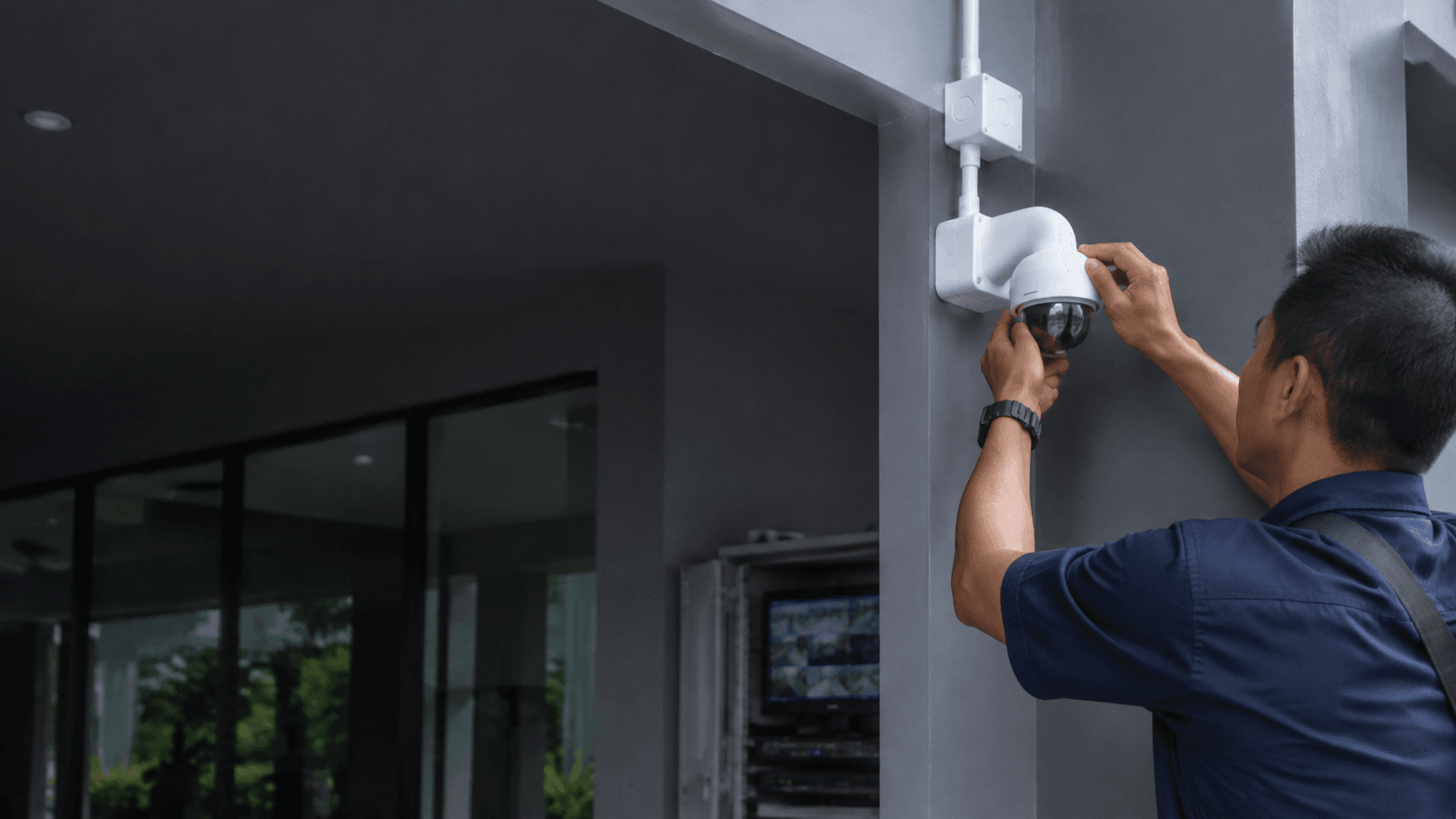
The exact-match query smart camera system describes more than a camera in a box. It describes a working arrangement: cameras positioned where they see something useful, a recorder that keeps the footage, and a way to check the view from elsewhere. Eyonic Sdn Bhd handles that arrangement as a single job rather than a loose device sale, and the company's founder, Eric Yong, has worked in technical installation of digital security solutions for commercial businesses in Sarawak for more than 10 years.
Most buyers in Malaysia meet this category through product listings, which show models and prices but not how a site gets covered. The practical questions come later: where each camera points, what happens when the internet drops, who can open the recording, and what the installation actually involves. This article works through those questions for four common property types and explains how a Sarawak supply-and-install path runs from first survey to handover.
What a smart camera system covers on a working site
A smart camera system covers four connected parts: the cameras, the recording device, the network that carries the video, and the viewing method used to watch it. Each part affects the others. A camera with excellent low-light performance still fails if its recorder cannot store the footage, and a recorder is useless if nobody can reach the live view when it matters.
Eyonic describes its CCTV work as planning, supplying, and installing monitoring systems with camera placement, recording, and remote viewing. Those three elements map onto the parts above. Camera placement decides what the system can see. Recording decides what can be reviewed afterwards. Remote viewing decides who can check the site without being there.
Two constraints shape every design. The first is lighting. Eyonic advises checking actual lighting conditions before confirming placement for ColorVu-style cameras, because a position that looks adequate in daylight can behave differently after dark. The second is the recording location. Where the recorder sits determines whether footage survives an incident at the camera itself, so the recorder is usually placed away from the most exposed point on the site.
Camera placement, recording, and remote viewing
Camera placement starts with the paths people and vehicles actually use, not with the number of cameras available. An entrance, a counter, a gate, and a corridor each need a different angle and height. Recording then follows from placement: the recorder needs enough capacity for the cameras connected to it and for the period the site wants to review. Remote viewing depends on the network at the site, since the live view and playback both travel over that connection.
These three decisions are made together during planning. Changing one later usually means revisiting the others, which is why the survey comes before any equipment is proposed.
How Eyonic plans a smart camera system before installation
Eyonic's CCTV installation process runs through four stages: site survey, system proposal, installation, and handover. The sequence matters because each stage produces the information the next one needs.
- Site survey. The site is reviewed on location, including entry points, movement paths, lighting conditions, and where cabling and the recorder can sit.
- System proposal. The survey findings become a proposed system covering camera positions, recording, and remote viewing.
- Installation. Cameras, cabling, and the recorder are installed and configured on site.
- Handover. The system is tested with the people who will use it, including the mobile viewing setup.
The survey is the stage that most affects the outcome. A proposal built from a survey reflects the actual building rather than a standard package, and it surfaces problems early, such as a position with no practical cable route or a corner where lighting changes through the day.
Handover is the stage that most affects daily use. A system that nobody can operate confidently tends to be ignored, so the handover covers the viewing setup and basic operation rather than ending at the point the cameras are mounted.
What the site survey looks for
The survey examines arrival and entry points, staff and visitor movement, lighting at different times, and the practical routes for cable and equipment. For a public-facing building, arrival flow and visitor movement carry more weight than they would in a private home, because the system has to support how the space is used every day.
Lighting is checked rather than assumed. A position that appears well lit during a daytime visit may need a different camera choice or a different angle once the site is reviewed after dark.
Smart camera system choices for homes, offices, shops, and industrial sites
The same four-stage process applies across property types, but the priorities shift. A home usually centres on entrances, gates, and the perimeter. An office usually centres on staff movement, visitor handling, and tidy cabling. A shop usually centres on the counter, the entrance, and the stock area. An industrial site usually centres on access points, vehicle movement, and equipment areas.
Eyonic's project work shows how these priorities differ in practice. For KTA Sarawak Sdn Bhd, an engineering consultancy, the requirement was a practical office setup in Kuching supporting staff movement, visitor handling, tidy cabling, and clearer daily site control. The emphasis on cabling is typical of office work, where visible wiring affects how the space presents to visitors.
Industrial and commercial sites also tend to need more planning around recording and network than a single-camera home setup, because more cameras mean more video to store and more traffic on the connection used for remote viewing.
Where a single camera is enough, and where it is not
A single camera can cover one entrance or one counter. It cannot cover an entrance, a counter, and a rear access point at the same time, and adding cameras later usually means revisiting the recorder and the network as well. Sites with more than one point of interest are better served by planning the full set at survey stage, even if the installation is staged over time.
Homes with one main entry and a gate are the clearest case for a small system. Shops and offices with public movement are the clearest case for a planned multi-camera layout.
Kuching Immigration Office. a in daily public use
Eyonic completed a project for the Kuching Immigration Office, a public office where the system supports arrival flow, staff areas, visitor movement, and dependable daily operation. The scope is instructive because it is not a single-room installation. A public office has to keep working through opening hours, so the system has to be dependable rather than merely capable.
The project also shows how the planning priorities change for public buildings. Arrival flow and visitor movement are the primary concerns, and staff areas are covered separately. Dependable daily operation is the outcome the design aims at, which places weight on the recorder, the network, and the handover rather than on camera count alone.
Eyonic lists an approximate budget range of RM 12,000 to RM 28,000 for this type of work. That range reflects a public-office scope, not a single-camera home setup, and it is a planning reference rather than a quotation for any specific site.
What public and commercial sites need from handover
Public and commercial sites usually have more than one person who needs to view footage, so handover covers who can access the system and how. The KTA Sarawak project points to the same theme from a different angle: tidy cabling and clearer daily site control matter as much as the cameras themselves when a space is used by staff and visitors throughout the day.
questions answered before a site survey
Several questions come up before a survey is booked, and the answers shape what the survey needs to cover.
Does the system need internet? Remote viewing depends on a network connection at the site. Recording itself is handled by the recorder, so the two functions are separate. A site with unreliable internet can still record locally while remote viewing remains limited by that connection.
Can an existing camera be added to a new system? That depends on the camera and the recorder, and it is checked during the survey rather than assumed. Compatibility is a practical question about the specific equipment on site.
How long does installation take? Duration depends on the number of cameras, the cable routes, and the building. The survey is what produces a realistic view of the work involved.
What does a basic package include? Eyonic's Hikvision CCTV Package is listed at RM 1,599 and covers camera supply and setup, basic recording configuration, and mobile viewing handover. The same RM 1,599 figure applies to the Hikvision Alarm System and the Autogate Package, which cover different scopes.
What about lighting at night? Lighting conditions are checked on site before placement is confirmed, because the right position for a camera depends on how the area is lit after dark.
For sites in Sarawak, the practical next step is to share the location, property type, and required system with Eyonic on WhatsApp at +60 11-5111 7959. That information is what a survey is planned around, and it is the point at which a general question about a smart camera system becomes a specific proposal for one site.