
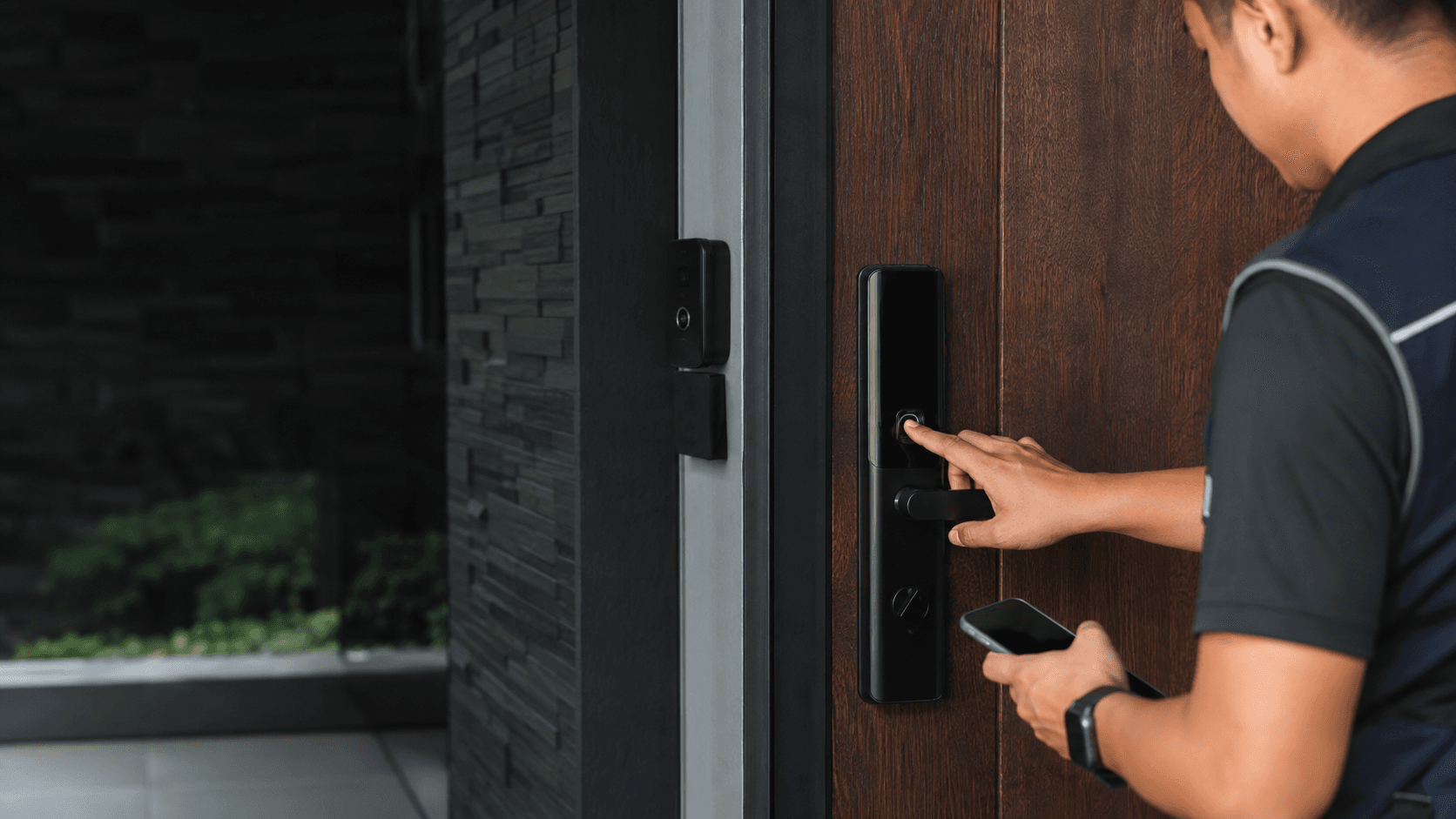
Metal doors are common on Malaysian shop lots, offices, and gate frames, and they behave differently from timber. Steel reflects wireless signal, resists boring, and holds tighter tolerances, so a lock that fits a wooden door may not seat correctly on a steel one. The practical question is not whether a smart lock for metal door use exists, but whether the specific leaf, frame, and existing hardware will accept one.
Smart Lock For Metal Door. What Has To Match
Three physical dimensions decide most outcomes. Door thickness sets whether the lock body and its fixing bolts can clamp the leaf. Backset, the distance from the door edge to the centre of the existing hole, decides whether a replacement unit lines up with the old cutout. The lock type, whether a rim lock, mortise body, or deadbolt replacement, decides how much new metalwork is needed.
Eyonic's own product guidance states that smart locks work best when the door condition, user roles, and backup method are reviewed before installation. That order matters on metal. A lock chosen before the door is measured usually means either a return or a second round of drilling.
For business premises, the same guidance notes that a standalone smart lock and an access control panel are not automatically interchangeable. A single steel door with a handful of users suits a standalone unit. A site with shift changes, visitor logs, and multiple entry points usually needs the panel approach instead.
Metal Door Types And Why They Behave Differently
Not every metal door is solid steel. A steel-skinned door over a timber or composite core drills and cuts much like a wooden door, and the skin is thin enough that signal passes through with little trouble. A solid steel leaf or a hollow steel section behaves very differently: it is harder to bore cleanly, it can deform at the cut edge, and it blocks radio more aggressively.
Gate and grille frames add a third case. These are often narrow-section steel with limited flat surface, which restricts where a lock body can sit and how a keypad or reader can be mounted. A lock that assumes a wide, flat stile will not fit a slim gate post.
Signal interference is the most commonly reported metal-door problem. Steel between the lock and the phone, hub, or router weakens Bluetooth and Wi-Fi range. The effect is not uniform. a lock on the outer face of a steel door with the router on the same side may work normally, while the same lock on an internal steel partition can drop connection at a few metres. Placement of the hub or gateway matters as much as the lock itself.
Checks Before Buying A Smart Lock For Metal Door
Work through these in order. Each one can rule out a product before money changes hands.
- Measure the door thickness at the lock stile and confirm the lock body's stated range covers it.
- Measure the backset from the door edge to the centre of the existing hole and compare it with the replacement unit.
- Identify the lock type already fitted, whether rim, mortise, or deadbolt, and confirm the new unit matches that format.
- Check the flat mounting area on the leaf or gate post for the keypad, reader, and handle.
- Test wireless reach by placing a phone at the intended lock position and checking signal from the planned hub or router location.
- Confirm the backup entry method, whether a mechanical key, external power point, or secondary access route, before the door is closed on the installation.
The backup check is the one most often skipped. A smart lock with no mechanical override and a flat battery leaves a steel door with no easy way in, and steel is far less forgiving of improvised entry than timber.
Door thickness and backset
These two numbers do most of the filtering. A lock rated for a narrow thickness range will not clamp a thicker leaf, and a backset that does not match leaves the old hole visible and the new body misaligned. On steel, a misaligned body is harder to correct because the cut edge cannot be patched as easily as wood.
User permissions and access control
User roles decide whether a standalone lock is enough. A home or small office with a fixed set of people can run on a standalone unit with per-user codes or cards. A site with rotating staff, contractors, and visitors needs permissions that can be issued and revoked centrally, which points toward an access control panel rather than a single lock.
Power, Signal, And Backup Entry
Power and connectivity are the two failure modes that turn a convenience feature into a lockout. Battery-powered locks depend on the cell holding charge, and a lock that reports low battery only through an app is a problem if the app cannot reach the lock through the steel.
Signal planning is a placement exercise, not a product specification. The useful test is a phone at the lock position checking the connection to the planned hub or router location. If the signal is marginal, moving the hub closer or adding a gateway is usually simpler than changing the lock.
Backup entry should be decided before installation, not after. The options are a mechanical key override, an external power terminal for a jump start, or a second entry point that does not depend on the lock. On a steel door, the mechanical override is the most reliable of the three because it does not depend on power or radio at all.
Installation And Handover In Sarawak
Eyonic's documented installation process runs through site survey, system proposal, installation, and handover. The same sequence applies to door access work, and the survey stage is where the thickness, backset, and mounting checks are confirmed on site rather than from a photograph.
- Site survey to confirm door type, thickness, backset, mounting surface, and signal conditions.
- System proposal covering whether a standalone smart lock or an access control panel suits the site.
- Installation of the lock, reader, and any gateway or hub, with wiring and calibration.
- Handover covering user permissions, backup entry, and daily operation.
Eyonic's project record includes the Kuching Immigration Office, where the work focused on arrival flow, staff areas, visitor movement, and dependable daily operation. That is the pattern door access work follows on a busy site: the hardware matters less than whether staff and visitors can move through without the system becoming the bottleneck.
Eric Yong, founder of Eyonic Security Systems, has worked in technical installation of digital security solutions for commercial businesses in Sarawak for more than 10 years. That experience is relevant to metal doors specifically because the survey decisions, not the product box, determine whether the installation holds up.
Costs And Next Practical Step
Eyonic publishes RM 1,599 packages for Hikvision CCTV, alarm systems, and autogate work. Those figures cover those three systems and do not represent smart lock supply and installation, which is quoted separately after the door survey.
Budget expectations should be set after the survey, because the work varies with door type. A steel-skinned door over a timber core with an existing cutout is a straightforward swap. A solid steel leaf or a narrow gate post may need additional fabrication, a different lock format, or a move to an access control panel, and each of those changes the scope.
For the next practical step, share the location, property type, and required system with Eyonic on WhatsApp at +60 11-5111 7959. Photographs of the door edge, the existing lock, and the surrounding frame help confirm the thickness and backset before any site visit.
The limits are worth stating plainly. No smart lock model's door thickness range, backset, battery type, or operating temperature is confirmed in the available material, and no compatibility statement exists for a specific gate, grille, or steel door type. Those values have to come from the manufacturer's specification sheet for the model under consideration, checked against the measurements taken at the door.