
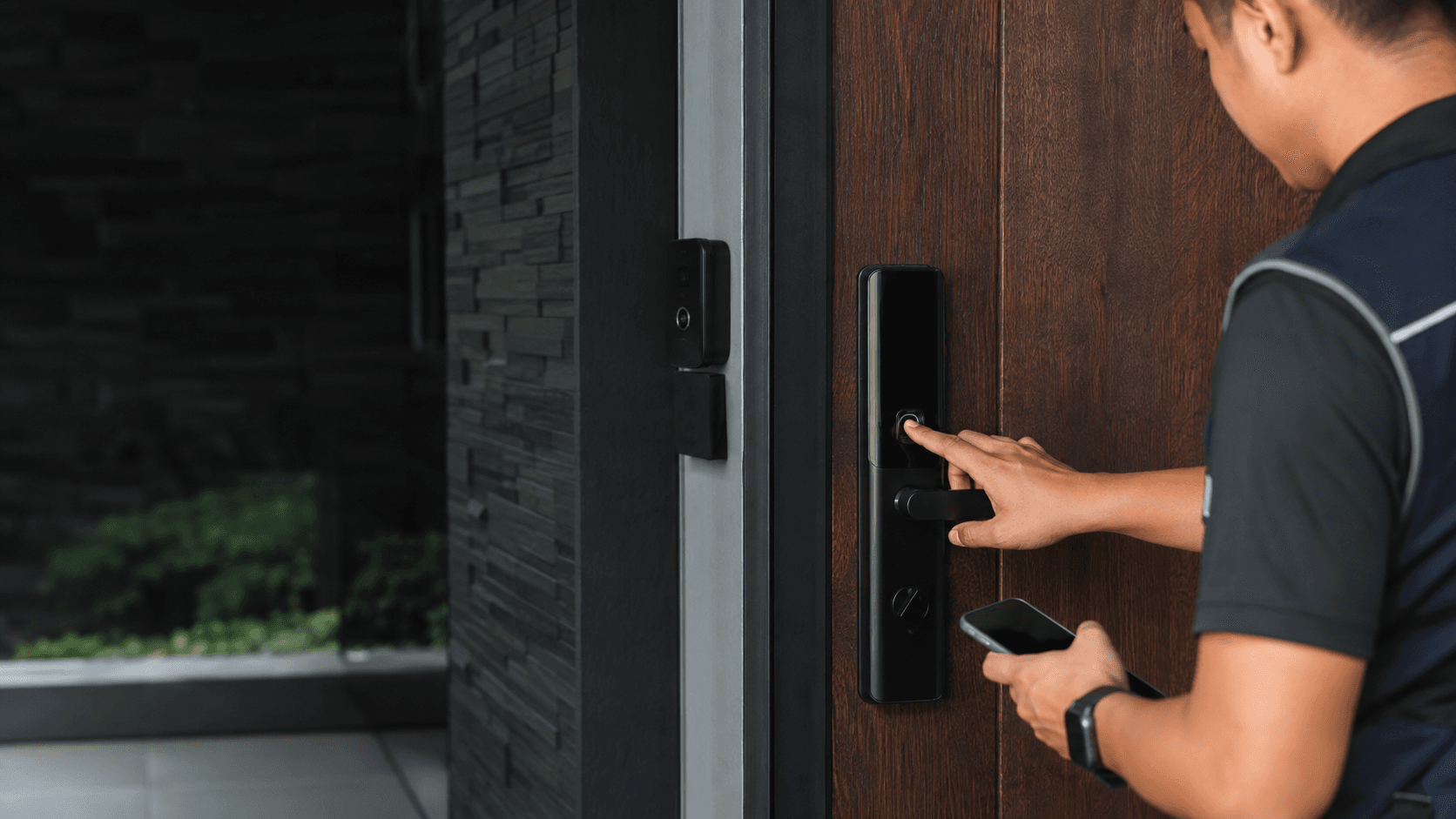
The exact-match query best commercial electronic door lock is not a single product. It is a category decision. A small office with one entrance and a warehouse with twelve doors need different hardware, different power arrangements, and different ways to get people out during a fire alarm.
Eyonic Sdn Bhd, a security system supplier in Sarawak, Malaysia, plans, supplies, and installs CCTV and ELV systems for homes, offices, shops, and industrial sites. The company's own product review notes that smart locks work best when door condition, user roles, and backup entry are reviewed before installation, and that for business use the first question is whether a standalone smart lock or an access-control panel fits better.
Best Commercial Electronic Door Lock: What Matters Before You Choose
Three things decide most commercial lock projects: how the door is built, who needs to enter, and what must happen when power fails or a fire alarm triggers.
- Identify the door type and frame material, because a hollow metal storefront door, a glass door, and a solid wood office door accept different hardware.
- Count the people and the traffic pattern, since a five-person office and a fifty-person clinic place very different demands on a lock.
- Decide the credential, whether that is a PIN code, a card or fob, a mobile credential, or a mix.
- Confirm the fail mode, because fail-safe unlocks on power loss while fail-secure stays locked.
- Check egress and life-safety requirements, so the door always opens freely from the inside along the exit path.
- Plan backup entry, so a dead battery or a network outage does not strand staff outside.
- Choose standalone or networked control, based on whether the site needs audit trails and remote management or just controlled convenience.
That sequence matters because the hardware follows the decision, not the other way around. A lock chosen before the door and traffic questions are answered usually gets replaced.
Choosing the Right Commercial Electronic Door Lock
The main hardware families differ in how they interrupt the door, and each one suits a different building.
Standalone keypad locks carry the credential and the locking mechanism in one unit. They fit single doors where no central system exists and where someone can update codes on the device. Networked or wired access control locks connect to a panel or software, which allows scheduled access, audit logs, and remote changes. Electric strikes replace the strike plate in the frame and release the existing latch, which makes them a common retrofit choice on storefront doors. Magnetic locks hold the door with electromagnetism and are typically fail-safe, so they release when power drops. Electric mortise and cylindrical locksets replace the lock body itself and suit doors that need a finished, integrated look. Electric push bar locks combine an exit device with electric release, which fits high-traffic exit doors in schools, clinics, and public buildings.
Credential choice runs alongside hardware choice. PIN codes suit shared entrances where codes change often. Cards and fobs suit staff who carry a badge already. Mobile credentials suit sites that want to issue and revoke access without cutting new keys. Biometric readers suit controlled areas where identity matters more than speed.
What is commercial electronic door lock hardware built from?
A commercial electronic door lock is built from a locking mechanism, a credential reader, a power source, and a control layer. The locking mechanism is the part that physically holds the door. The reader accepts the credential. The power source is either batteries in the lock or low-voltage wiring from a power supply. The control layer is either the lock's own keypad programming or a networked access-control panel and software.
That last layer is where most commercial projects differ from residential ones. A home smart lock usually manages itself. A commercial system often needs to answer who entered, when, and through which door, and that requires either a networked panel or a lock with an audit log.
Practical Considerations for Commercial Electronic Door Lock Projects
Fail-safe and fail-secure is the decision that carries the most consequence. Fail-safe hardware unlocks when power is lost, which supports life safety but leaves the opening unsecured during an outage. Fail-secure hardware stays locked when power is lost, which protects the space but can trap people if the door is not also openable from the inside by mechanical means. Most jurisdictions resolve this by requiring free egress at all times along the exit path, with the electronic lock releasing on the way out regardless of the fail mode.
Power is the second constraint. Battery-powered standalone locks avoid wiring but need a maintenance schedule and a documented backup entry method. Hardwired locks need a power supply, and often a power transfer device if the door swings on hinges that must carry current. Sites that cannot run new cable may find a wireless or standalone option more practical than a networked one.
Door condition decides feasibility more often than buyers expect. A door that does not close squarely, a frame that is out of alignment, or a hollow frame with no room for a strike can all block an otherwise suitable lock. This is why a site survey comes before a hardware list. Eyonic's installation process follows site survey, system proposal, installation, and handover, and the same order applies to access hardware.
Traffic and user roles shape the credential plan. A back-of-house door used by six staff needs less management than a main entrance used by visitors, contractors, and deliveries. Where visitor movement and staff movement share an entrance, the lock usually needs a schedule rather than a single shared code.
Maintenance is a real cost. Readers get dirty, batteries die, and firmware needs updating. A lock with no audit trail is also a lock with no record of who came through, which matters in workplaces that need to account for entry.
Where commercial electronic door locks fit in Sarawak buildings
In Kuching and across Sarawak, the practical split is usually between standalone convenience and managed access. Eyonic's work for the Kuching Immigration Office focused on arrival flow, staff areas, visitor movement, and dependable daily operation, which is the same set of concerns a commercial lock decision has to answer. A separate project for KTA Sarawak Sdn Bhd covered staff movement, visitor handling, tidy cabling, and clearer daily site control for an engineering consultancy office.
Those two projects show the pattern. Public-facing sites need a clear arrival path and controlled visitor movement. Office sites need staff to move without friction while the building still knows who is inside. Neither need is solved by picking a lock model first.
Making an Informed Choice About Commercial Electronic Door Lock Systems
The best commercial electronic door lock for a given building is the one that matches the door, the traffic, the credential plan, and the life-safety requirement at the same time. A lock that wins on features but fails on egress or backup entry is the wrong lock.
Budget shapes the shortlist. Eyonic's published package pricing lists a Hikvision CCTV package at RM 1,599, a Hikvision alarm system at RM 1,599, and an autogate package at RM 1,599, each covering supply, setup, and handover. Access hardware is scoped separately because door count, door type, and wiring vary far more than a camera package does. Larger integrated projects sit in a different range: Eyonic's Kuching Immigration Office project carried an approximate budget of RM 12,000 to RM 28,000, and the KTA Sarawak Sdn Bhd project carried an approximate budget of RM 8,000 to RM 18,000.
Those figures are useful as a scale reference, not as a quote for a lock. A single standalone keypad lock on an existing door is a small job. A networked system across multiple doors with power supplies, request-to-exit devices, and software is a project.
Two edge cases deserve attention before committing. First, a site that wants remote management but has no network cabling at the door may need a wireless lock or a standalone lock with an audit log instead of a fully networked system. Second, a site with a fire alarm system needs the lock release coordinated with that system, so the door unlocks on alarm. Skipping that coordination creates a compliance problem, not just a convenience problem.
For sites that already run CCTV, alarm, or intercom systems, the lock decision is easier when it is made alongside them. Eyonic supplies and installs CCTV, alarm, autogate, keyphone intercom, and Starlink internet services in Sarawak, so a single site survey can cover the door, the camera positions, and the network path at once. Eyonic's founder, Eric Yong, has worked in technical installation of digital security solutions for commercial businesses in Sarawak for more than 10 years.
Share the location, property type, and required system with Eyonic on WhatsApp at +60 11-5111 7959 for the next practical step.