
The exact-match query dahua fisheye camera describes a category of network camera rather than one fixed product. Dahua builds fisheye models across more than one series, and the practical differences between them sit in resolution, lens behaviour, mounting position, and how the recorded image is dewarped for viewing. Because those details vary by model, the useful planning question is not which unit is "best" but whether one wide view actually suits the space being watched.
Eyonic Sdn Bhd is a security system supplier in Sarawak that plans, supplies, and installs CCTV and ELV systems for homes, offices, shops, and industrial sites. The company's founder, Eric Yong, has worked in technical installation of digital security solutions for commercial businesses in Sarawak for more than 10 years.
What a Dahua Fisheye Camera Does in One Wide View
A fisheye lens captures a very wide field of view, and the camera then presents that capture in one of several ways. A single circular or panoramic image can be recorded, or the recorder and viewing software can flatten the same capture into separate rectangular views that look like conventional cameras pointed in different directions.
That second behaviour is what makes a Dahua Fisheye Camera interesting for planning. One physical unit can feed several logical views, so a room can be monitored as a whole and also reviewed as distinct angles. The trade-off is that the flattened views are produced from the same sensor area, so each individual view carries less pixel detail than a dedicated camera aimed at the same spot.
Two practical consequences follow. First, identification at distance is harder with a fisheye than with a narrow-angle camera, because the subject occupies fewer pixels. Second, the value of the camera sits in situational awareness — seeing the whole of a space at once — rather than in close detail on a single doorway.
Dewarping and display modes
Fisheye footage is distorted at capture and corrected for viewing. Dahua recorders and client software typically offer several display modes, including a full panoramic strip, a set of split views, and a mode that follows activity. The mode chosen affects what an operator actually sees during review, so it belongs in the planning conversation rather than being left to default settings.
Where the lens shape matters
A fisheye sees a wide horizontal and vertical field, which means ceiling placement often produces a near-complete view of a room floor. Wall placement produces a different shape of coverage and can leave blind areas behind the camera. Ground or table placement suits specific retail and inspection scenarios. The mounting surface is therefore a design decision, not an afterthought.
Where a Single Wide View Fits in Malaysian Premises
One wide view tends to suit spaces where the goal is coverage of an area rather than identification of a person at a specific point. Common fits include a small office reception, a shop floor with a compact footprint, a meeting room, a lobby, a lift landing, and an entrance where the whole approach should be visible at once.
It also suits sites where running cable to several camera positions is awkward. A single ceiling point with one network run can cover a room that would otherwise need three or four separate units, which reduces cabling work and the number of mounting points.
It fits less well where the requirement is a clear face or plate at a known distance. A corridor with a single entry point, a gate with a defined approach lane, and a perimeter wall are usually better served by cameras aimed at those specific lines. In those cases a fisheye adds overview but does not replace the targeted camera.
Rooms, entrances, and open areas
Interior rooms with a ceiling height that allows a downward view are the most straightforward case. Entrances work when the camera can see the approach and the door together. Open areas such as a warehouse aisle or a covered yard can work if the mounting height and the distance to the far edge are checked, because the far edge is where detail drops off first.
When several standard cameras remain the better answer
If the site needs readable detail at two or more separate points, or if the space is long and narrow, several conventional cameras usually deliver more usable evidence than one fisheye. A fisheye can still be added as an overview unit alongside them, but it should not be treated as a straight swap for targeted coverage.
How Eyonic Plans a Installation
Eyonic's CCTV installation process runs through four stages, and each one produces something the next stage depends on.
- Site survey. The premises are inspected to establish room dimensions, ceiling height and material, existing cabling routes, lighting conditions through the day, and the points that actually need to be seen.
- System proposal. The survey findings are turned into a proposed camera layout, recording arrangement, and viewing setup, so the coverage being offered can be checked against the requirement before any work starts.
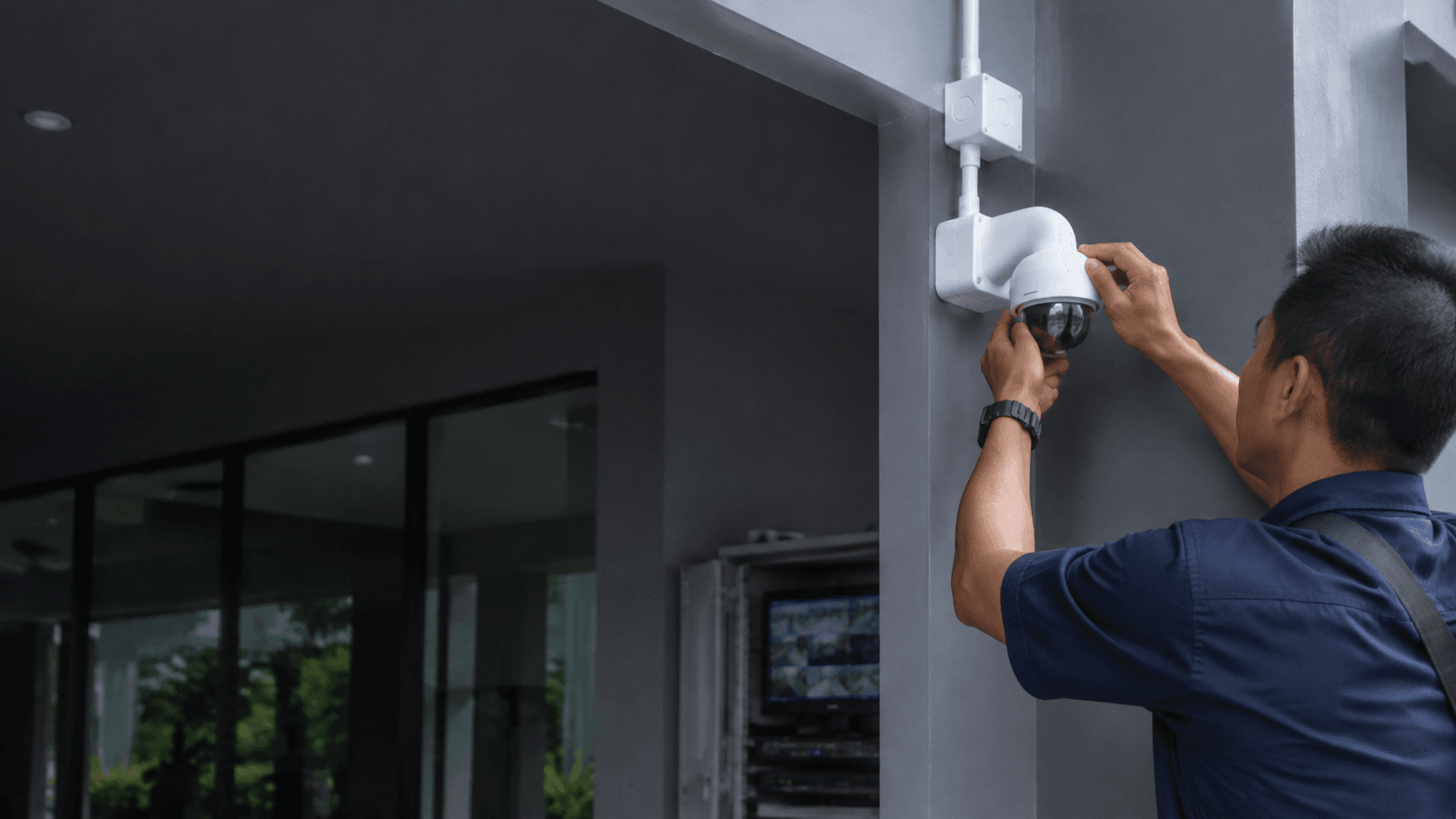
- Installation. Cameras are mounted, cabling is run, and the recorder is configured, including the display mode used for any fisheye unit.
- Handover. Recording and remote viewing are tested with the user, and the operating basics are explained so the system can be used day to day.
Lighting deserves specific attention during the survey. Eyonic's guidance on ColorVu-style cameras is to check actual lighting conditions before confirming placement, and the same discipline applies to a fisheye position: a ceiling point that looks fine in daylight can behave differently once the room lights are off.
Eyonic has completed work for the Kuching Immigration Office, focused on arrival flow, staff areas, visitor movement, and dependable daily operation. That project illustrates the kind of requirement where overview coverage and targeted coverage are planned together rather than treated as alternatives. Eyonic has also completed an office setup in Kuching for KTA Sarawak Sdn Bhd covering staff movement, visitor handling, and tidy cabling.
What to Confirm Before Choosing a
Several items have to be settled on site before a fisheye decision is safe. None of them can be answered from a product listing alone.
Mounting position and height. The camera's view depends on where it sits and how far it is from the floor or the far wall. A position that covers the whole room from one height may leave the near edge cut off from another.
Lighting through the full day. Natural light, room lighting, and any after-hours lighting all change what the camera records. Placement should be confirmed against the conditions the site actually has, not the conditions present during the survey visit.
Recorder and viewing compatibility. Fisheye footage needs a recorder and client that support the display modes being planned. The NVR setup and the remote viewing app should be confirmed as part of the proposal, because a fisheye stream viewed without dewarping support is far less useful.
Network and power route. A single camera still needs a working cable path and a power source, whether that is PoE from the recorder or a local supply. The route affects both cost and how tidy the finished installation looks.
What the footage must prove. If the purpose is to see that something happened, overview coverage may be enough. If the purpose is to identify who did it, the pixel detail at the relevant distance has to be checked before committing.
Model confirmation. Dahua fisheye models differ in resolution, lens behaviour, and features. The specific model should be confirmed against the site requirement rather than assumed from the category name.
Questions Before Site Survey
Can one unit replace several cameras? Sometimes. It replaces several cameras when the requirement is area coverage from one point. It does not replace them when the requirement is detail at multiple separate points.
Does a fisheye work outdoors in Malaysia? It depends on the specific model's housing and rating, which varies across the range. Outdoor use also raises the question of rain, glare, and how far the camera needs to see, all of which belong in the survey.
Is a fisheye harder to review? Reviewing a dewarped panoramic view is different from reviewing a standard camera feed. The display mode chosen at setup determines how intuitive that review feels, which is why handover includes walking through it.
What information helps a first conversation? Location, property type, and the system required are the three items that let a supplier respond usefully. Sharing those with Eyonic on WhatsApp at +60 11-5111 7959 is the next practical step.
Eyonic's published packages start at RM 1,599 for a Hikvision CCTV package covering camera supply and setup, basic recording configuration, and mobile viewing handover, with matching RM 1,599 packages for alarm systems and autogate. Those figures cover the listed package contents, and a fisheye layout would be quoted separately once the site requirement is known.