
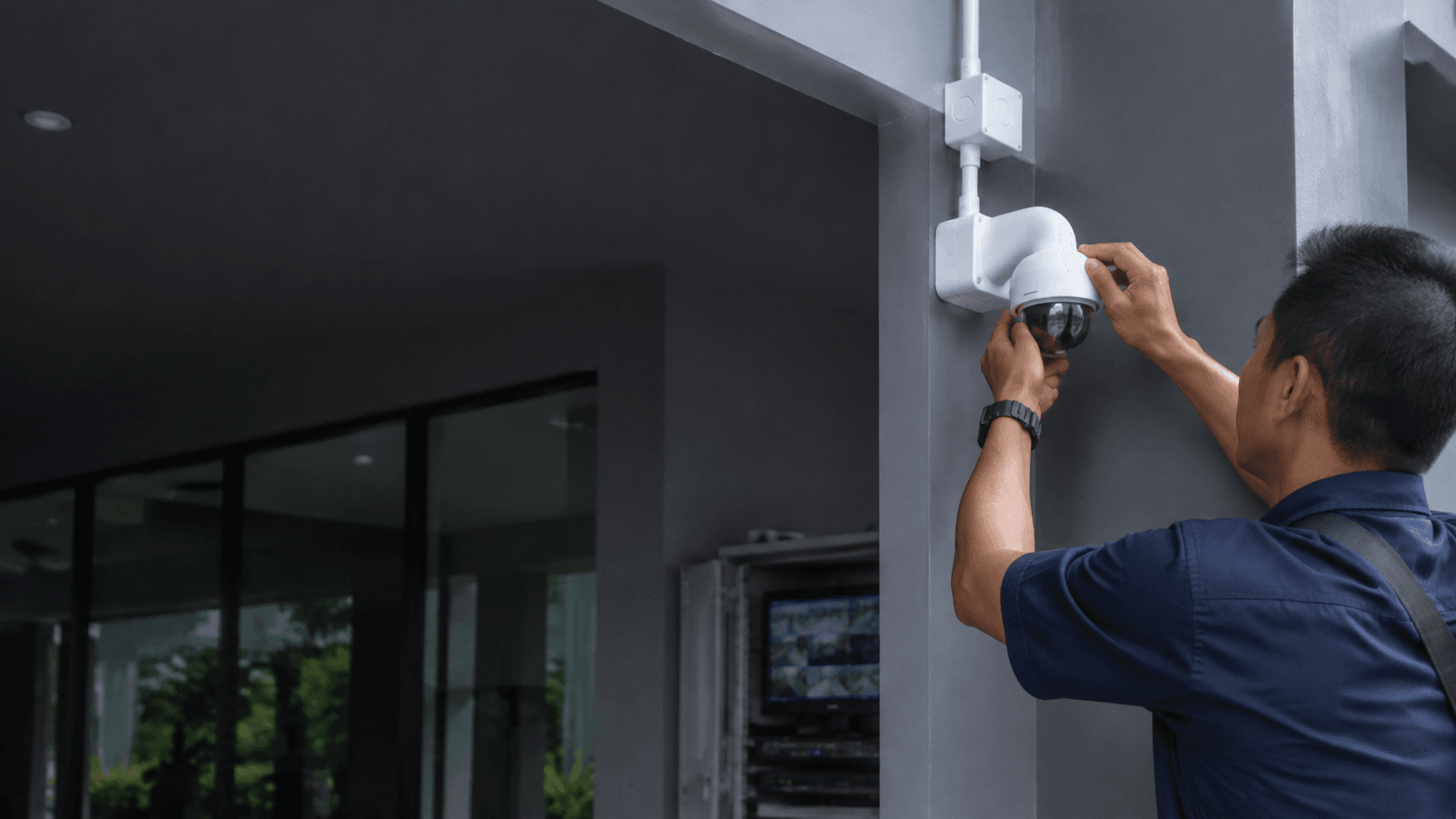
The exact-match query outdoor wireless cctv camera system describes a category with real trade-offs, not a single product. Wireless here usually means the video travels over Wi-Fi or a dedicated wireless bridge, while each camera still needs power unless it runs on a battery or solar panel. That distinction decides most of the practical questions that follow.
Outdoor Wireless Cctv Camera System: What Matters Before Choosing
Four things separate a system that works for years from one that disappoints within months: how each camera gets power, how strong the wireless signal is at the mounting point, how footage is stored, and how the property is actually used day to day.
- Confirm what "wireless" covers at the site — video only, or video and power.
- Walk the property and check Wi-Fi signal strength at each intended camera position.
- Check the real lighting at each position, including after dark, before fixing placement.
- Decide where recordings live. a recorder with a hard drive, a memory card, or cloud storage.
- Match camera count and coverage to entrances, walkways and staff or visitor movement.
- Plan the installation sequence. site survey, system proposal, installation, handover.
Eyonic's CCTV installation process follows exactly that sequence — site survey, system proposal, installation and handover — which keeps placement and power decisions grounded in the actual building rather than a catalogue.
What Is an Outdoor Wireless Cctv Camera System?
An outdoor wireless cctv camera system is a set of weather-rated cameras that send video to a recorder, hub or app over a wireless network instead of through video cable runs. Power is a separate question. many cameras are described as wireless because the video is wireless, yet each unit still connects to a power outlet or uses a battery or solar panel.
That split matters because it changes installation work. A camera with a nearby power point may need only a short cable and a mounting bracket, while a battery camera can go almost anywhere but needs a charging plan. A wireless bridge can also carry video between buildings where running cable is impractical.
Wireless (Wi-Fi) Security Cameras & Systems
Wi-Fi cameras connect to an existing network and stream to a phone app, a hub or a Wi-Fi recorder. Systems built around a Wi-Fi NVR typically pair several cameras with one recorder and one hard drive, so recordings stay local and the app handles viewing. Standalone Wi-Fi cameras are simpler and cheaper per unit, but each one manages its own storage and its own connection.
The practical difference shows up at scale. One or two cameras on a home network are usually straightforward. Six or more cameras streaming continuously compete for bandwidth, and the recorder or hub becomes the more reliable backbone.
Choosing the Right Outdoor Wireless Cctv Camera System
Selection comes down to matching the system to the property rather than to a specification sheet. A terrace house, a shop lot and an industrial site in Sarawak present different constraints on power, signal and coverage.
| Consideration | What it affects | Practical check |
|---|---|---|
| Power source | Where cameras can be mounted | Is there a power point near each position, or is battery or solar needed? |
| Wireless signal | Video stability and dropouts | How strong is the Wi-Fi signal at the mounting point, including through walls? |
| Lighting | Night image quality | What does the scene actually look like after dark? |
| Storage | How far back footage can be reviewed | Recorder with hard drive, memory card, or cloud? |
| Coverage | Whether the important areas are captured | Are entrances, walkways and movement routes all in view? |
Eyonic recommends checking actual lighting conditions before confirming placement for ColorVu-style cameras, because low-light performance depends on the scene rather than the label on the box. A position that looks bright at midday can be the darkest corner of the property at night.
Where Wireless Fits Best
Wireless suits properties where cable runs are difficult, disruptive or expensive: rented premises, finished interiors, detached structures, and sites where trenching or conduit work would cause damage. It also suits staged installations where coverage is added over time.
Wired or PoE remains the better answer where continuous high-bandwidth recording is required across many cameras, or where the wireless environment is congested. A hybrid approach — wireless where cable is impractical, wired where it is easy — is common on larger sites.
Practical Considerations for Outdoor Wireless Cctv Camera System
Several constraints decide whether a wireless design holds up after handover.
Signal is not the same as coverage. A router that reaches the far end of a house with a phone signal may still struggle to carry continuous video from a camera mounted on an outer wall. Walls, metal roofing and distance all reduce throughput.
Power still has to reach the camera. Battery and solar cameras remove the cable but introduce a maintenance cycle. Cameras that record continuously drain faster than cameras that record on motion.
Storage choice affects review. Local recording on a recorder or memory card keeps footage on site and avoids recurring fees. Cloud storage adds off-site access but usually carries a subscription.
Placement should follow movement, not symmetry. The Kuching Immigration Office project focused on arrival flow, staff areas, visitor movement and dependable daily operation — a reminder that camera positions should follow how people actually move through a building.
Installation quality decides reliability. Mounting height, angle, cable dressing and network configuration all affect whether the system is useful months later. The KTA Sarawak Sdn Bhd project in Kuching covered staff movement, visitor handling, tidy cabling and clearer daily site control, which reflects the same principle.
Budget and Package Context
Eyonic lists a Hikvision CCTV Package at RM 1,599 covering camera supply and setup, basic recording configuration and mobile viewing handover. Larger or more complex sites sit well above that figure: the Kuching Immigration Office project carried an approximate budget of RM 12,000 to RM 28,000, and the KTA Sarawak Sdn Bhd project an approximate budget of RM 8,000 to RM 18,000. Those ranges reflect scope, camera count and site conditions rather than the wireless technology alone.
Making an Informed Choice About
The decision usually resolves into a short set of questions about the property itself. A single shop entrance with a nearby power point is a different problem from a factory perimeter with no power and weak signal at the far corner.
Where the property is a home, office, shop or industrial site in Sarawak, a site survey is the step that turns a general plan into a specific one. It establishes where cameras can be mounted, where power exists, how strong the wireless signal is at each point, and what the scene looks like after dark.
Eric Yong, founder of Eyonic Security Systems, has worked in the industry for more than ten years and is experienced in technical installation of digital security solutions for commercial businesses in Sarawak — background that matters when a wireless design has to survive real site conditions.
Share your location, property type and required system with Eyonic on WhatsApp at +60 11-5111 7959 for the next practical step.