
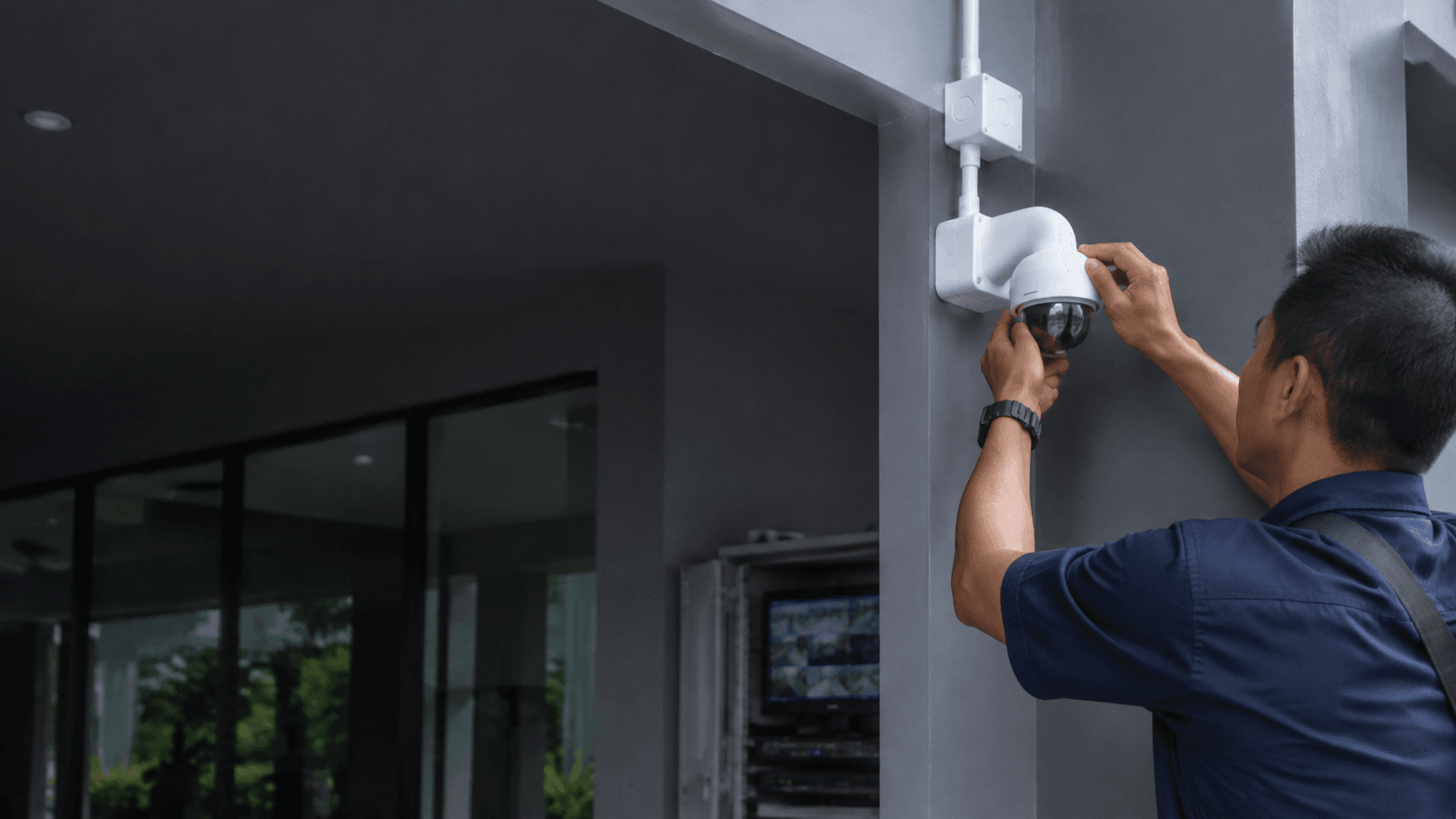
The phrase describes a bundle rather than a single product. Buyers in Malaysia comparing these sets are usually weighing three things at once: what arrives in the box, whether the screen earns its place on a wall, and who handles the survey, mounting, and handover. Retail listings answer the first question and leave the other two open.
Cctv Camera Full Set With Monitor: What Matters Before You Choose
A full set is a kit, not a camera. The parts work together or not at all, so the contents matter more than any single specification.
- Cameras for the positions identified during a site survey.
- A recorder that stores footage and feeds the display.
- Cabling and power components sized to the cable runs.
- A monitor or display screen for live viewing.
- Configuration of recording and remote viewing access.
Eyonic's CCTV work covers planning, supply, and installation of monitoring systems with camera placement, recording, and remote viewing for homes, offices, shops, and industrial sites. The RM 1,599 Hikvision CCTV Package covers camera supply and setup, basic recording configuration, and mobile viewing handover. Whether a monitor forms part of that package is not confirmed in the published material, so it should be settled directly rather than assumed from a listing photo.
Two components deserve attention before purchase. The recorder determines how many cameras the set can grow to accept, and the cable type determines how far cameras can sit from the recorder without signal problems. A set that fits today's four positions but cannot accept a fifth camera later forces a replacement rather than an addition.
Where the Monitor Fits in Daily Use
The monitor is the part of a cctv camera full set with monitor that people notice, and it is also the part most often left switched off.
A screen earns its place when someone watches it during working hours. Reception counters, guard posts, shop counters, and site offices are the natural homes for a live display, because staff there can glance at arrivals, queues, or a gate without opening an app. In those settings the monitor is doing real work.
In a house or a small office where nobody sits in front of a screen, the same money buys storage or an extra camera position instead. Remote viewing on a phone covers the check-the-driveway use case, and a wall-mounted screen adds little to it. The honest trade-off is between a display that someone watches and coverage that records whether or not anyone is watching.
Placement of the screen follows the same logic as camera placement. It needs a power point, a cable route back to the recorder, and a viewing angle that does not put the screen in direct glare. A monitor mounted where sunlight falls across it for half the day is a monitor nobody uses.
Camera Placement and Lighting Checks
Placement decides whether a set is useful. A well-chosen camera at a doorway beats a higher-specification camera pointed at a blank wall.
Eyonic recommends checking actual lighting conditions before confirming placement for ColorVu-style cameras. That step matters because night performance depends on what light already exists at the position, not on the model name alone. A position with a nearby streetlight or porch light behaves differently from a dark back lane, and the check happens on site rather than on a specification sheet.
Coverage planning also has to respect what the camera can actually see. Wide angles capture more area but shrink faces and number plates. Narrow angles capture detail but miss movement at the edges. The practical answer is usually a mix: wider views over open areas, tighter views on entry points where identification matters.
Edge cases worth raising during a survey include cable runs that exceed the practical distance for the chosen cable type, positions where a camera would overlook a neighbouring property, and areas where a camera would be obscured by foliage or parked vehicles for part of the day. Each of these is cheaper to solve before drilling than after.
How Eyonic Plans and Installs a Set
Eyonic's CCTV installation process runs through four stages: site survey, system proposal, installation, and handover. The sequence exists because the survey determines the proposal, and the proposal determines what gets installed.
The survey establishes where cameras can physically go, what lighting exists at each position, where the recorder will sit, and how cable will be routed. The proposal then sets out the system that fits those findings. Installation follows the agreed layout, and handover covers recording configuration and viewing access so the system is usable on the first day rather than after a follow-up visit.
Eyonic Sdn Bhd is a security system supplier in Sarawak working on CCTV and ELV systems, with planning, supply, and installation for homes, offices, shops, and industrial sites. Eric Yong founded the company and has worked in the industry for more than ten years, with experience in technical installation of digital security solutions for commercial businesses in Sarawak.
For a cctv camera full set with monitor, the handover step is where the monitor question resolves. Someone has to confirm the screen shows the right camera grid, that recording runs as intended, and that remote viewing works from outside the property. A set handed over without that check tends to sit unused.
Kuching Immigration Office Project
Eyonic completed a project for the Kuching Immigration Office, focused on arrival flow, staff areas, visitor movement, and dependable daily operation. The approximate budget for that type of work was RM 12,000 to RM 28,000.
A second project for KTA Sarawak Sdn Bhd covered a practical office setup in Kuching to support staff movement, visitor handling, tidy cabling, and clearer daily site control, with an approximate budget of RM 8,000 to RM 18,000.
Both projects point to the same planning pattern that applies to smaller sets. Public and commercial sites need coverage that matches how people actually move through the building, and they need cabling that stays tidy because it will be inspected and maintained for years. A monitor in a reception or guard area fits that pattern directly, since staff can watch arrivals without leaving their post.
For a home or small shop, the same reasoning scales down. The question is not how many cameras a set contains but which positions matter and who will watch the screen. Share the location, property type, and required system with Eyonic on WhatsApp at +60 11-5111 7959 for the next practical step.