
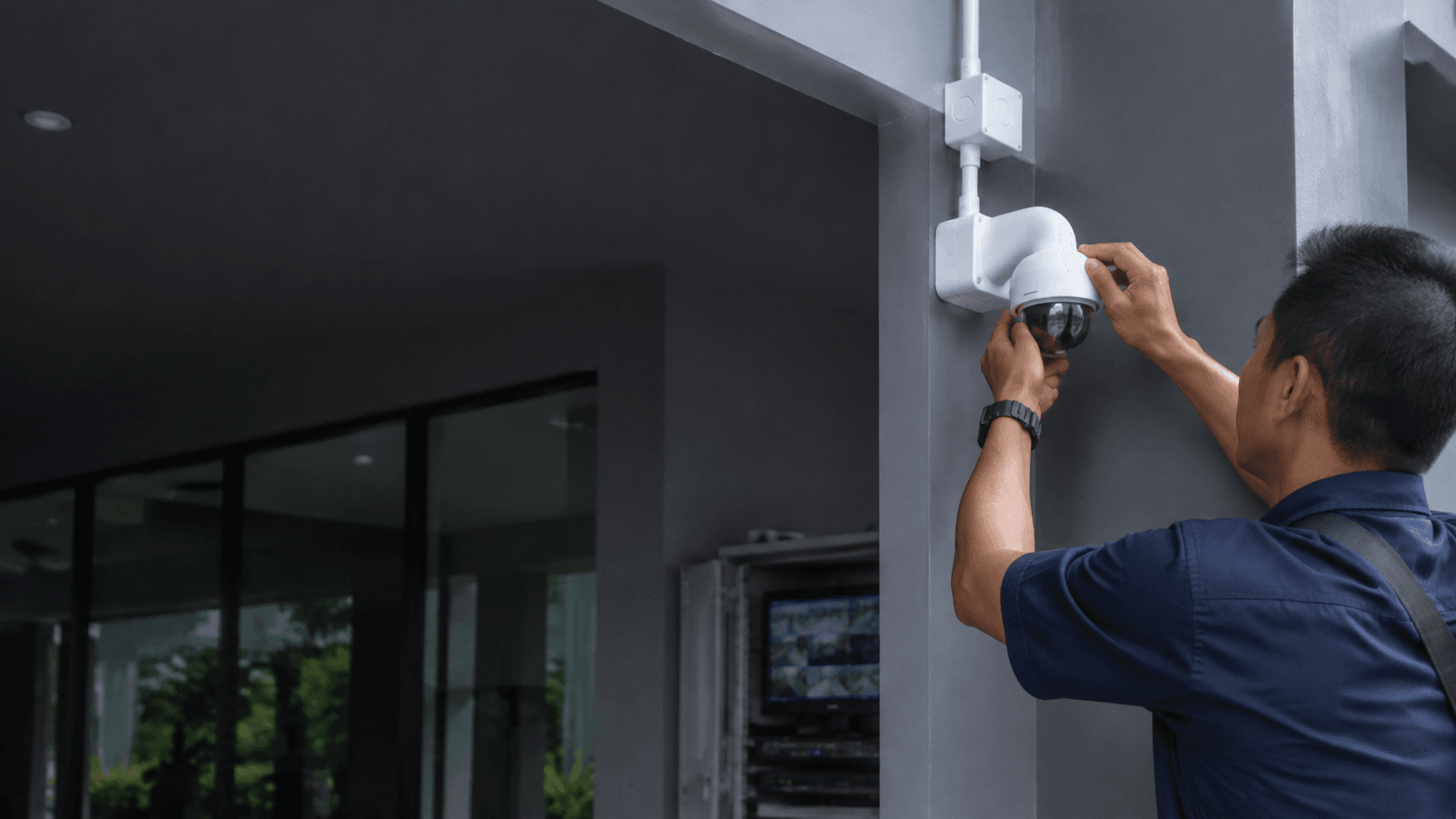
The bullet shape is the workhorse of outdoor surveillance: a long cylindrical housing on an adjustable bracket, aimed down a fence line, a driveway, or a warehouse yard. It is the camera most people picture when they picture CCTV, and it earns that position because the shape solves a specific problem — covering distance in one direction without a wide, wasteful spread.
This guide covers what the housing is built for, how it differs from dome and box cameras, where it fits on Malaysian properties, and how a bullet CCTV installation is planned, supplied, and handed over in Sarawak.
What a bullet CCTV camera is built for
A bullet camera is a directional instrument. The cylindrical body holds the lens and image sensor at the front, and the bracket lets the installer tilt and pan the whole unit until the sightline lands where it should. Once tightened, the aim stays put.
That fixed aim is the point. A camera pointed down a 30-metre boundary does not need to sweep; it needs to hold the same view every hour of every day so that footage from Monday can be compared with footage from Friday. The long housing also gives the lens room to sit further from the mounting surface, which reduces the chance of the wall or eave intruding into the frame.
Three practical traits follow from the shape:
- Reach over width. A bullet is chosen when the priority is distance along a line rather than coverage of a wide open area.
- Visible presence. The housing is obvious. On a perimeter, that visibility is often part of the requirement rather than a side effect.
- Straightforward servicing. The lens sits at the front of an exposed body, so cleaning and re-aiming do not require opening a ceiling or removing a dome cover.
Those traits are general to the shape. Specific figures — resolution, lens focal length, infrared distance, weather rating — vary by model and must be read from the manufacturer's datasheet for the exact unit being quoted, not assumed from the word "bullet".
Bullet CCTV compared with dome and box cameras
The three common outdoor shapes are not ranked; they are matched to different jobs. The comparison below stays at the level of housing and mounting behaviour, because no verified performance measurements for specific models are available to cite.
- Dome. A dome hides the direction the lens is pointing, which suits entrances, lobbies, and retail interiors where the camera should be less conspicuous and less easy to grab or turn. The trade-off is that a dome is generally the harder shape to aim precisely at a distant target.
- Bullet. A bullet announces its direction and holds a long sightline. It suits perimeters, gates, car parks, and loading areas. The trade-off is that an exposed, obvious housing is also an exposed target for tampering or for a branch that grows into the frame.
- Box. A box camera separates the body from the lens, so the lens can be changed later. That flexibility costs more in mounting hardware and housing, and it is usually reserved for specialist work rather than routine perimeter coverage.
A mixed site often uses more than one shape. A shop might run domes over the counter and a bullet down the back lane. The decision is made per sightline, not per building.
Where bullet CCTV works on Malaysian properties
Long, narrow, or boundary-driven sightlines are where the bullet shape earns its place. Typical fits include.
- Terrace and semi-detached houses. A camera at the front corner covering the gate, the car porch, and the length of the road frontage.
- Shoplots and commercial rows. A rear-lane camera covering a service entrance and the stretch of back wall where stock moves.
- Warehouses and industrial lots. Yard and loading-bay coverage where the distance from the building to the fence is the main concern.
- Offices and public buildings. Corridors, arrival points, and staff or visitor routes where a fixed, predictable view supports daily operation.
Two local conditions shape placement more than the camera choice. The first is rain. Sarawak's rainfall is heavy and frequent, so mounting height, bracket angle, and cable entry all matter — water that runs down a wall should not run into a connector. The second is lighting. Eyonic's own guidance on ColorVu-style cameras is to check the actual lighting conditions on site before confirming placement, because a camera specified for low light behaves differently under a bright porch lamp than under an unlit lane.
There is also a boundary question. A camera aimed along a shared lane or across a neighbouring lot can capture more than the owner intends. Aiming is therefore part of the survey, not an afterthought once the bracket is on the wall.
How Eyonic plans a bullet CCTV installation
Eyonic's documented CCTV process runs in four stages, from first visit to handover. The same sequence applies whether the cameras are bullets, domes, or a mix.
- Site survey. The property is walked to identify sightlines, mounting points, power and cabling routes, and the lighting conditions at each proposed position.
- System proposal. The survey findings become a proposed camera layout, recording setup, and scope of work for the property.
- Installation. Cameras are mounted and aimed, cabling is run, and the recorder is configured.
- Handover. The system is tested with the user, and remote viewing is set up so the footage can be checked from a phone.
The survey stage is where most of the value sits. A bullet camera placed two metres too low, or aimed a few degrees off the gate, produces footage that looks fine on the day and proves useless months later. Checking the actual lighting at each position before confirming placement is a specific step Eyonic applies to low-light camera choices, and it applies equally to any bullet position that will be relied on after dark.
Recording and viewing are planned alongside the cameras. A bullet CCTV system needs a recorder — typically an NVR for network cameras — plus storage sized to the retention the site actually needs, and a remote viewing setup that works on the phones the users carry. None of that is decided by the camera shape, but all of it is decided at the same time.
Bullet CCTV packages and next steps
Eyonic publishes a Hikvision CCTV Package at RM 1,599 covering camera supply and setup, basic recording configuration, and mobile viewing handover. That is the documented entry point for a CCTV installation; the final scope for a bullet-heavy layout depends on how many sightlines the property has and how far each one runs.
For larger or more complex sites, the range is wider. Eyonic's documented Kuching Immigration Office project — covering arrival flow, staff areas, visitor movement, and dependable daily operation — carried an approximate budget of RM 12,000 to RM 28,000. A separate office project for KTA Sarawak Sdn Bhd, covering staff movement, visitor handling, and tidy cabling, sat in the RM 8,000 to RM 18,000 range. Both are CCTV and office-fit work rather than bullet-specific deployments, but they show how project scope moves the number well beyond a single-camera package.
Three things determine where a bullet CCTV quote lands:
- Number of sightlines. Each long run needs its own camera and its own cable path.
- Cable distance and routing. Long outdoor runs, conduit, and difficult access add labour and materials.
- Recording and retention. The recorder, storage, and whether remote viewing is required across multiple users.
For the next practical step, share the location, property type, and required system with Eyonic on WhatsApp at +60 11-5111 7959. A site survey is what turns a general bullet CCTV question into a specific layout, and the survey is the first stage of the documented process.