
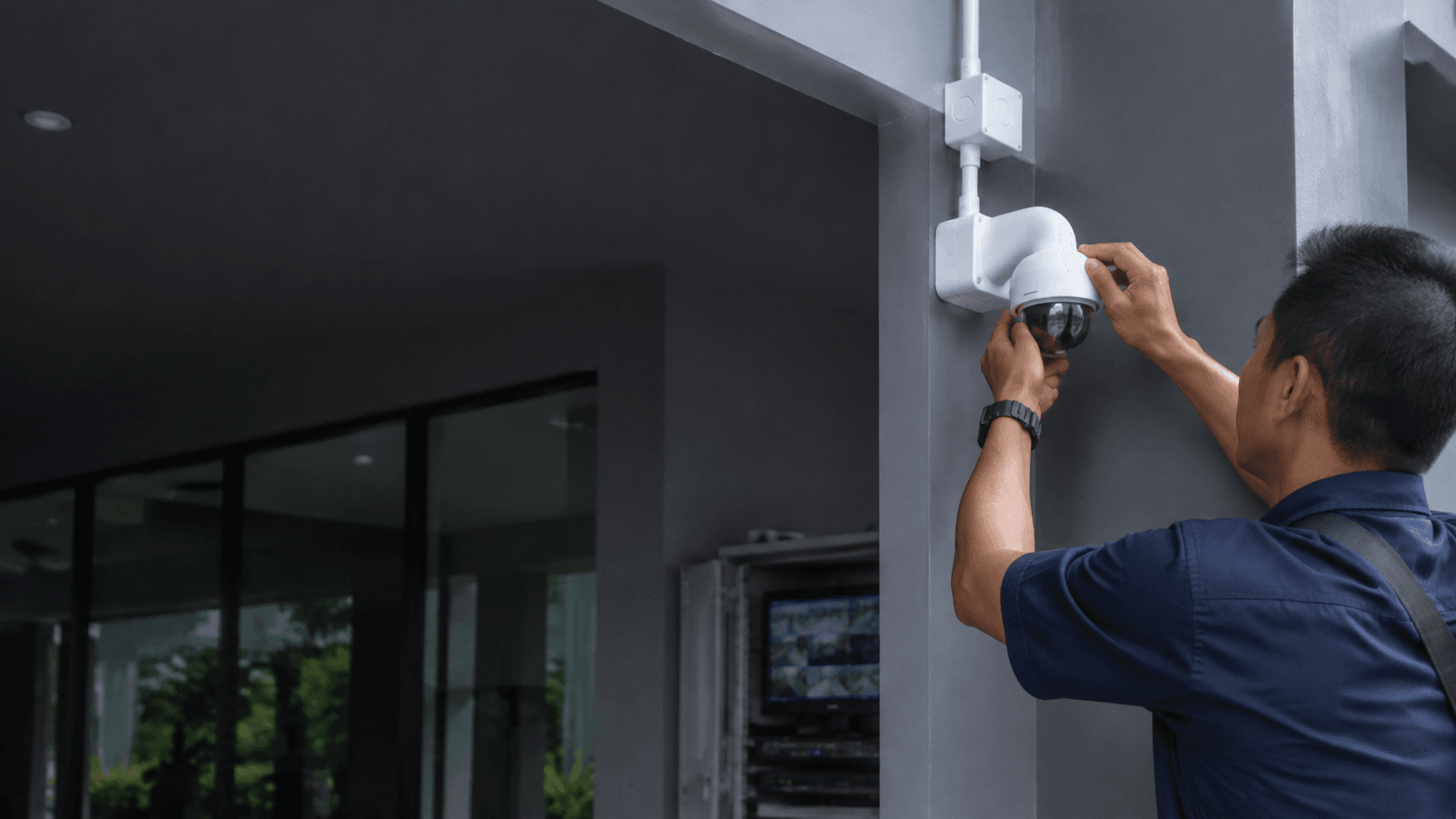
Four inputs is the smallest practical recorder size for a real installation. It covers a gate, a doorway, a counter, and one blind spot without paying for capacity that will never be used. The trade-off is fixed. once all four inputs carry a camera, adding a fifth position means replacing the recorder, not just buying another camera.
Eyonic Sdn Bhd plans, supplies, and installs monitoring systems with camera placement, recording, and remote viewing for homes, offices, shops, and industrial sites in Sarawak. The company's published CCTV installation process runs through site survey, system proposal, installation, and handover.
Dvr Cctv 4 Channel: what the recorder does in a small system
The recorder is the box that turns camera signals into stored video. Cameras send video down their own cable runs; the recorder receives those signals, writes them to a hard disk inside the unit, and serves the same footage to a monitor or to a phone app.
Four-channel recorders exist because most small premises do not need more. A shophouse with one entrance, one back door, and a parking spot rarely needs sixteen views. The recorder also handles the parts that are easy to overlook: it keeps time across all cameras, manages playback and export, and provides the remote viewing connection that lets an owner check the premises from elsewhere.
Two practical consequences follow from that design. First, the recorder is the single point of failure, so its location matters as much as camera angles. Second, because all footage lands in one box, storage sizing is a recorder decision rather than a camera decision.
Camera formats and recorder compatibility to confirm first
Compatibility is the most common reason a four-channel project stalls. Analog and HD-over-coax cameras and network cameras do not connect the same way, and recorders differ in which signal types they accept. A recorder bought without checking format support can arrive unable to read the cameras already on site.
Before committing, confirm which camera formats the quoted recorder accepts, whether existing cameras on the premises are the same format, and whether the recorder can mix formats across its four inputs. Where an existing camera set is being reused, the recorder should be chosen around those cameras rather than the other way round. Where everything is new, the format decision can be made once and applied across all four positions.
Eyonic's own product review guidance on smart locks makes the same point in a different context: the door condition, user roles, and backup method get reviewed before installation, and for business use the choice between a standalone device and a panel is checked first. The pattern applies to recorders. Confirm what the site already has before selecting the box.
Storage, recording time and playback expectations
Recording time is not a fixed number. It depends on how many cameras record, at what quality, whether recording runs continuously or only on motion, and how large the installed hard disk is. Two identical four-channel recorders can hold very different amounts of footage.
What can be stated plainly is the relationship. More cameras recording at once shortens retention. Higher recording quality shortens retention. Continuous recording shortens retention compared with motion-triggered recording. A larger hard disk lengthens it. Retention is therefore a design choice made at survey stage, not a property of the recorder model.
Playback matters as much as retention. A recorder that stores thirty days of footage is only useful if a specific incident can be found quickly. Event search, timeline scrubbing, and export to a usable file are the functions that decide whether footage is actually usable after an incident. These should be demonstrated at handover rather than assumed.
Lighting and placement checks before fixing camera positions
Camera positions should be confirmed against real conditions on site, not against a floor plan alone. Eyonic's guidance on ColorVu-style cameras is to check actual lighting conditions before confirming placement. A position that looks correct on paper can face directly into a setting sun, sit under a light that blows out the image at night, or cover a doorway that is already covered by another camera.
Four channels make this check more important, not less. With only four inputs, a wasted position is a quarter of the system. Each camera should be justified by a specific view: an entry point, a boundary, a high-value area, or a movement path. Overlapping coverage is sometimes deliberate, but it should be a decision rather than an accident.
Cabling routes belong in the same check. Cable runs affect where cameras can physically go, and tidy cabling was one of the stated needs in Eyonic's KTA Sarawak Sdn Bhd project in Kuching, alongside staff movement, visitor handling, and clearer daily site control.
How a dvr cctv 4 channel installation runs from survey to handover
Eyonic's published installation process has four stages. The sequence matters because each stage constrains the next: camera positions depend on the survey, the proposal depends on confirmed positions, and handover depends on the system being configured and tested.
- Site survey — assess the premises, existing cabling, lighting conditions, and the specific views required.
- System proposal — set out the recommended recorder, cameras, storage, and placement based on the survey findings.
- Installation — mount cameras, run cabling, install and configure the recorder, and set up recording and remote viewing.
- Handover — test the system with the user, confirm playback and export, and walk through mobile viewing.
Handover is where a four-channel system is either usable or not. Mobile viewing setup, playback, and export should be tested with the person who will actually use the system, not demonstrated once and left. Eyonic's Hikvision CCTV package at RM 1,599 includes camera supply and setup, basic recording configuration, and mobile viewing handover, which reflects that sequence at package level.
For larger or more complex sites, the shape of the work changes. Eyonic's Kuching Immigration Office project focused on arrival flow, staff areas, visitor movement, and dependable daily operation, with an approximate budget for that type of work of RM 12,000 to RM 28,000. That scale sits well beyond a four-channel recorder, and it illustrates where four inputs stop being the right answer.
Practical limits of a four-channel setup
Four channels is a ceiling, and the ceiling is reached quickly. A small shop with a front counter, a back door, a stockroom, and a rear lane is already at capacity. Any later addition means a larger recorder, and possibly a different recorder family if the camera format changes.
There are other limits worth naming. A single recorder is a single point of failure, so premises that cannot tolerate recording downtime need a different design. Sites with long cable runs, multiple buildings, or outdoor boundaries may find that four positions cannot cover the required views at usable quality. Sites that need to identify faces or number plates at distance need cameras and recording quality chosen for that purpose, which is a different specification exercise.
Where those conditions apply, the honest answer is that a four-channel recorder is the wrong starting point. Where they do not, it is often the most cost-effective option available.
Choosing between four channels and a larger recorder
The decision usually comes down to three questions. How many distinct views are genuinely required? Is there any realistic chance of adding a fifth or sixth camera within the life of the system? Does the site need recording to survive the failure of a single device?
If the answers are four or fewer, no, and no, a four-channel recorder fits. If any answer changes, sizing up at the outset is cheaper than replacing the recorder later. The cost difference between recorder sizes is usually smaller than the cost of a second installation visit.
Existing infrastructure also shapes the choice. Premises that already have coax cabling and analog cameras are often best served by a recorder that accepts those cameras, avoiding a full re-cable. Premises starting from nothing have more freedom and can choose the format that best fits the required views.
For readers in Malaysia comparing options, the practical next step is to establish the required views and confirm what the recorder must be compatible with before any model is selected. Sharing the location, property type, and required system with Eyonic on WhatsApp at +60 11-5111 7959 is one way to start that conversation.