
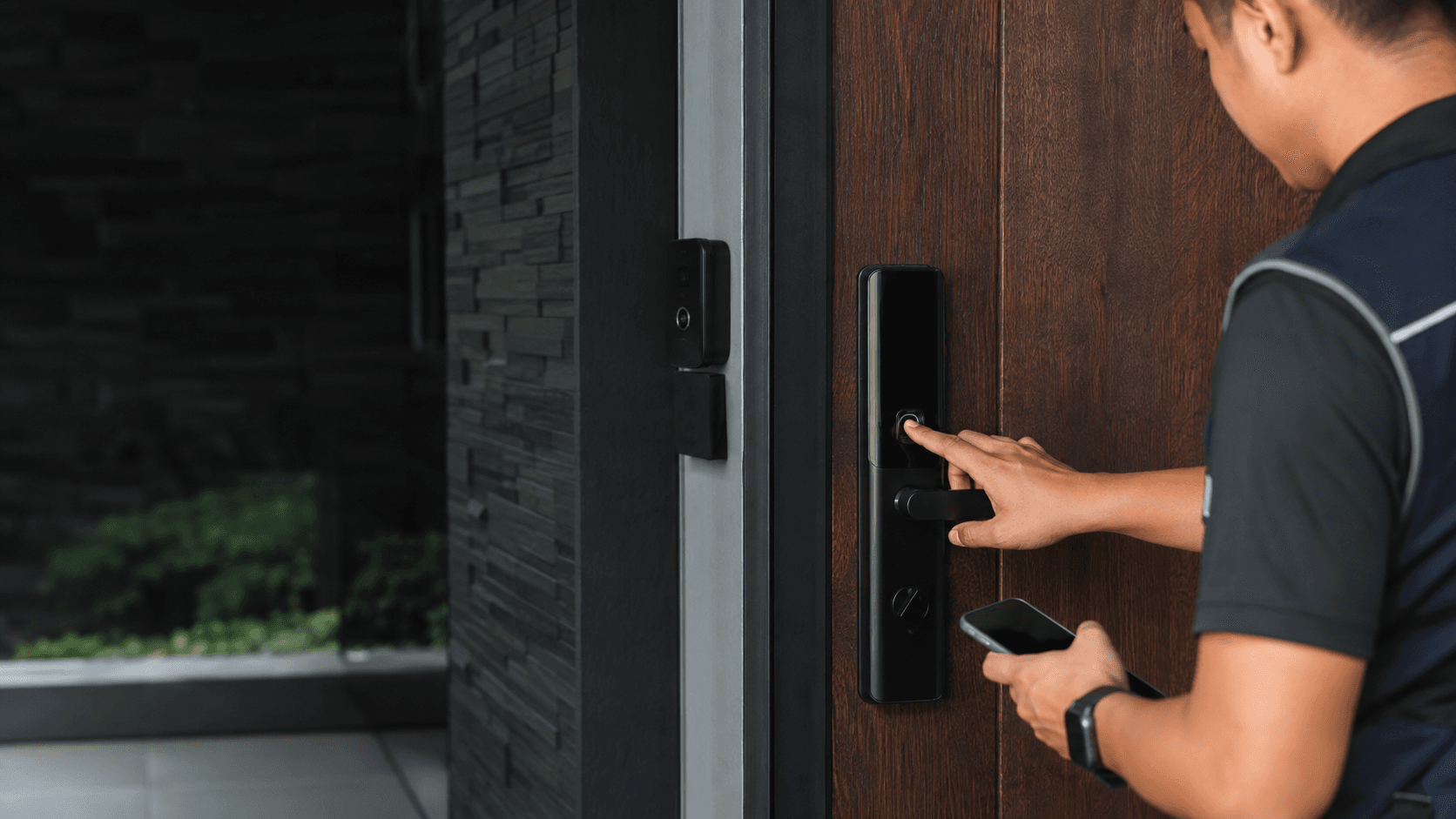
The appeal is straightforward. no keypad slab on the exterior, no thumb-turn housing to explain, and no visual signal that the door is electronically controlled. That matters in Malaysia for two different buyers. A homeowner in a terrace house or condominium may want the entrance to match the rest of the joinery. A shop, office, or clinic may want staff and visitors to enter without a visible access device advertising what sits behind the door.
What follows covers how a hidden smart lock differs from a standard one, the two main design families, the door and user questions that decide feasibility, and the checks worth completing before any installation is scheduled.
What a hidden smart lock changes about the door
A standard smart lock is a visible object. The exterior carries a keypad, fingerprint reader, or touch surface, and the interior carries a battery housing and manual override. A hidden smart lock removes that exterior presence. The electronics sit inside the door, inside the existing deadbolt bore, or behind the face of the door rather than on it.
The practical consequence is that the door keeps its original appearance and, in some designs, its original key. The trade-off is that the lock is no longer self-explanatory. A visitor who has never used the door has nothing to press. Access has to be planned in advance through a phone, a card, a fob, or a code, and the person managing the door has to be able to issue and revoke that access.
This is why a hidden smart lock suits controlled environments better than public ones. A main entrance used by delivery riders, contractors, and first-time visitors benefits from visible hardware that explains itself. A staff entrance, a server room, a records office, or a private residence door benefits from concealment.
Concealed deadbolt and invisible lock designs
Two broad approaches appear in the market, and they behave differently during installation.
The first is a concealed deadbolt built around a standard deadbolt footprint. The exterior cylinder looks like ordinary hardware, and the smart components replace or sit within the existing deadbolt assembly. Because the door already has a deadbolt bore, this route is closer to a retrofit than a rebuild. The door face does not change, and the lock reads as conventional hardware from the outside.
The second is an invisible or fully concealed lock, where the locking body is hidden inside the door or behind a panel. Some designs in this family are operated by RFID card or fob rather than a keypad, and some are intended for interior doors, cabinets, or concealed room entries rather than a main exterior entrance. These are the designs most likely to require door preparation that a standard door does not have.
Both families share one constraint: the door has to be able to accept the hardware. That is a physical question, not a software one, and it is answered by looking at the door rather than at a product page.
Door condition, user roles and backup entry
Eyonic's own guidance on smart lock door access states that smart locks work best when the door condition, user roles, and backup method are reviewed before installation, and that for business use the choice between a standalone smart lock and an access-control panel should be checked first. That sequence applies with more force to a concealed lock, because the hardware is harder to change after the fact.
Door condition covers the material, the thickness, the existing bore, the alignment of the frame and strike, and whether the door is solid or hollow. A concealed lock that depends on internal space needs that space to exist. A door that already closes cleanly and holds a deadbolt is a better candidate than one that needs adjustment before any lock is fitted.
User roles decide how access is issued. A household needs a small number of permanent users and a way to add a cleaner or a relative temporarily. A business needs staff access that changes when staff change, plus a record of who entered. A standalone smart lock handles the first case well. A larger staff group with shifting rosters usually points toward an access-control panel instead, because permissions and audit trails are managed centrally rather than door by door.
Backup entry is the question that decides whether a concealed lock is acceptable at all. If the battery fails, if the phone is lost, or if the app account is unavailable, the door still has to open. A mechanical key override, a physical key cylinder, or a documented manual release all serve that purpose. A concealed lock with no workable backup path is a single point of failure on the only way into a property.
Hidden smart lock compared with a standard smart lock
The comparison is not about which is more secure in the abstract. It is about which fits the door and the people using it.
A standard smart lock is easier to specify, easier to demonstrate, and easier to replace. Its access methods are visible, so a new user can be shown the keypad or reader once and operate the door afterwards. Its weaknesses are equally visible: the hardware announces itself, and the exterior surface is exposed to weather and handling.
A hidden smart lock trades that clarity for concealment. The door looks untouched, which is the entire point, and there is no exterior reader to weather or to invite attention. In exchange, access depends on a device or credential the user must already hold, and troubleshooting is less obvious because there is nothing on the door to inspect.
For a Malaysian home where the entrance is part of the design, or a business where a visible access device is undesirable, the concealed route can be the better fit. For a door with heavy first-time visitor traffic, a standard lock with a visible keypad usually causes fewer daily problems.
Practical checks before a hidden smart lock installation
These checks are worth completing in order, because each one can rule out the next.
- Confirm the door's material, thickness, and internal structure, and whether it can accept concealed hardware without weakening the door.
- Inspect the existing bore, deadbolt, frame, and strike alignment, and note whether the door currently closes and latches cleanly.
- Decide whether the door is an exterior entrance, an interior door, or a cabinet or concealed-room entry, since the design families differ by application.
- List every person who needs access, how often, and how quickly access must be revoked when someone leaves.
- Choose the access methods the door will actually use, such as app, keypad, card, fob, or fingerprint, and confirm each is supported by the chosen design.
- Confirm a working backup entry method exists and that the people who need it can reach it.
- Decide between a standalone smart lock and an access-control panel based on the number of users and the need for records.
- Have the door and the intended access plan reviewed on site before any hardware is ordered.
The last item matters more than it looks. A concealed lock is specified against a specific door, and the same product can be straightforward on one door and unsuitable on the next. A site survey is the point at which that becomes clear, and it is the same sequence Eyonic uses for its installation work: site survey, system proposal, installation, and handover.
For context on how access planning fits into a wider property setup, Eyonic's completed work includes the Kuching Immigration Office project, which focused on arrival flow, staff areas, visitor movement, and dependable daily operation, and the KTA Sarawak Sdn Bhd project, which covered staff movement, visitor handling, and clearer daily site control. Both are examples of access being planned around how a building is actually used rather than around a single device.
Where a concealed lock is part of a broader door and entry plan, it is worth reading Eyonic's smart lock door access review alongside the site survey and installation process before committing to a design.
Share your location, property type and required system with Eyonic on WhatsApp at +60 11-5111 7959 for the next practical step.