
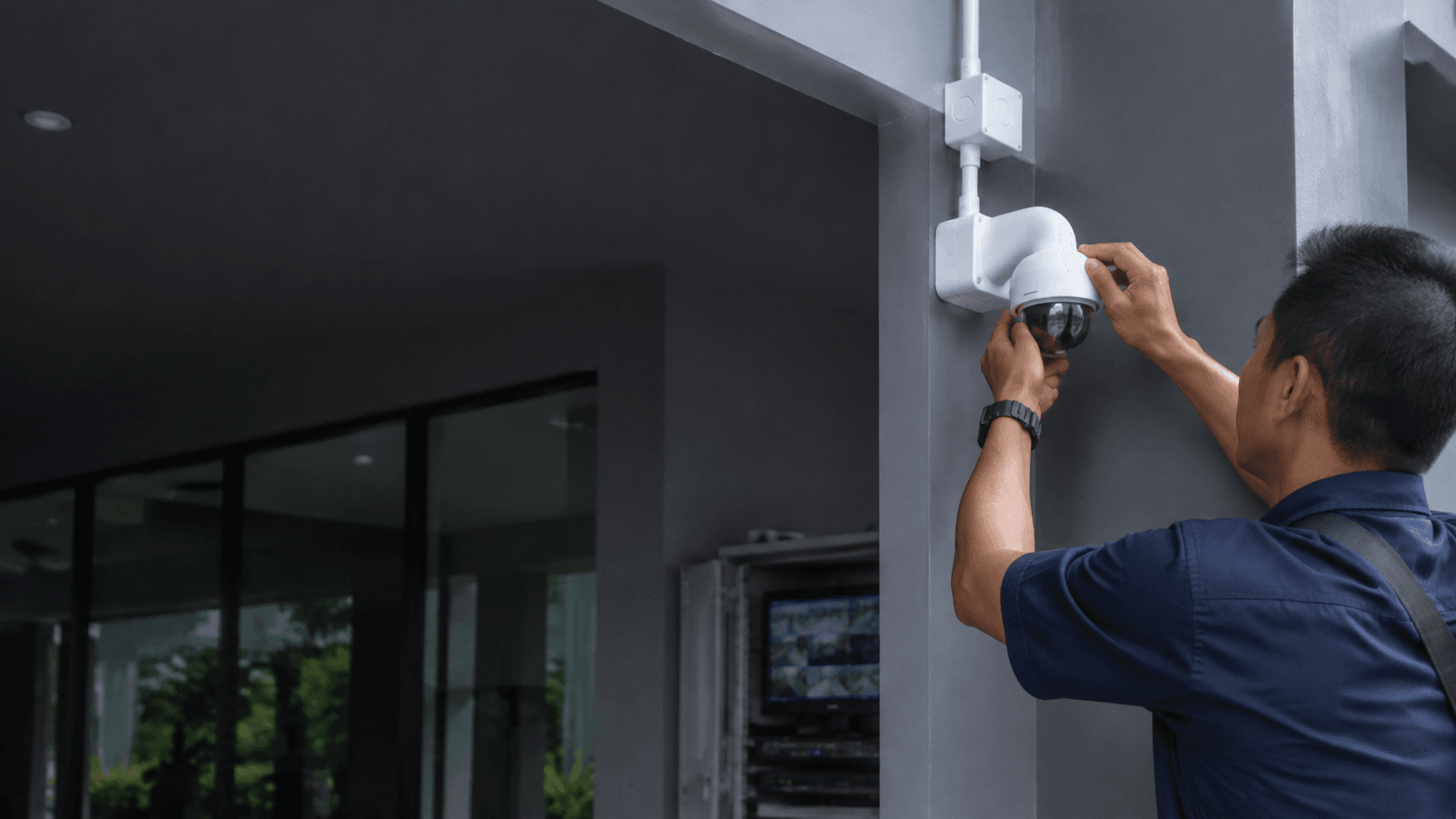
The exact-match query doorbell security describes a small but high-value part of a property's monitoring setup. The entry point is where deliveries arrive, strangers appear, and staff or family members pass through many times a day. A camera at that point answers a narrow question well: who is at the door, and what happened there. It does not replace coverage of a driveway, a back lane, or an internal corridor.
Eyonic Sdn Bhd plans, supplies, and installs monitoring systems with camera placement, recording, and remote viewing for homes, offices, shops, and industrial sites in Sarawak. The same site survey discipline that applies to a full CCTV layout applies to a single entry camera, because placement and lighting decide whether the footage is useful.
Doorbell Security. What It Covers at the Front Entry
Doorbell security is entry-point coverage. A camera mounted at the door looks outward at the approach, the gate, or the corridor leading to the unit. Its job is to capture the moment someone arrives and to make that moment reviewable later.
What it typically covers.
- The immediate approach to the door, including steps, porch, or landing
- Visitor movement at the threshold, such as arrivals, deliveries, and departures
- A live or recorded view that can be checked remotely when nobody is at the property
- A record that can be reviewed after an incident rather than relying on memory
What it does not cover on its own: a long driveway, a side gate, a car porch, a back entrance, or interior rooms. Those need separate cameras or a wider system. Treating one doorbell camera as whole-property coverage is the most common mismatch between expectation and result.
For a shop or office, the entry camera also supports visitor handling. A receptionist or staff member can confirm who is at the door before opening it, which matters when the door is the only controlled access point. The Kuching Immigration Office project, completed by Eyonic, focused on arrival flow, staff areas, visitor movement, and dependable daily operation — the same concerns that shape entry-camera placement in a public-facing building.
Doorbell Security Cameras and Video Doorbells
A doorbell camera and a video doorbell describe the same class of device: a camera at the door that also serves as, or sits beside, the doorbell. The distinction in practice is how the device is powered, how it connects, and where the recording lives.
A doorbell camera records video. A video doorbell adds two-way audio and a chime or notification function so the person inside can speak with the person outside. Many units do both. The choice matters less than whether the device fits the door, the wiring, and the network at that specific property.
What a doorbell camera does at an entry point
At its core, the device watches a fixed field of view and records when it detects activity or when someone presses the button. That footage is either stored locally on a recorder or memory card, or held in a cloud service. Remote viewing lets a phone or computer check the live feed and review past events.
Two practical limits apply. First, a camera sees what its lens is pointed at; a badly aimed unit captures a wall or a ceiling. Second, detection depends on how the device decides something is worth recording, and that behaviour varies by model. Neither limit can be judged from a product listing alone — both depend on the actual door.
Where doorbell security fits and where it does not
Doorbell security suits a single controlled entry: a house with one main door, a shop with a street frontage, an office suite with a reception door. It is a poor fit for a property with multiple uncontrolled approaches, a long perimeter, or a need to monitor internal movement. In those cases the entry camera becomes one camera in a larger layout rather than the whole answer.
Wired, Battery, and Power over Ethernet Doorbells
Power and connection method decide most of the practical constraints. The three common approaches behave differently at the door.
Wired doorbells use existing doorbell wiring for power. They avoid battery changes and usually support continuous operation. The constraint is that the wiring must exist and be in usable condition. Older properties may have no doorbell circuit, or one that no longer works.
Battery doorbells need no wiring at the door, which makes them the practical option for rented premises, concrete walls where chasing a cable is disruptive, and doors with no existing circuit. The trade-off is periodic charging or battery replacement, and battery behaviour can change in hot or humid conditions.
Power over Ethernet doorbells draw power and send data over a single network cable. They suit properties where a cable run to the door is feasible and where a stable wired network connection is preferred over Wi-Fi. The constraint is the cable itself: if the route from the door to the network point is difficult, the installation cost and disruption rise.
Wi-Fi signal strength at the door is a separate issue from power. A door that sits behind a thick wall or at the far end of a building may have weak coverage, which affects live viewing and event uploads regardless of how the device is powered.
What to Check Before Choosing a Doorbell Camera
The checks below are the ones that change the recommendation. They are practical questions about the property, not product comparisons.
- Confirm the door and frame condition, including whether the surface can take a mount and whether the door opens against the camera position.
- Check the actual lighting at the entry across the day, including morning shade, afternoon sun, and night-time conditions, before confirming placement.
- Establish whether usable doorbell wiring exists, or whether the door needs a battery unit or a new cable run.
- Test the Wi-Fi or network signal at the door position, not from inside the building.
- Decide where recording will live — a local recorder, a memory card, or a cloud service — and who will review it.
- Identify what the entry camera will not see, and whether that gap needs a second camera or a wider system.
- Agree who manages the footage day to day, including how clips are exported when something needs to be reported.
Eyonic's CCTV installation process runs through site survey, system proposal, installation, and handover. The survey stage is where the lighting and placement questions above get answered, because a recommendation made without seeing the door is a guess.
Lighting and placement decide usefulness
Eyonic recommends checking actual lighting conditions before confirming placement for ColorVu-style cameras. The same principle applies at a door. A position that looks correct on a floor plan can face directly into an afternoon sun or sit in deep shade at night. Both change what the camera records.
Placement also has a human dimension. A camera aimed at the face of every visitor is more useful for identification; a camera aimed too high or too low captures hats, feet, or empty space. The mount height and angle are decisions worth making on site.
as Part of a Wider CCTV or Alarm Setup
A doorbell camera is strongest when it is one layer of a wider setup rather than the only device. The entry point is where an alarm system and a camera system overlap most usefully.
An alarm system detects and alerts. A camera system records and shows. At the door, the two work together: a sensor or motion trigger can prompt a recording, and the camera provides the visual context that a sensor alone cannot. Eyonic supplies and installs alarm systems alongside CCTV, which means the entry point can be planned as a single design rather than two separate purchases.
For a shop or office, the entry camera often connects to a broader layout covering the counter, the stock area, and the staff entrance. The KTA Sarawak Sdn Bhd project, completed by Eyonic, needed a practical office setup in Kuching to support staff movement, visitor handling, tidy cabling, and clearer daily site control — the same combination of concerns that shapes an entry-camera design in a commercial unit.
Where a property has a gate, an autogate system and an entry camera address different parts of the same arrival sequence. The gate controls vehicle access; the door camera records who reaches the door. Neither substitutes for the other.
Recording and review
Recording is only useful if someone can find the clip later. Before installation, it is worth deciding how long footage is kept, who can access it, and how a specific event is located. A system that records everything but cannot be searched quickly tends to go unreviewed.
Remote viewing extends that access beyond the property. It also raises a practical question about who holds access and how it is removed when a staff member leaves. That is an administrative decision, not a technical one, and it is easier to settle before the system goes live.
Installation Handover and Daily Use
Installation quality shows up months later, not on the day of fitting. Cabling that is tidy and protected lasts; a mount that is level and sealed keeps water out; a network connection that was tested at the door keeps working when the weather changes.
Handover is where the system becomes usable. It covers how to view live footage, how to find a past event, how to export a clip, and who to contact when something stops working. A system handed over without that walkthrough tends to be used less than it could be.
Daily use is simple when the setup matches the property. A single entry camera on a reliable connection, with recording that someone actually reviews, does more than a larger system nobody checks. The reverse is also true. a well-specified system with no clear owner for the footage becomes background equipment.
For properties in Sarawak, humidity and rainfall are part of the operating environment. Mounting position, sealing, and cable routing matter more here than in drier climates, and they are worth confirming during the site survey rather than after installation.
Eyonic's founder, Eric Yong, has worked in the industry for more than ten years and is experienced in the technical installation of digital security solutions for commercial businesses in Sarawak. That experience is applied at the survey stage, where the entry point is assessed alongside the rest of the property.
Share your location, property type and required system with Eyonic on WhatsApp at +60 11-5111 7959 for the next practical step.