
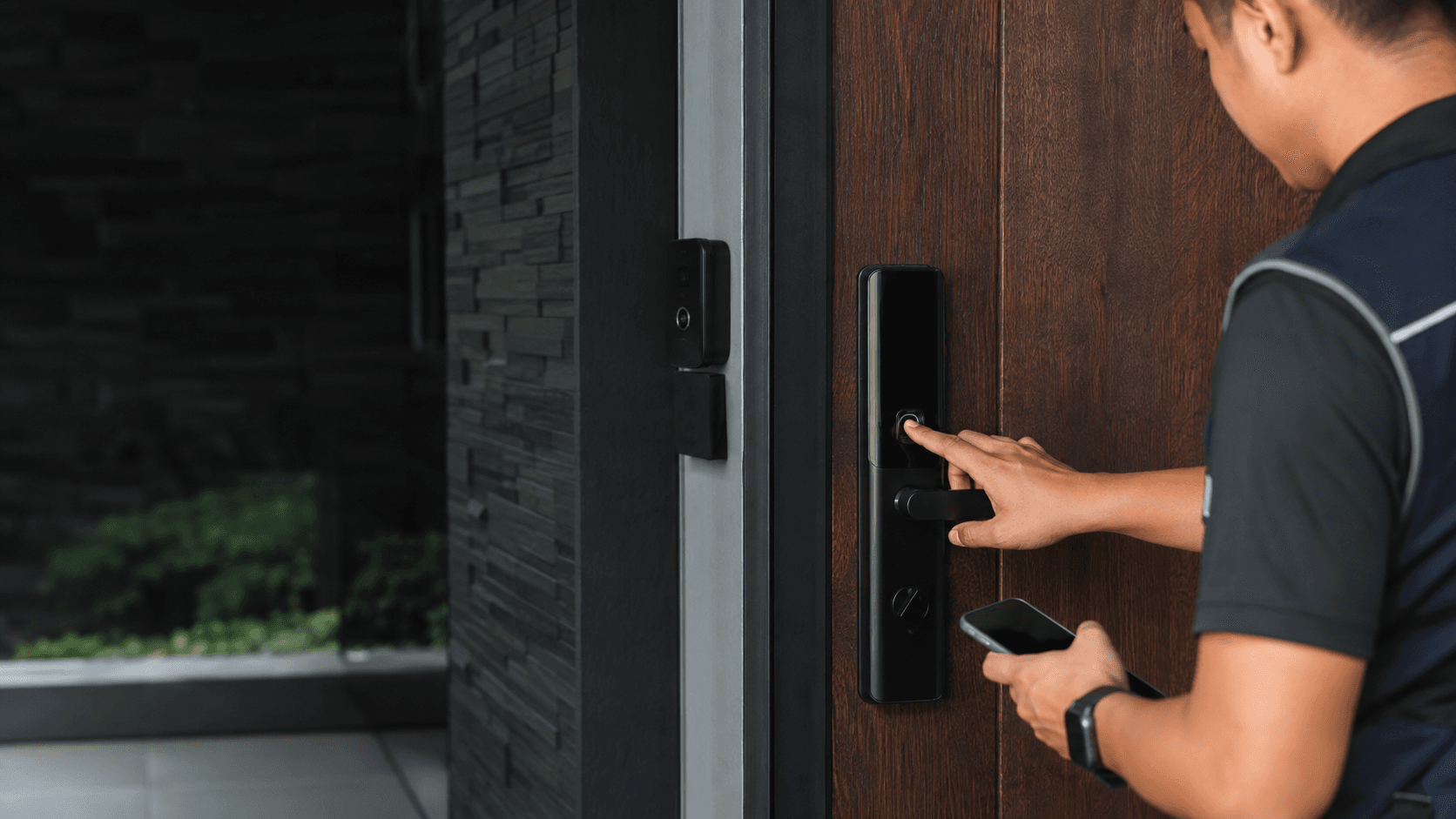
The phrase "best fingerprint door lock 2026" is a search for a shortlist, but the shortlist only holds up when the door itself, the people who use it, and the fallback when a finger will not read have all been settled first. Eyonic Sdn Bhd, a security system supplier in Sarawak, reviews smart lock door access on the basis that door condition, user roles and backup method come before any model choice, and that a standalone smart lock and an access-control panel are different answers for different sites.
Best Fingerprint Door Lock 2026: What the Shortlist Has to Prove
A shortlist is only useful if each candidate can be checked against the same set of site facts. Because no verified technical specifications, prices, or comparative test data for fingerprint door lock models were supplied for this article, the honest version of a 2026 shortlist is a set of questions that any candidate must survive, not a ranking of named products.
Four things decide whether a candidate belongs on the list at all:
- Whether the existing door and frame can carry the lock without structural work.
- Whether the user group is small and fixed, or large and changing.
- Whether a backup entry method exists that does not depend on power or a working scanner.
- Whether the site needs a standalone lock or a managed access-control system.
A lock that fails any of these four checks is not a weaker option; it is the wrong category of product for that door. That is why a list of model names without site facts tends to mislead more than it helps.
Fingerprint Door Lock Basics. Biometrics, Keypad, and Backup Entry
A fingerprint door lock reads a stored fingerprint template and releases the locking mechanism when the read matches. The practical questions are what happens when the read fails, and what happens when the lock has no power.
Biometric reading is convenient because nothing has to be carried. It is also the method most exposed to conditions the installer cannot control: a wet hand, a worn print, a very dry print, or a finger presented at the wrong angle. A keypad code, a card or fob, and a mechanical key each fail in different circumstances, which is why most workable installations combine at least two methods rather than relying on the scanner alone.
Backup entry deserves to be decided before the lock is chosen, not after. If the only way in is a fingerprint, then a failed read at the wrong moment becomes an access problem rather than an inconvenience. A mechanical key kept off site, or a keypad code held by a second person, changes that risk profile completely.
Where biometrics fits and where it does not
Biometric entry suits a small, stable user group on a door that is used often and by the same people: a family home, a small office entrance, a staff door. It fits less well where the user group changes constantly, where users cannot be enrolled in person, or where every entry must be individually logged and reviewed. In those cases the fingerprint reader may still be present, but the access decision belongs to a panel rather than to the lock.
Door Condition and User Roles Before Any Fingerprint Door Lock Is Chosen
Door condition is the constraint that eliminates more candidates than any feature comparison. A lock that fits one door may not fit the next one in the same building.
Before a fingerprint door lock is selected, the door and frame need to be checked in person. Thickness, the existing cutout, the frame's condition, and whether the door closes squarely all affect what can be fitted and how reliably it will work over time. A frame that has moved, or a door that needs lifting to latch, will keep causing problems regardless of how good the lock is.
User roles come next. The questions that matter are how many people need entry, whether that group changes, whether anyone needs time-limited access, and whether entry needs to be reviewed afterwards. A household and a shop with rotating staff produce very different requirements from the same hardware category.
Eyonic's own review of smart lock door access notes that for business use the usual check is whether a standalone smart lock or an access-control panel is more appropriate. That distinction is worth settling early, because it changes the budget, the wiring, and the handover.
Pre-installation checks, in order
- Confirm the door and frame condition, including thickness, cutout and how the door closes.
- Map user roles and permissions. who needs entry, how often the group changes, and whether access needs reviewing.
- Decide the backup entry method and where the backup credential is kept.
- Confirm power and connectivity arrangements for the chosen lock or panel.
- Schedule installation and handover, including who will be enrolled and who will administer the system.
Access Methods Compared. Fingerprint, Keypad, Card, and Mechanical Key
Each access method carries its own dependency. The table below sets out who each method suits, what it depends on, and what to confirm before installation.
| Access method | Who it suits | What it depends on | Confirm before installation |
|---|---|---|---|
| Fingerprint | Small, stable user groups on frequently used doors | A clean, consistent read from enrolled fingers | That every regular user can be enrolled in person, and that a failed read has a fallback |
| Keypad code | Groups that change, and visitors who need temporary entry | Codes being issued, changed and withdrawn deliberately | Who controls code changes, and how codes are removed when someone leaves |
| Card or fob | Sites where entry should be individually identifiable | Cards being issued, tracked and cancelled | Whether the site wants a managed access-control system rather than a standalone lock |
| Mechanical key | Any site as a fallback, and as the last line of entry | Physical key security and controlled duplication | Where the backup key is stored, and who can reach it |
The trade-off is straightforward. Fingerprint entry is the fastest for a regular user and the least useful for a one-off visitor. Keypad codes are the most flexible and the most dependent on good administration. Cards give the clearest record of who entered and require the most discipline to manage. A mechanical key is the least convenient and the most reliable when everything else has failed.
Installation Sequence for a in Sarawak Properties
Eyonic's documented installation process runs through site survey, system proposal, installation, and handover. The same sequence applies to access work: the survey establishes what the door can take, the proposal sets out what will be supplied and fitted, installation follows, and handover covers enrolment and administration.
- Site survey, covering the door, frame, power and connectivity arrangements.
- System proposal, setting out the recommended lock or panel and the access methods.
- Installation of the hardware and any supporting wiring.
- Handover, including user enrolment and administration of codes or credentials.
Handover is the step most often treated as a formality, and it is the one that decides whether the system stays usable. If nobody at the site knows how to add a user, remove a departed staff member, or replace a backup credential, the lock will be bypassed within months.
Eyonic's completed work in Sarawak includes a project for the Kuching Immigration Office, focused on arrival flow, staff areas, visitor movement and dependable daily operation, and a project for KTA Sarawak Sdn Bhd covering staff movement, visitor handling and tidy cabling. Both illustrate the same point. on sites where people move through a door all day, the access method has to hold up under daily use rather than perform well in a demonstration.
What handover should cover
Handover should leave the site with enrolled users, a documented way to add and remove access, a defined backup entry method, and a named person responsible for administration. Anything less tends to surface as a support call later.
Cost Handover and Ongoing Support Questions to Settle Early
No verified pricing for fingerprint door lock hardware or installation in Malaysia was supplied for this article, so cost has to be established from a quotation for the specific door and site rather than from a published figure. What can be settled early is the scope that the quotation should cover.
For reference on how access and security work is scoped in Sarawak, Eyonic's published project budgets for comparable office work sit in the RM 8,000 to RM 18,000 range for the KTA Sarawak Sdn Bhd project and RM 12,000 to RM 28,000 for the Kuching Immigration Office project. Those figures cover wider security and access scopes, not a single door lock, and they are useful mainly as an indication of how project-level access work is priced rather than as a lock price.
Three questions are worth settling before work starts. First, what the quotation includes beyond the hardware: installation, wiring, enrolment, and handover. Second, who administers the system after handover, and whether that person will be trained. Third, what happens when the lock needs attention, and who is contacted.
On support terms, no verified warranty or service interval for fingerprint door locks was supplied, so any warranty or service arrangement should be confirmed in writing as part of the proposal rather than assumed.
Where a site needs more than one door covered, or where entry needs to be reviewed rather than simply permitted, the decision usually moves from a standalone lock to a wider access-control scope. Eyonic's other Sarawak installation services, including alarm systems, autogate, keyphone intercom and Starlink internet, are often planned alongside access work on the same site, which is one reason a survey comes before a product choice.
For a site in Sarawak, sharing the location, property type and required system with Eyonic on WhatsApp at +60 11-5111 7959 is the practical next step, because the door and the user group decide the answer far more than any product list does.