
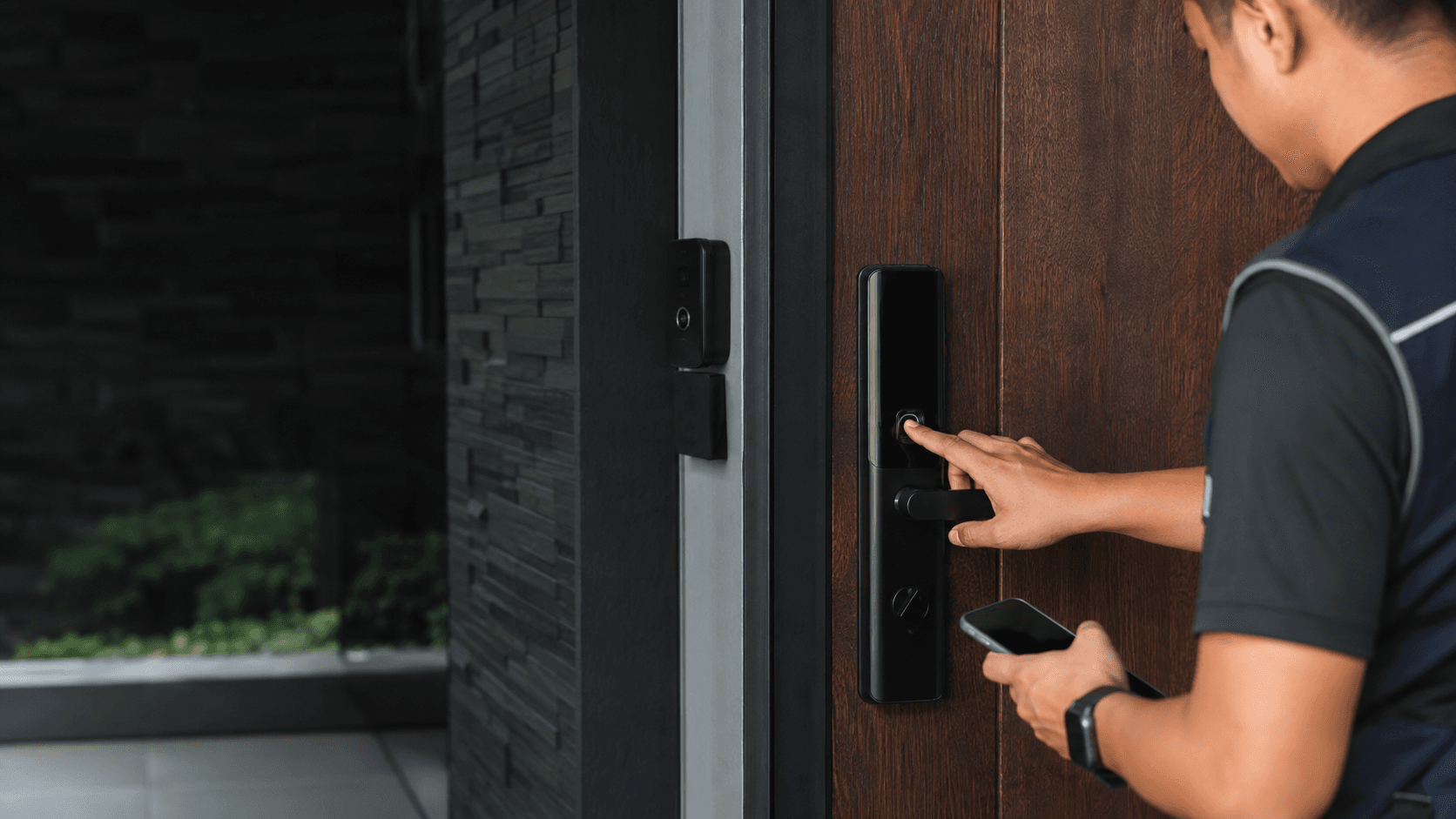
The exact-match query smart lock for french doors describes a real compatibility problem rather than a simple product category. French doors are built as pairs, and the two leaves behave differently. One leaf opens and closes with the handle and the main lock; the other leaf usually stays fixed and is held by flush bolts, surface bolts, or a coordinating mechanism at the top and bottom. A lock that replaces a single deadbolt cannot secure both leaves on its own.
Eyonic Sdn Bhd, a security system supplier in Sarawak, Malaysia, reviews door condition, user roles, and backup entry method before recommending smart lock hardware, and the same review applies to double-door setups. The company's own product guidance notes that smart locks work best when those three items are checked first, and that for business premises a standalone smart lock and a panel-based access control system are not interchangeable choices.
Smart Lock For French Doors. What Matters Before Choosing
Three physical facts decide most of the outcome: how much flat surface exists on the door stile, how the passive leaf is currently secured, and whether the existing deadbolt bore hole matches the new lock body. A lock with a wide escutcheon or a long backset will not sit on a narrow stile, and a lock designed for a single 1¾-inch door will not coordinate two leaves.
Door material also matters. Timber French doors can usually be drilled and mortised on site. uPVC and aluminium frames often contain a steel or aluminium reinforcement channel, and cutting into that channel without checking its position can weaken the frame or block the lock body. Glass panels close to the stile edge reduce the safe drilling zone further.
Power and network access are the third constraint. A battery lock avoids running cable through a glass door, but battery replacement becomes a recurring task on a door that may be opened many times a day. A mains-powered lock needs a cable route, which on an exterior French door usually means drilling through the frame or the adjacent wall.
Choosing the Right Smart Lock For French Doors
The decision sequence below follows the order that avoids wasted purchases. Each step removes options that cannot physically work before cost and features are compared.
- Measure the stile width, door thickness, and the distance from the door edge to the centre of the existing deadbolt bore.
- Identify how the passive leaf is held: flush bolts, surface bolts, an astragal, or a multi-point mechanism.
- Decide whether the passive leaf will stay manually bolted or be released automatically when the active leaf unlocks.
- Confirm the lock body fits the measured stile and backset, and that the handle or escutcheon does not foul the glass.
- Choose the entry method. keypad, fingerprint, card, app, or a combination, based on who needs daily access.
- Plan the backup entry method before installation, not after the first lockout.
- Confirm power source and, for connected models, whether a gateway or hub is required for remote access.
Steps two and three carry the most weight. If the passive leaf is held by top and bottom flush bolts, an active-leaf smart lock secures only half the opening. Someone inside can release the bolts and open the passive leaf regardless of what the smart lock reports. Coordinating hardware that ties both leaves to one lock exists, but it is a different product class from a standard residential smart deadbolt.
What is smart lock for french doors?
In practice the phrase covers three distinct hardware situations rather than one product. The first is a smart deadbolt or smart handle fitted to the active leaf only, with the passive leaf left on manual bolts. The second is a coordinated set where unlocking the active leaf also releases the passive leaf through a connecting mechanism. The third is a slim-profile lock designed specifically for narrow stiles, often used where a standard deadbolt body is too wide.
Each situation has a different failure mode. Active-leaf-only setups leave the passive leaf as the weak point. Coordinated sets cost more and depend on correct alignment between the two leaves. Slim-profile locks solve the width problem but may offer fewer entry methods or shorter battery life because the internal space is smaller.
R/homeautomation On Reddit. How To Get Keyless Entry For This French Door?
Home automation discussions around this query repeatedly raise the same practical point: an August door lock attaches to an existing deadbolt, so it can work where a deadbolt already exists on the active leaf. That is a useful constraint to understand, because it means the lock is not creating new security on the passive leaf. It is automating a deadbolt that is already there.
The same discussions include a separate case where a manual lock on a sliding door was being considered for smart conversion. Sliding doors and hinged French doors have different locking geometry, so hardware from one category does not transfer to the other. A lock built for a swinging deadbolt will not fit a sliding track.
Reddit threads are useful for identifying which problems real installations hit, but they are not a specification source. Thread titles, vote counts, and comment counts describe discussion activity, not product performance. Treat them as a list of questions to verify against the actual door.
Practical Considerations for Smart Lock For French Doors
Alignment is the most common long-term problem. Two leaves that meet correctly when new can shift with humidity, settling, or repeated use. A coordinated lock depends on the two leaves meeting within a small tolerance, and once that tolerance is exceeded the mechanism binds or fails to engage. Regular adjustment of hinges and strike plates is part of owning this type of hardware, not an optional extra.
Weather exposure matters on exterior French doors. Rain-driven water and direct sun affect keypads, fingerprint readers, and battery compartments. A covered porch or deep overhang reduces that exposure considerably. Where the door faces open weather, a lock rated for outdoor use and a routine of checking the seal around the keypad will extend service life.
User roles change the right answer. A home with two or three regular occupants is well served by a keypad or fingerprint lock with a mechanical key backup. A shop or office with staff, deliveries, and visitors needs time-limited codes, an audit trail of who entered and when, and a clear process for removing access when someone leaves. Eyonic's own review guidance draws the line here: for business use, the choice between a standalone smart lock and an access-control panel is a real decision, not a preference.
Backup entry deserves its own plan. Battery failure, a forgotten code, and a failed fingerprint read are all normal events over the life of the lock. A mechanical key kept somewhere other than inside the property, or a second entry door, resolves all three. A lock with no mechanical override and no second entry point creates a single point of failure on the main door of the property.
Where smart locks fit and where they do not
Residential French doors onto a garden or patio are the most common fit, particularly where carrying keys is inconvenient and where the door is used many times a day. Interior French doors between rooms are a weaker case, because the security benefit is minimal and the cost is the same.
Commercial and hospitality settings need more than a lock. Multiple users, staff turnover, and a record of movement point toward a managed access system rather than a standalone unit. Eyonic's completed work for the Kuching Immigration Office focused on arrival flow, staff areas, visitor movement, and dependable daily operation, which is the kind of requirement where access is managed as a system rather than as a single door device. A smaller office project for KTA Sarawak Sdn Bhd in Kuching addressed staff movement, visitor handling, tidy cabling, and clearer daily site control.
Rental properties introduce a further constraint. A lock that requires drilling new holes may conflict with a tenancy agreement, and a lock that stores entry records raises questions about who holds that data. Checking the agreement before purchase avoids an expensive reversal.
Making an Informed Choice About
The workable path is to measure first, decide how the passive leaf will be secured second, and only then compare entry methods and connectivity. A lock that fits the stile and coordinates both leaves will outperform a feature-rich lock that does not fit, regardless of price.
Where the door is part of a wider security setup, the lock should be planned alongside cameras, alarms, and intercom rather than added later. Eyonic's installation process runs through site survey, system proposal, installation, and handover, which is the sequence that catches stile width, cable routes, and user roles before hardware is ordered. The company's published packages for Hikvision CCTV, alarm systems, and autogate are each listed at RM 1,599, and project budgets for office-scale work have fallen in the RM 8,000 to RM 18,000 and RM 12,000 to RM 28,000 ranges depending on scope.
For a single residential French door, the practical next step is to record the stile width, door thickness, backset, and the passive-leaf bolt type, then confirm those figures against a specific lock's published fit requirements. Share the location, property type, and required system with Eyonic on WhatsApp at +60 11-5111 7959 for the next practical step.